


Shopping Cart
Remove All Your shopping cart is currently empty


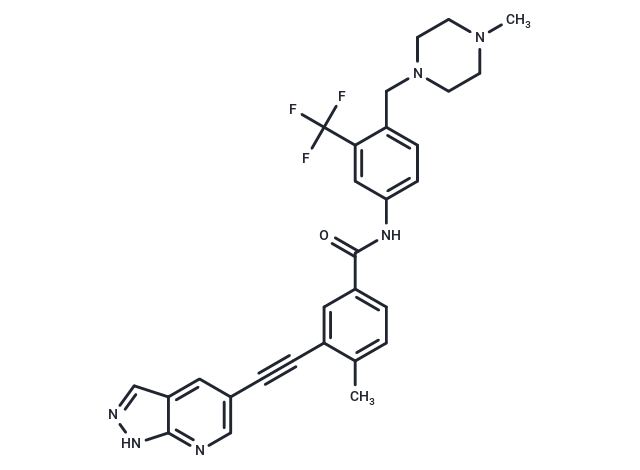
Synonyms: GZD 824
| Pack Size | Price | USA Stock | Global Stock | Quantity |
|---|---|---|---|---|
| 1 mg | $30 | In Stock | In Stock | |
| 2 mg | $38 | In Stock | In Stock | |
| 5 mg | $61 | In Stock | In Stock | |
| 10 mg | $92 | In Stock | In Stock | |
| 25 mg | $211 | In Stock | In Stock | |
| 50 mg | $337 | In Stock | In Stock | |
| 100 mg | $463 | In Stock | In Stock | |
| 1 mL x 10 mM (in DMSO) | $71 | In Stock | In Stock |
| Description | Olverembatinib (GZD 824) is an orally bioavailable Bcr-Abl inhibitor for Bcr-Abl(WT, IC50: 0.34 nM) and Bcr-Abl(T315I, IC50: 0.68 nM). |
| Targets & IC50 | BCR-ABL:0.34 nM, BCR-ABL:0.68 nM |
| In vitro | GZD824 potently inhibits the growth of Ba/F3 cells expressing wildtype Bcr-Abl with IC50 of 1.0 nM. Highly consistent with biochemical kinase inhibition and tight protein binding affinity, GZD824 also strongly inhibits the proliferation of Ba/F3 cells expressing Bcr-AblT315I mutant and 14 other resistance-relevant Bcr-Abl mutants. In addition, GZD824 efficiently suppresses the activation of Bcr-Abl as well as downstream Crkl and STAT5 in a concentration-dependent manner in K562 CML cells. [1] |
| Synonyms | GZD 824 |
| Kinase Assay | FRET-Based Z′-Lyte Assay Detecting Peptide Substrate Phosphorylation: The kinases ABL1, ABL1(E255K), ABL1 (G250E), ABL1(T315I), and ABL1(Y253F) are P3049, PV3864, PV3865, PV3866, and PV3863 are full-length human recombinant protein expressed in insect cells and histidine-tagged. Inhibition activities of inhibitors against Abl1 and its mutants are performed in 384-well plates using the FRET-based Z′-Lyte assay system. Briefly, the kinase substrate is diluted into 5 μL of kinase reaction buffer; and the kinase is added. Compounds (10 nL) with indicated concentrations are then delivered to the reaction by using Echo liquid handler, and the mixture is incubated for 30 min at room temperature. Then 5 μL of 2X ATP solution is added to initiate the reaction, and the mixture is further incubated for 2 h at room temperature. The resulting reactions contains 10 μM (for wild-type Abl1, and mutants Y253F, Q252H, M351T, and H396P) or 5 μM (for mutants E255K, G250E, T315I) of ATP, 2 μM of Tyr2 Peptide substrate in 50 mM HEPES (PH 7.5), 0.01% BRIJ-35, 10 mM MgCl2, 1 mM EGTA, 0.0247 μg/mL Abl1, and inhibitors as appropriate. Then, 5 μL of development reagent is added, and the mixture is incubated for 2 h at room temperature before 5 μL of stop solution is added. Fluorescence signal ratio of 445 nm (Coumarin)/520 nm (fluorescin) is examined on an EnVision Multilabel Reader. The data are analyzed using Graphpad Prism5. The data are the mean value of three experiments. |
| Cell Research | Cells in the logarithmic phase are plated in 96-well culture dishes. Twenty-four hours later, cells are treated with the corresponding compounds or vehicle control at the indicated concentration for 72 h. CCK-8 is added into the 96-well plates (10 μL/well) and incubated with the cells for 3 h. OD450 and OD650 are determined by a microplate reader. Absorbance rate (A) for each well is calculated as OD450 – OD650. The cell viability rate for each well is calculated as V% = (As – Ac)/(Ab – Ac) × 100%, and the data were further analyzed using Graphpad Prism5. The data are the mean value of the three experiments. As is the absorbance rate of the test compound well, Ac is the absorbance rate of the well without either cell or test compound, and Ab is the absorbance rate of the well with cell and vehicle control.(Only for Reference) |
| Molecular Weight | 532.56 |
| Formula | C29H27F3N6O |
| Cas No. | 1257628-77-5 |
| Smiles | CN1CCN(Cc2ccc(NC(=O)c3ccc(C)c(c3)C#Cc3cnc4[nH]ncc4c3)cc2C(F)(F)F)CC1 |
| Relative Density. | 1.39 g/cm3 (Predicted) |
| Storage | Store at low temperature Powder: -20°C for 3 years | In solvent: -80°C for 1 year Shipping with blue ice/Shipping at ambient temperature. | |||||||||||||||||||||||||||||||||||
| Solubility Information | DMSO: 245 mg/mL (460.04 mM), Sonication is recommended.  | |||||||||||||||||||||||||||||||||||
| In Vivo Formulation | 10% DMSO+40% PEG300+5% Tween 80+45% Saline: 4 mg/mL (7.51 mM), Sonication is recommended. Please add the solvents sequentially, clarifying the solution as much as possible before adding the next one. Dissolve by heating and/or sonication if necessary. Working solution is recommended to be prepared and used immediately. The formulation provided above is for reference purposes only. In vivo formulations may vary and should be modified based on specific experimental conditions. | |||||||||||||||||||||||||||||||||||
Solution Preparation Table | ||||||||||||||||||||||||||||||||||||
DMSO
Note : The dilution table applies only to solid products. For liquid products, please calculate the stock solution based on the stated concentration and/or density. | ||||||||||||||||||||||||||||||||||||
 For example, if the intended dosage is 10 mg/kg for animals weighing 20 g , with a dosing volume of 100 μL per animal, and a total of 10 animals are to be administered, using a formulation of
  10% DMSO+ 40% PEG300+ 5% Tween 80+ 45% Saline/PBS/ddH2O , the resulting working solution concentration would be 2 mg/mL.
Dissolve 2 mg of the compound in 100 μL DMSO to obtain a stock solution at a concentration of 20 mg/mL . If the required concentration exceeds the compound's known solubility, please contact us for technical support before proceeding.
1) Add 100 μL of the DMSO stock solution to 400 µL PEG300 and mix thoroughly until the solution becomes clear.
2) Add 50 µL Tween 80 and mix well until fully clarified.
3) Add 450 µL Saline,PBS or ddH2O and mix thoroughly until a homogeneous solution is obtained.
| Size | Quantity | Unit Price | Amount | Operation |
|---|
 Feedback
 Hello! How can I help you today?
Copyright © 2015-2026 TargetMol Chemicals Inc. All Rights Reserved.
