


Shopping Cart
Remove All Your shopping cart is currently empty


Synonyms:

| Pack Size | Price | USA Stock | Global Stock | Quantity |
|---|---|---|---|---|
| 5 mg | $41 | In Stock | In Stock | |
| 10 mg | $59 | In Stock | In Stock | |
| 25 mg | $113 | In Stock | In Stock | |
| 50 mg | $161 | In Stock | In Stock | |
| 100 mg | $226 | In Stock | In Stock | |
| 1 mL x 10 mM (in DMSO) | $46 | In Stock | In Stock |
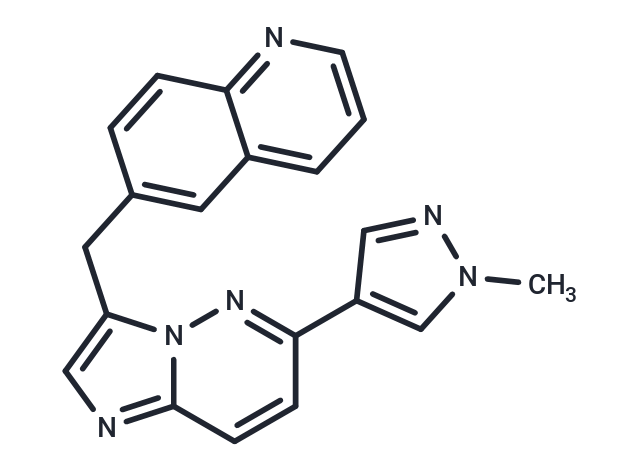
| Description | NVP-BVU972 is a selective and potent Met inhibitor with IC50 of 14 nM. |
| Targets & IC50 | MET:14 nM |
| In vivo | NVP-BVU972 effectively inhibited the growth of MET gene-dispersed cell lines GTL-16, MKN-45, and EBC-1 with IC50 of 66, 82, and 32 nM, respectively.NVP-BVU972 effectively inhibited the MET kinase, while the inhibition of other kinases (including the most closely related ones), RON, was very low, with an IC50 of >1000 nM.NVP-BVU972 inhibited GTL-16, MKN-45 and EBC-1 with IC50 of >1000 nM.NVP-BVU972 inhibited GTL-16, MKN-45 and EBC-1 with IC50 of >1000 nM. BVU972 inhibited constitutive MET phosphorylation in GTL-16 cells and HGF-stimulated MET phosphorylation in A549 cells with IC50s of 7.3 and 22 nM, respectively.NVP-BVU972 acted on BaF3 cells expressing wild-type TPR-MET and dose-dependently decreased TPR-MET phosphorylation. |
| Kinase Assay | TR-FRET biochemical assay with MET wild type and mutants: Enzyme activity is measured in a time resolved fluorescence resonance energy transfer (TR-FRET) assay, detecting tyrosine phosphorylation with a Eu-labelled anti-phospho-tyrosine antibody (fluorescence donor) and Allophycocyanin conjugated to Streptavidin (fluorescence acceptor) which binds to a biotin on the substrate peptide. For each variant, Km concentrations for ATP are determined in the absence of NVP-BVU972, and the ATP concentration in the kinase reaction is set to Km (4 μM for MET wt, 1 μM for MET Y1230H and MET F1200I). NVP-BVU972 is dissolved and diluted in DMSO and assayed in quadruplicate. Kinase reactions are carried out in 50 mM Tris-HCl pH 7.5, 8 mM MgCl2, 4 mM MnCl2, 0.05 % Tween 20, 0.05% bovine serum albumin, 0.1 mM EDTA, 1 mM DTT, 0.1 mM Na3VO4, in white 1536 well plates at room temperature. NVP-BVU972 and enzyme are incubated in a volume of 2 μL for 20 min, followed by the addition of 1 μL ATP and 1 μL biotinylated peptide substrate (PTK1) to final concentrations of Km and 1 μM, respectively. Enzyme concentrations in the reactions are 5 nM for MET wt, and 4 nM for the F1200I and Y1230H variants. After 90 min, reactions are stopped by addition of 1 μL stop/detection solution to reach final concentrations of 10 mM EDTA, 3.5 nM Eu-labelled antiphospho-tyrosine antibody PY20, and 10 nM Streptavidin Allophycocyanin. Time resolved fluorescence resonance energy transfer is measured in an Envision plate reader (excitation 320 nm, emission 615 nm and 665 nm). |
| Cell Research | BaF3 cells containing TPR-MET or various mutants thereof are grown in RPMI 1640 medium containing 10% fetal calf serum. For maintenance of parental BaF3 cells the medium is additionally supplemented with 10 ng/mL interleukin-3 (IL-3). For proliferation assays, BaF3 cells are seeded on 96-well-plates in triplicates at 104 cells per well and incubated with various concentrations of NVP-BVU972 for 72 hours followed by quantification of viable cells using a resazurin sodium salt dye reduction readout. IC50 values are determined with the XLFit Excel Add-In using a 4-parameter dose response model.(Only for Reference) |
| Molecular Weight | 340.38 |
| Formula | C20H16N6 |
| Cas No. | 1185763-69-2 |
| Smiles | Cn1cc(cn1)-c1ccc2ncc(Cc3ccc4ncccc4c3)n2n1 |
| Relative Density. | 1.35 g/cm3 |
| Storage | Powder: -20°C for 3 years | In solvent: -80°C for 1 year Shipping with blue ice/Shipping at ambient temperature. | |||||||||||||||||||||||||||||||||||
| Solubility Information | DMSO: 45 mg/mL (132.21 mM), Sonication is recommended.  Ethanol: 63 mg/mL (185.09 mM), Sonication is recommended. H2O: < 1 mg/mL (insoluble or slightly soluble) | |||||||||||||||||||||||||||||||||||
| In Vivo Formulation | 10% DMSO+40% PEG300+5% Tween 80+45% Saline: 2 mg/mL (5.88 mM), Sonication is recommended. Please add the solvents sequentially, clarifying the solution as much as possible before adding the next one. Dissolve by heating and/or sonication if necessary. Working solution is recommended to be prepared and used immediately. The formulation provided above is for reference purposes only. In vivo formulations may vary and should be modified based on specific experimental conditions. | |||||||||||||||||||||||||||||||||||
Solution Preparation Table | ||||||||||||||||||||||||||||||||||||
DMSO/Ethanol
Note : The dilution table applies only to solid products. For liquid products, please calculate the stock solution based on the stated concentration and/or density. | ||||||||||||||||||||||||||||||||||||
 For example, if the intended dosage is 10 mg/kg for animals weighing 20 g , with a dosing volume of 100 μL per animal, and a total of 10 animals are to be administered, using a formulation of
  10% DMSO+ 40% PEG300+ 5% Tween 80+ 45% Saline/PBS/ddH2O , the resulting working solution concentration would be 2 mg/mL.
Dissolve 2 mg of the compound in 100 μL DMSO to obtain a stock solution at a concentration of 20 mg/mL . If the required concentration exceeds the compound's known solubility, please contact us for technical support before proceeding.
1) Add 100 μL of the DMSO stock solution to 400 µL PEG300 and mix thoroughly until the solution becomes clear.
2) Add 50 µL Tween 80 and mix well until fully clarified.
3) Add 450 µL Saline,PBS or ddH2O and mix thoroughly until a homogeneous solution is obtained.
| Size | Quantity | Unit Price | Amount | Operation |
|---|
 Feedback
 Hello! How can I help you today?
Copyright © 2015-2026 TargetMol Chemicals Inc. All Rights Reserved.
