


Shopping Cart
Remove All Your shopping cart is currently empty


Synonyms:
| Pack Size | Price | USA Stock | Global Stock | Quantity |
|---|---|---|---|---|
| 1 mg | $40 | In Stock | In Stock | |
| 5 mg | $156 | In Stock | In Stock | |
| 10 mg | $278 | In Stock | In Stock | |
| 25 mg | $473 | In Stock | In Stock |
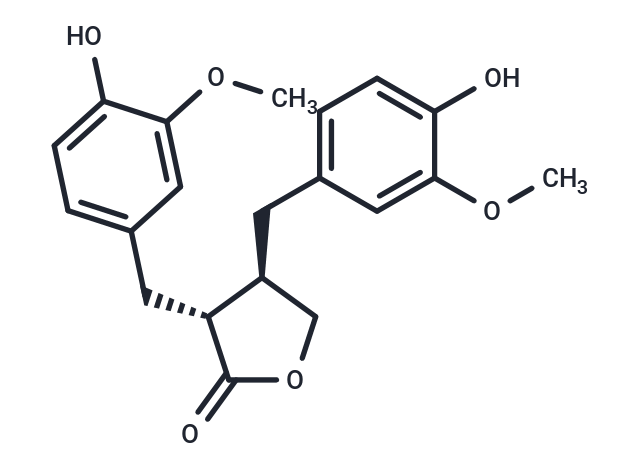
| Description | Matairesinol is a phytolignan found in a variety of foods such as seeds, vegetables and fruits.Matairesinol has a variety of biological functions including anti-angiogenic, anti-cancer and anti-fungal activities; the anti-osteoporotic activity of matairesinol may derive from its anti-osteoclastic potential through p38/ERK-NFATc1 signaling , rather than through an anti-resorptive effect. |
| In vitro | METHODS: Antiproliferative effect of matairesinol on human pancreatic cancer cells. Cell proliferation was analyzed in PANC-1 and MIA PaCa-2 using different matairesinol treatments (0, 5, 10, 20, 40, 80 and 100 μM). RESULTS The 80 μM concentration of matairesinol inhibited proliferation by 48% in PANC-1 cells and inhibited cellular appreciation by 50% in MIA PaCa-2 cells. METHODS: Immunoblotting images of PCNA were analyzed in PANC-1 and MIA PaCa-2 cells treated with matairesinol (0, 20, 40, and 80 μM), and the inhibitory effect of matairesinol on globule formation was assessed in a three-dimensional (3D) environment using a droplet assay. RESULTS Treatment with matairesinol (80 μM) reduced PCNA expression by 30% and 33% in both PC cell lines; in PANC-1 cells, the relative total area of formed spheroids was reduced by 78% in PANC-1 cells (p < 0.05) and 61% in MIA PaCa-2 cells (p < 0.01). [1] Translated with DeepL.com (free version) |
| In vivo | METHODS: A rat sepsis model was established by CLP surgery. On this basis, the rats were given Matairesinol (5, 10, 20 mg/kg, oral administration). Subsequently, blood and IHC were performed to calculate the number of Caspase-3 positive cells and TUNEL staining was performed to detect tissue apoptosis. RESULTS Matairesinol (>5 mg/kg) inhibited the production of S100β, GFAP and NSE; at the same time, the use of Matairesinol on the basis of CLP reduced the damage of CLP to brain tissue and neurons; Matairesinol (>5 mg/kg) significantly inhibited the expression of Caspase-3 and inhibited cell apoptosis. [2] |
| Molecular Weight | 358.39 |
| Formula | C20H22O6 |
| Cas No. | 580-72-3 |
| Smiles | COc1cc(C[C@H]2COC(=O)[C@@H]2Cc2ccc(O)c(OC)c2)ccc1O |
| Relative Density. | 1.290 g/cm3 (Predicted) |
| Storage | Powder: -20°C for 3 years | In solvent: -80°C for 1 year Shipping with blue ice/Shipping at ambient temperature. | |||||||||||||||||||||||||||||||||||
| Solubility Information | DMSO: 200 mg/mL (558.05 mM), Sonication is recommended.  | |||||||||||||||||||||||||||||||||||
Solution Preparation Table | ||||||||||||||||||||||||||||||||||||
DMSO
Note : The dilution table applies only to solid products. For liquid products, please calculate the stock solution based on the stated concentration and/or density. | ||||||||||||||||||||||||||||||||||||
 For example, if the intended dosage is 10 mg/kg for animals weighing 20 g , with a dosing volume of 100 μL per animal, and a total of 10 animals are to be administered, using a formulation of
  10% DMSO+ 40% PEG300+ 5% Tween 80+ 45% Saline/PBS/ddH2O , the resulting working solution concentration would be 2 mg/mL.
Dissolve 2 mg of the compound in 100 μL DMSO to obtain a stock solution at a concentration of 20 mg/mL . If the required concentration exceeds the compound's known solubility, please contact us for technical support before proceeding.
1) Add 100 μL of the DMSO stock solution to 400 µL PEG300 and mix thoroughly until the solution becomes clear.
2) Add 50 µL Tween 80 and mix well until fully clarified.
3) Add 450 µL Saline,PBS or ddH2O and mix thoroughly until a homogeneous solution is obtained.
| Size | Quantity | Unit Price | Amount | Operation |
|---|
 Feedback
 Hello! How can I help you today?
Copyright © 2015-2026 TargetMol Chemicals Inc. All Rights Reserved.
