


Shopping Cart
Remove All Your shopping cart is currently empty

Synonyms: K-201, K 201, JTV-519, JTV 519
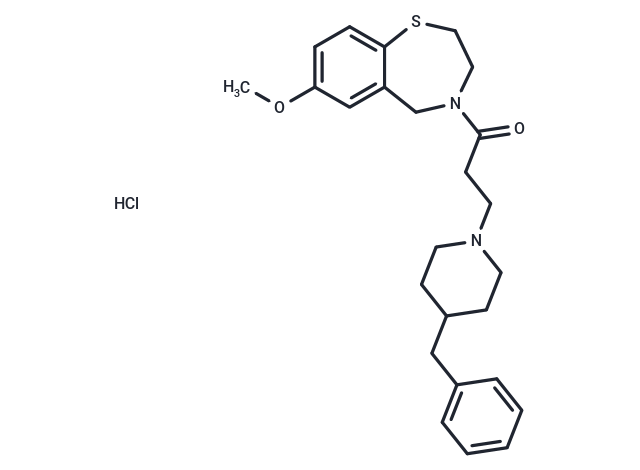
| Pack Size | Price | USA Stock | Global Stock | Quantity |
|---|---|---|---|---|
| 1 mg | $55 | In Stock | In Stock | |
| 5 mg | $112 | In Stock | In Stock | |
| 10 mg | $157 | In Stock | In Stock | |
| 25 mg | $260 | In Stock | In Stock | |
| 50 mg | $385 | In Stock | In Stock | |
| 100 mg | $573 | In Stock | In Stock | |
| 500 mg | $1,250 | - | In Stock | |
| 1 mL x 10 mM (in DMSO) | $136 | In Stock | In Stock |
| Description | JTV-519 is a Ca2+-dependent blocker and prevents abnormal Ca(2+) leak from the sarcoplasmic reticulum in the ischemic heart and skeletal muscle (SkM) by stabilizing the ryanodine receptors. |
| In vitro | In isolated cardiac and SkM SR microsomes, K201 slowed the rate of SR Ca(2+) loading, suggesting potential SERCA block and/or RyR agonism. K201 displayed Ca(2+)-dependent inhibition of SERCA-dependent ATPase activity, which was measured in microsomes incubated with 200, 2, and 0.25 µM Ca(2+) and with the half-maximal K201 inhibitory doses (IC50) estimated at 130, 19, and 9 µM (cardiac muscle) and 104, 13, and 5 µM (SkM SR). K201 (≥5 µM) increased RyR1-mediated Ca(2+) release from SkM microsomes. Maximal K201 doses at 80 µM produced ∼37% of the increase in SkM SR Ca(2+) release observed with the RyR agonist caffeine. K201 (≥5 µM) increased the open probability (Po) of very active ('high-activity') RyR1 of SkM reconstituted into bilayers, but it had no effect on 'low-activity' channels. Likewise, K201 activated cardiac RyR2 under systolic Ca(2+) conditions (∼5 µM; channels at Po ∼0.3) but not under diastolic Ca(2+) conditions (∼100 nM; Po < 0.01)[1]. |
| Synonyms | K-201, K 201, JTV-519, JTV 519 |
| Molecular Weight | 461.06 |
| Formula | C25H33ClN2O2S |
| Cas No. | 1038410-88-6 |
| Smiles | Cl.O=C(N1CC2=CC(OC)=CC=C2SCC1)CCN3CCC(CC=4C=CC=CC4)CC3 |
| Relative Density. | no data available |
| Storage | Powder: -20°C for 3 years | In solvent: -80°C for 1 year Shipping with blue ice/Shipping at ambient temperature. | ||||||||||||||||||||||||||||||
| Solubility Information | DMSO: 25 mg/mL (54.22 mM), Sonication is recommended.  | ||||||||||||||||||||||||||||||
Solution Preparation Table | |||||||||||||||||||||||||||||||
DMSO
Note : The dilution table applies only to solid products. For liquid products, please calculate the stock solution based on the stated concentration and/or density. | |||||||||||||||||||||||||||||||
 For example, if the intended dosage is 10 mg/kg for animals weighing 20 g , with a dosing volume of 100 μL per animal, and a total of 10 animals are to be administered, using a formulation of
  10% DMSO+ 40% PEG300+ 5% Tween 80+ 45% Saline/PBS/ddH2O , the resulting working solution concentration would be 2 mg/mL.
Dissolve 2 mg of the compound in 100 μL DMSO to obtain a stock solution at a concentration of 20 mg/mL . If the required concentration exceeds the compound's known solubility, please contact us for technical support before proceeding.
1) Add 100 μL of the DMSO stock solution to 400 µL PEG300 and mix thoroughly until the solution becomes clear.
2) Add 50 µL Tween 80 and mix well until fully clarified.
3) Add 450 µL Saline,PBS or ddH2O and mix thoroughly until a homogeneous solution is obtained.
| Size | Quantity | Unit Price | Amount | Operation |
|---|
 Feedback
 Hello! How can I help you today?
Copyright © 2015-2026 TargetMol Chemicals Inc. All Rights Reserved.
