


Shopping Cart
Remove All Your shopping cart is currently empty


Synonyms:

| Pack Size | Price | USA Stock | Global Stock | Quantity |
|---|---|---|---|---|
| 2 mg | $37 | In Stock | In Stock | |
| 5 mg | $58 | In Stock | In Stock | |
| 10 mg | $103 | In Stock | In Stock | |
| 25 mg | $200 | In Stock | In Stock | |
| 50 mg | $358 | In Stock | In Stock | |
| 100 mg | $511 | In Stock | In Stock | |
| 1 mL x 10 mM (in DMSO) | $70 | In Stock | In Stock |
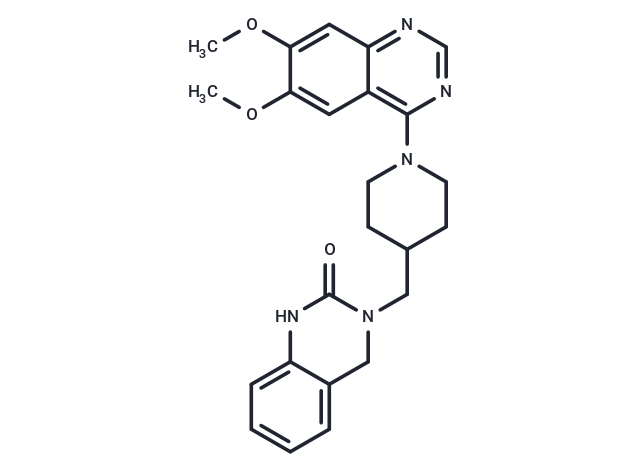
| Description | K-756 is a direct and selective inhibitor of tankyrase (TNKS), inhibiting the ADP-ribosylation activity of TNKS1 [IC50 = 31 nM] and TNKS2 [IC50 = 36 nM]. |
| Targets & IC50 | TNKS2:36 nM, TNKS1:31 nM |
| In vitro | K-756 inhibits the cell growth of APC-mutant colorectal cancer COLO 320DM and SW403 cells by inhibiting the Wnt/β-catenin pathway. K-756 is a novel and selective Wnt/β-catenin pathway inhibitor targeting tankyrase (TNKS). TNKS is one of the members of the PARP family. K-756 binds to the induced pocket of TNKS and inhibits its enzyme activity. K-756 inhibits TNKS1 and TNKS2 by 97% and 100%, respectively. The inhibitory activity of K-756 against PARP1, PARP2, PARP3, PARP6, PARP7, and PARP11 is less than 13%. K-756 strongly inhibits the reporter activity in DLD-1/TCF-Luc cells (IC50: 110 nM) but does not inhibit DLD-1/mtTCF-Luc cells, even at 1,000 nM. APC-mutant colorectal cancer cell line COLO 320DM and SW403 cells are treated with K-756 and after 144 hours, cell growth inhibition is measured by an XTT assay. The application of K-756 inhibits the cell growth of COLO 320DM with a GI50 of 780 nM. K-756 also inhibits SW403 with a GI50 of 270 nM[1]. |
| In vivo | Vehicle (0.5% MC400) or K-756 is given orally once daily for three consecutive days at doses of 100, 200, and 400 mg/kg. The inhibition of the Wnt/β-catenin pathway in tumors is assessed by measuring the levels of FGF20 and LGR5, as well as luciferase activity. Inhibition of the Wnt/β-catenin pathway is evident at a 400 mg/kg dose after just one day of administration. After three days of treatment, significant reductions in FGF20 expression and reporter activity are observed at doses of 100 mg/kg and higher, while LGR5 expression significantly decreases at doses of 200 mg/kg and higher. The greatest inhibitory effect is achieved with a three-day administration of K-756 at 400 mg/kg [1]. |
| Molecular Weight | 433.5 |
| Formula | C24H27N5O3 |
| Cas No. | 130017-40-2 |
| Smiles | COc1cc2ncnc(N3CCC(CN4Cc5ccccc5NC4=O)CC3)c2cc1OC |
| Relative Density. | 1.261 g/cm3 (Predicted) |
| Storage | Powder: -20°C for 3 years | In solvent: -80°C for 1 year Shipping with blue ice/Shipping at ambient temperature. | ||||||||||||||||||||
| Solubility Information | DMSO: 4.5 mg/mL (10.38 mM), Sonication is recommended. | ||||||||||||||||||||
Solution Preparation Table | |||||||||||||||||||||
DMSO
Note : The dilution table applies only to solid products. For liquid products, please calculate the stock solution based on the stated concentration and/or density. | |||||||||||||||||||||
 For example, if the intended dosage is 10 mg/kg for animals weighing 20 g , with a dosing volume of 100 μL per animal, and a total of 10 animals are to be administered, using a formulation of
  10% DMSO+ 40% PEG300+ 5% Tween 80+ 45% Saline/PBS/ddH2O , the resulting working solution concentration would be 2 mg/mL.
Dissolve 2 mg of the compound in 100 μL DMSO to obtain a stock solution at a concentration of 20 mg/mL . If the required concentration exceeds the compound's known solubility, please contact us for technical support before proceeding.
1) Add 100 μL of the DMSO stock solution to 400 µL PEG300 and mix thoroughly until the solution becomes clear.
2) Add 50 µL Tween 80 and mix well until fully clarified.
3) Add 450 µL Saline,PBS or ddH2O and mix thoroughly until a homogeneous solution is obtained.
| Size | Quantity | Unit Price | Amount | Operation |
|---|
 Feedback
 Hello! How can I help you today?
Copyright © 2015-2026 TargetMol Chemicals Inc. All Rights Reserved.
