


Shopping Cart
Remove All Your shopping cart is currently empty

Synonyms: COL-3, CMT-3

| Pack Size | Price | USA Stock | Global Stock | Quantity |
|---|---|---|---|---|
| 1 mg | $80 | In Stock | In Stock | |
| 2 mg | $96 | In Stock | In Stock | |
| 5 mg | $122 | In Stock | In Stock | |
| 10 mg | $198 | In Stock | In Stock | |
| 25 mg | $413 | In Stock | In Stock | |
| 50 mg | $637 | In Stock | In Stock | |
| 100 mg | $892 | In Stock | In Stock | |
| 200 mg | $1,220 | - | In Stock | |
| 1 mL x 10 mM (in DMSO) | $97 | In Stock | In Stock |
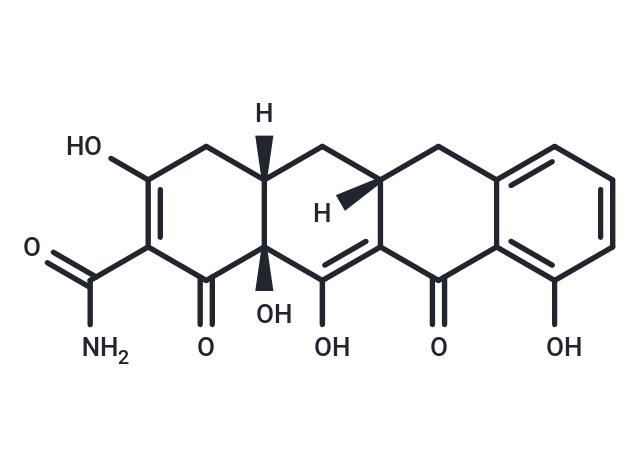
| Description | Chemically modified tetracyclines (CMTs) can inhibit MMPs, but lack antimicrobial activity. Nonantimicrobial derivative of tetracycline called incyclinide (COL-3, CMT-3). Incyclinide (CMT-3) has been shown to experimentally suppress prostate cancer, colon adenocarcinoma and melanoma invasiveness in cell culture and to inhibit tumor growth and metastasis. |
| In vitro | Incyclinide has been shown to experimentally suppress prostate cancer, colon adenocarcinoma, and melanoma invasiveness in cell culture. Adding incyclinide at final concentrations of 5 to 20 μM inhibits MT1-MMP gelatinolytic and caseinolytic activity, blocks MT1-MMPactivation of pro-MMP-2, and decreases invasiveness of HT-1080 fibrosarcoma cells [1]. Most of the MICs of CMT-3 against filamentous fungi are found to be between 0.25 and 8 μg/mL, and the inhibition of viability of these fungi by incyclinide is routinely higher than 90% [2]. |
| In vivo | Probably by reducing the number of osteoclasts at the compression side, Incyclinide suppresses tooth movement in the rat. Reduced MMP activity by incyclinide might also directly inhibit degradation of the organic bone matrix. This might be due to the induction of apoptosis in activated osteoclasts or reduced osteoclast migration [3]. |
| Synonyms | COL-3, CMT-3 |
| Molecular Weight | 371.34 |
| Formula | C19H17NO7 |
| Cas No. | 15866-90-7 |
| Smiles | [H][C@@]12Cc3cccc(O)c3C(=O)C1=C(O)[C@]1(O)C(=O)C(C(N)=O)=C(O)C[C@]1([H])C2 |
| Relative Density. | 1.70 g/cm3 (Predicted) |
| Storage | Powder: -20°C for 3 years | In solvent: -80°C for 1 year Shipping with blue ice/Shipping at ambient temperature. | |||||||||||||||||||||||||||||||||||
| Solubility Information | DMSO: 95 mg/mL (255.83 mM), Sonication is recommended. | |||||||||||||||||||||||||||||||||||
Solution Preparation Table | ||||||||||||||||||||||||||||||||||||
DMSO
Note : The dilution table applies only to solid products. For liquid products, please calculate the stock solution based on the stated concentration and/or density. | ||||||||||||||||||||||||||||||||||||
 For example, if the intended dosage is 10 mg/kg for animals weighing 20 g , with a dosing volume of 100 μL per animal, and a total of 10 animals are to be administered, using a formulation of
  10% DMSO+ 40% PEG300+ 5% Tween 80+ 45% Saline/PBS/ddH2O , the resulting working solution concentration would be 2 mg/mL.
Dissolve 2 mg of the compound in 100 μL DMSO to obtain a stock solution at a concentration of 20 mg/mL . If the required concentration exceeds the compound's known solubility, please contact us for technical support before proceeding.
1) Add 100 μL of the DMSO stock solution to 400 µL PEG300 and mix thoroughly until the solution becomes clear.
2) Add 50 µL Tween 80 and mix well until fully clarified.
3) Add 450 µL Saline,PBS or ddH2O and mix thoroughly until a homogeneous solution is obtained.
| Size | Quantity | Unit Price | Amount | Operation |
|---|
 Feedback
 Hello! How can I help you today?
Copyright © 2015-2026 TargetMol Chemicals Inc. All Rights Reserved.
