


Shopping Cart
Remove All Your shopping cart is currently empty

Synonyms: Homidium bromide, EtBr, EB
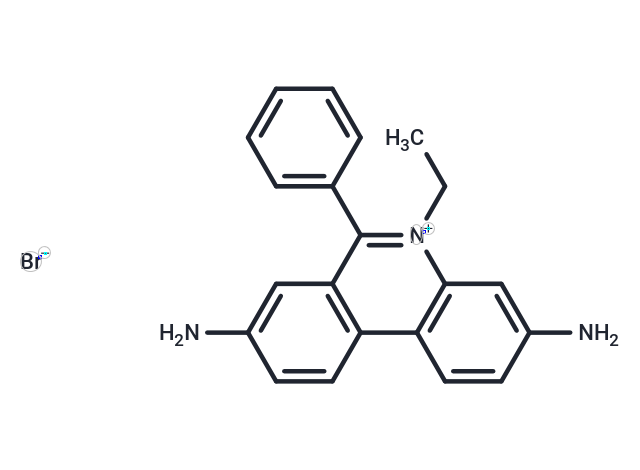
| Pack Size | Price | USA Stock | Global Stock | Quantity |
|---|---|---|---|---|
| 250 mg | $42 | - | In Stock |

| Description | Ethidium bromide (EB) A trypanocidal agent and possible antiviral agent that is widely used in experimental cell biology and biochemistry. Ethidium has several experimentally useful properties including binding to nucleic acids, noncompetitive inhibition of nicotinic acetylcholine receptors, and fluorescence among others. It is most commonly used as the bromide. Ethidium bromide has a λEx of 300-360 nm and a λEm of 590 nm. |
| In vitro | Instructions 1. Solution preparation: Prepare agarose gel of appropriate concentration (usually 0.5% to 2.5%) according to the size of the band to be separated. 2. Operation steps 1. Accurately weigh a certain amount of agarose powder and mix it with a certain amount of 1X TAE/TBE. 2. Heat in a microwave oven for 1-3 minutes until the agarose is completely dissolved. 3. Shake the melted agar solution to mix well, pour it into the electrophoresis tank, and wait for it to solidify; 4. Add Ethidium bromide (EtBr) to a final concentration of about 0.2-0.5 μg/mL (the stock solution is usually 10 mg/mL, and 5 μL of stock solution/100 mL of gel is required); 5. Ethidium bromide binds to DNA, and DNA can be visualized under ultraviolet (UV) light. The above information is based on published literature. Experimental procedures should be appropriately modified to meet specific research demands. |
| Synonyms | Homidium bromide, EtBr, EB |
| Molecular Weight | 394.32 |
| Formula | C21H20BrN3 |
| Cas No. | 1239-45-8 |
| Smiles | [Br-].CC[n+]1c2cc(N)ccc2c2ccc(N)cc2c1c1ccccc1 |
| Relative Density. | 1.3739 g/cm3 (Estimated) |
| Storage | Keep away from direct sunlight Powder: -20°C for 3 years | In solvent: -80°C for 1 year Shipping with blue ice/Shipping at ambient temperature. | |||||||||||||||||||||||||||||||||||
| Solubility Information | DMSO: 23.86 mg/mL (60.51 mM), Sonication is recommended.  H2O: 1 mg/mL (2.54 mM), Sonication is recommended. | |||||||||||||||||||||||||||||||||||
Solution Preparation Table | ||||||||||||||||||||||||||||||||||||
H2O/DMSO
DMSO
Note : The dilution table applies only to solid products. For liquid products, please calculate the stock solution based on the stated concentration and/or density. | ||||||||||||||||||||||||||||||||||||
 For example, if the intended dosage is 10 mg/kg for animals weighing 20 g , with a dosing volume of 100 μL per animal, and a total of 10 animals are to be administered, using a formulation of
  10% DMSO+ 40% PEG300+ 5% Tween 80+ 45% Saline/PBS/ddH2O , the resulting working solution concentration would be 2 mg/mL.
Dissolve 2 mg of the compound in 100 μL DMSO to obtain a stock solution at a concentration of 20 mg/mL . If the required concentration exceeds the compound's known solubility, please contact us for technical support before proceeding.
1) Add 100 μL of the DMSO stock solution to 400 µL PEG300 and mix thoroughly until the solution becomes clear.
2) Add 50 µL Tween 80 and mix well until fully clarified.
3) Add 450 µL Saline,PBS or ddH2O and mix thoroughly until a homogeneous solution is obtained.
| Size | Quantity | Unit Price | Amount | Operation |
|---|
 Feedback
 Hello! How can I help you today?
Copyright © 2015-2026 TargetMol Chemicals Inc. All Rights Reserved.
