


Shopping Cart
Remove All Your shopping cart is currently empty

Synonyms: RO5190591, RG7227, R7227, ITMN-191
| Pack Size | Price | USA Stock | Global Stock | Quantity |
|---|---|---|---|---|
| 1 mg | $57 | In Stock | In Stock | |
| 5 mg | $139 | In Stock | In Stock | |
| 10 mg | $247 | In Stock | In Stock | |
| 25 mg | $422 | In Stock | In Stock | |
| 50 mg | $626 | In Stock | In Stock | |
| 100 mg | $889 | - | In Stock | |
| 1 mL x 10 mM (in DMSO) | $225 | In Stock | In Stock |
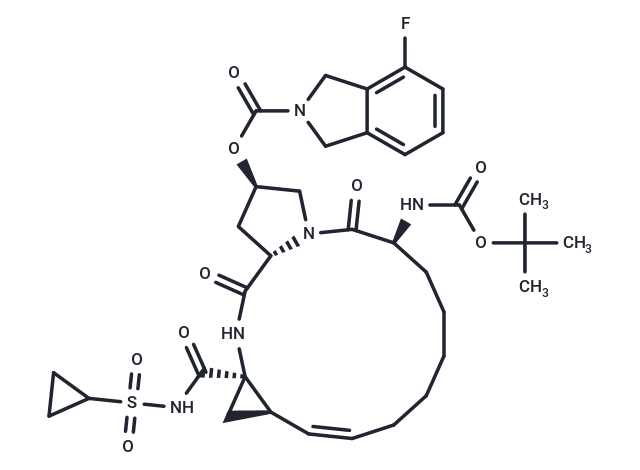
| Description | Danoprevir (RG7227) is a peptidomimetic inhibitor of the NS3/4A protease(IC50=0.2-3.5 nM) of hepatitis C virus (HCV). |
| Targets & IC50 | HCV NS3/4A protease:0.2 nM-3.5 nM |
| In vivo | In rats or monkeys,Danoprevir (30 mg/kg) was administered. |
| Synonyms | RO5190591, RG7227, R7227, ITMN-191 |
| Kinase Assay | Continuous fluorescent resonance energy transfer (FRET) assay: The assay buffer contains 25 μM NS4A peptide, 50 mM Tris-HCl, pH 7.5, 15% (vol/vol) glycerol, 0.6 mM lauryldimethylamine N-oxide, 10 mM dithiothreitol, and 0.5 μM fluorescein/QXL520-labeled FRET substrate {Ac-DE-Dap(QXL520)-EE-Abu-ψ-[COO]-AS-Cys(5-FAMsp)-NH2}. K2040 enzyme (50 pM) is added to initiate the reaction. Reactions are set up in black 96-well plates, and fluorescence data is collected. Control reactions lacking inhibitors and enzyme are included. Initial rates are calculated from the linear phase of the reaction (up to 1 hour) and are used to obtain IC50. Recovery of activity from preformed Danoprevir-NS3/4A complex is assessed by preincubating 10 nM NS3/4A with a two-fold excess of Danoprevir in 1× assay buffer for 15 min, followed by a rapid 200-fold dilution of the preformed complex into assay buffer containing substrate. A control reaction with the same final conditions without preincubation of NS3/4A and Danoprevir is initiated by the addition of enzyme to an otherwise-complete reaction mixture. Additional control reactions lack either Danoprevir or NS3. The progress of the reactions is followed over 5 hours. |
| Cell Research | Serially diluted Danoprevir is added to Huh7 cells harboring the K2040 replicon 1 day after cell plating. For antiviral assays, after a 48-hour incubation, intracellular RNA is extracted, and the level of HCV replicon RNA is quantified by reverse transcription (RT)-PCR assay with the primers (5'-CACTCCCCTGTGAGGAACTACTG-3' and 5'-AGGCTGCACGACACTCATACT-3') and a probe (5'-6-FAM-CTTCACGCAGAAAGCGTCTAGCCATGG-MGBNFQ-3' using an ABI Prism 7900 sequence detection system. Here, FAM is 6-carboxyfluorescin and MGBNFQ is a molecular-groove binding non-fluorescence quencher specific to the HCV 5' untranslated region. Single-tube reactions are performed using the TaqMan Gold RT-PCR kit. Triplicate reactions for the RNA standards and samples are performed in 50 μL with 5 μL intracellular RNA (50 ng). RT is carried out at 48 °C for 30 min followed by 10 min at 95 °C. The PCR is run as follows: 15 seconds at 95 °C and 1 min at 60 °C for 40 cycles. Each RNA concentration is determined in triplicate. The absolute concentration of replicon RNA is calculated based on its signal relative to that of a standard curve generated by known concentrations of an in vitro-transcribed RNA corresponding to a genotype 1b 5' untranslated region. Replicon levels in the presence of Danoprevir are fitted to a four-parameter logistic function to obtain EC50.(Only for Reference) |
| Molecular Weight | 731.83 |
| Formula | C35H46FN5O9S |
| Cas No. | 850876-88-9 |
| Smiles | CC(C)(C)OC(=O)N[C@H]1CCCCC\C=C/[C@H]2C[C@]2(NC(=O)[C@@H]2C[C@H](CN2C1=O)OC(=O)N1Cc2cccc(F)c2C1)C(=O)NS(=O)(=O)C1CC1 |
| Relative Density. | 1.41 |
| Storage | Store at low temperature Powder: -20°C for 3 years | In solvent: -80°C for 1 year Shipping with blue ice/Shipping at ambient temperature. | |||||||||||||||||||||||||||||||||||
| Solubility Information | H2O: < 1 mg/mL (insoluble or slightly soluble) DMSO: 150 mg/mL (204.97 mM), Sonication is recommended.  Ethanol: 133 mg/mL (181.74 mM), Sonication is recommended. | |||||||||||||||||||||||||||||||||||
| In Vivo Formulation | 10% DMSO+90% Saline: 10 mg/mL (13.66 mM), Suspension. 10% DMSO+40% PEG300+5% Tween 80+45% Saline: 4 mg/mL (5.47 mM), Sonication is recommended. Please add the solvents sequentially, clarifying the solution as much as possible before adding the next one. Dissolve by heating and/or sonication if necessary. Working solution is recommended to be prepared and used immediately. The formulation provided above is for reference purposes only. In vivo formulations may vary and should be modified based on specific experimental conditions. | |||||||||||||||||||||||||||||||||||
Solution Preparation Table | ||||||||||||||||||||||||||||||||||||
Ethanol/DMSO
Note : The dilution table applies only to solid products. For liquid products, please calculate the stock solution based on the stated concentration and/or density. | ||||||||||||||||||||||||||||||||||||
 For example, if the intended dosage is 10 mg/kg for animals weighing 20 g , with a dosing volume of 100 μL per animal, and a total of 10 animals are to be administered, using a formulation of
  10% DMSO+ 40% PEG300+ 5% Tween 80+ 45% Saline/PBS/ddH2O , the resulting working solution concentration would be 2 mg/mL.
Dissolve 2 mg of the compound in 100 μL DMSO to obtain a stock solution at a concentration of 20 mg/mL . If the required concentration exceeds the compound's known solubility, please contact us for technical support before proceeding.
1) Add 100 μL of the DMSO stock solution to 400 µL PEG300 and mix thoroughly until the solution becomes clear.
2) Add 50 µL Tween 80 and mix well until fully clarified.
3) Add 450 µL Saline,PBS or ddH2O and mix thoroughly until a homogeneous solution is obtained.
| Size | Quantity | Unit Price | Amount | Operation |
|---|
 Feedback
 Hello! How can I help you today?
Copyright © 2015-2026 TargetMol Chemicals Inc. All Rights Reserved.
