


Shopping Cart
Remove All Your shopping cart is currently empty

Synonyms: CUDC101, CUDC 101
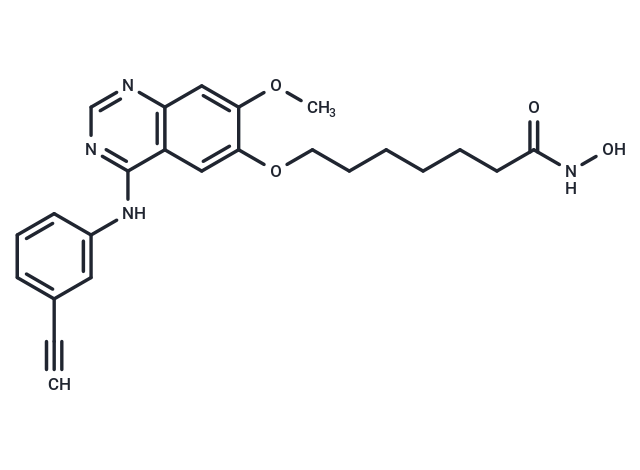

| Pack Size | Price | USA Stock | Global Stock | Quantity |
|---|---|---|---|---|
| 5 mg | $43 | In Stock | In Stock | |
| 10 mg | $77 | In Stock | In Stock | |
| 25 mg | $126 | In Stock | In Stock | |
| 50 mg | $207 | In Stock | In Stock | |
| 100 mg | $369 | In Stock | In Stock | |
| 200 mg | $548 | In Stock | In Stock | |
| 500 mg | $885 | - | In Stock |
| Description | CUDC-101 is a potent inhibitor of HDAC, EGFR, and HER2 with IC50s of 4.4 nM, 2.4 nM, and 15.7 nM, respectively. |
| Targets & IC50 | HDAC:4.4 nM, HDAC3:9.1 nM, HDAC10:26.1 nM, HER2:15.7 nM, HDAC4:13.2 nM, HDAC9:67.2 nM, HDAC6:5.1 nM, EGFR:2.4 nM, HDAC1:4.5 nM, HDAC7:373 nM, HDAC5:11.4 nM, HDAC2:12.6 nM, HDAC8:79.8 nM |
| In vitro | CUDC-101 exhibits a dose-dependent inhibition of growth in erlotinib-sensitive H358 NSCLC xenografts and effectively suppresses tumor growth in erlotinib-resistant A549 NSCLC xenograft models. Additionally, CUDC-101 significantly promotes tumor regression in lapatinib-resistant, HER2-negative, EGFR-overexpressing MDA-MB-468 breast cancer models, and EGFR-overexpressing CAL-27 head and neck squamous cell carcinoma (HNSCC) models. Administration of CUDC-101 at a daily dose of 120 mg/kg in the Hep-G2 liver tumor model induces tumor deterioration more effectively than the maximum tolerated dose of erlotinib (25 mg/kg/day) and an equimolar dose of vorinostat (72 mg/kg/day). |
| In vivo | CUDC-101 exhibits broad-spectrum antiproliferative activity in numerous human cancer cell lines with an IC50 range of 0.04 μM to 0.80 μM. It demonstrates higher potency compared to erlotinib, lapatinib, and combinations of these with either vorinostat or combinations of erlotinib or lapatinib. Notably, CUDC-101 can inhibit the proliferation of cancer cell lines resistant to lapatinib and erlotinib. This compound increases the acetylation of histones H3 and H4 and non-histone substrates like p53 and α-tubulin in a dose-dependent manner across various cancer cell lines. Additionally, CUDC-101 suppresses the expression of HER3, the amplification of Met, and the reactivation of AKT in tumor cells. |
| Synonyms | CUDC101, CUDC 101 |
| Kinase Assay | HDAC, EGFR and HER2 inhibition assays: The activities of Class I and II HDACs are assessed using the Biomol Color de Lys system. Briefly, HeLa cell nuclear extracts are used as a source of HDACs. Different concentrations of CUDC-101 are added to HeLa cell nuclear extracts in the presence of a colorimetric artificial substrate. Developer is added at the end of the assay and enzyme activity is measured in the Wallac Victor II 1420 microplate reader at 405 nM. EGFR and HER2 kinase activity are measured using HTScan EGF receptor and HER2 kinase assay kits. Briefly, the GST-EGFR fusion protein is incubated with synthetic biotinylated peptide substrate and varying concentrations of CUDC-101 in the presence of 400 mM ATP. Phosphorylated substrate is captured with strapavidin-coated 96-well plates. The level of phosphorylation is monitored by antiphospho-tyrosine- and europium-labeled secondary antibodies. The enhancement solution is added at the end of the assay and enzyme activity is measured in the Wallac Victor II 1420 microplate reader at 615 nM. |
| Cell Research | Cancer cell lines are plated at 5000 to 10000 cells per well in 96-well flatbottomed plates with varying concentrations of CUDC-101. The cells are incubated with CUDC-101 for 72 hours in the presence of 0.5% of fetal bovine serum. Growth inhibition is assessed by an adenosine triphosphate (ATP) content assay using the Perkin-Elmer ATPlite kit. Apoptosis is routinely assessed by measuring the activities of Caspase-3 and -7 using Apo-ONE Homogeneous Assay Kit.(Only for Reference) |
| Molecular Weight | 434.49 |
| Formula | C24H26N4O4 |
| Cas No. | 1012054-59-9 |
| Smiles | N(C=1C2=C(C=C(OC)C(OCCCCCCC(NO)=O)=C2)N=CN1)C3=CC(C#C)=CC=C3 |
| Relative Density. | 1.28 g/cm3 |
| Storage | Store at low temperature Powder: -20°C for 3 years | In solvent: -80°C for 1 year Shipping with blue ice/Shipping at ambient temperature. |
| Solubility Information | Ethanol: < 1 mg/mL (insoluble or slightly soluble) DMSO: 0.35 mg/mL (0.81 mM), Sonication is recommended.  |
| In Vivo Formulation | 10% DMSO+40% PEG300+5% Tween 80+45% Saline: 3.5 mg/mL (8.06 mM), Suspension. 10% DMSO+90% Saline: < 3.5 mg/mL (8.06 mM), Lower concentrations may be soluble, but exact solubility limit is unknown. Please add the solvents sequentially, clarifying the solution as much as possible before adding the next one. Dissolve by heating and/or sonication if necessary. Working solution is recommended to be prepared and used immediately. The formulation provided above is for reference purposes only. In vivo formulations may vary and should be modified based on specific experimental conditions. |
 For example, if the intended dosage is 10 mg/kg for animals weighing 20 g , with a dosing volume of 100 μL per animal, and a total of 10 animals are to be administered, using a formulation of
  10% DMSO+ 40% PEG300+ 5% Tween 80+ 45% Saline/PBS/ddH2O , the resulting working solution concentration would be 2 mg/mL.
Dissolve 2 mg of the compound in 100 μL DMSO to obtain a stock solution at a concentration of 20 mg/mL . If the required concentration exceeds the compound's known solubility, please contact us for technical support before proceeding.
1) Add 100 μL of the DMSO stock solution to 400 µL PEG300 and mix thoroughly until the solution becomes clear.
2) Add 50 µL Tween 80 and mix well until fully clarified.
3) Add 450 µL Saline,PBS or ddH2O and mix thoroughly until a homogeneous solution is obtained.
| Size | Quantity | Unit Price | Amount | Operation |
|---|
 Feedback
 Hello! How can I help you today?
Copyright © 2015-2026 TargetMol Chemicals Inc. All Rights Reserved.
