


Shopping Cart
Remove All Your shopping cart is currently empty


Synonyms:

| Pack Size | Price | USA Stock | Global Stock | Quantity |
|---|---|---|---|---|
| 5 mg | $54 | In Stock | In Stock | |
| 10 mg | $88 | In Stock | In Stock | |
| 25 mg | Preferential | In Stock | In Stock | |
| 50 mg | Preferential | In Stock | In Stock | |
| 1 mL x 10 mM (in DMSO) | $58 | In Stock | In Stock |
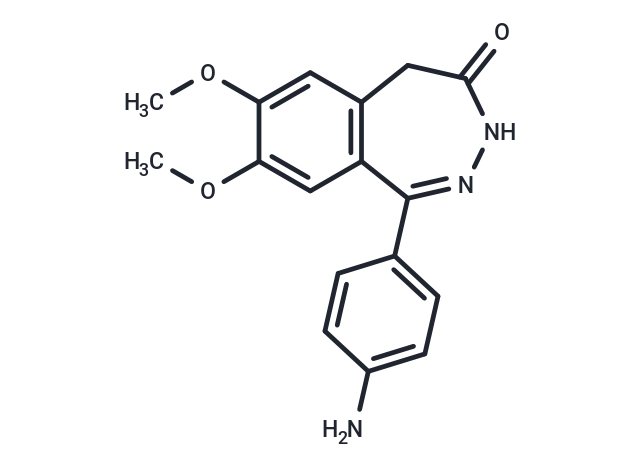
| Description | CFM-2, a potent and selective non-competitive antagonist of AMPAR (AMPAR), exhibits anticonvulsant activity across various seizure models. |
| In vitro | CFM-2 inhibits the extracellular signal-regulated kinase (ERK1/2) pathway, reduces phosphorylation of cAMP-responsive element-binding protein (CREB), and suppresses cyclin D1 expression. It upregulates cell cycle regulators and tumor suppressor proteins p21 and p53, consequently decreasing lung adenocarcinoma cell populations in the G2 and S phases of the cell cycle. |
| In vivo | Pretreatment with CFM-2 delayed the progression of seizure rank during repeated administration of pentylenetetrazole. At the end of the period of repeated pentylenetetrazole treatment (6 weeks), the mean seizure score was 0 in vehicle-treated controls, 4.3 in animals treated with vehicle + pentylenetetrazole, 2.2 in rats treated chronically with CFM-2 (20 μmol/kg i.p.) + pentylenetetrazole and 1.0 in rats treated repeatedly with CFM-2 (50 μmol/kg i.p.) + pentylenetetrazole. CFM-2 was also able to antagonize the long-term increase in sensitivity of the convulsant effects of GABA function inhibitors in pentylenetetrazole-kindled animals [1]. CFM-2 has been proven to possess anticonvulsant activity in various models of seizures [2]. Intrathecal application of two selective non-competitive AMPAR antagonists, CFM-2 (25 and 50 μg) and GYKI 52466 (50 μg), significantly attenuated mechanical and thermal hypersensitivities on the ipsilateral hind paw at 2 and 24 h post-CFA injection. Neither CFM-2 nor GYKI 52466 affected the contralateral basal responses to thermal and mechanical stimuli [4]. |
| Molecular Weight | 311.34 |
| Formula | C17H17N3O3 |
| Cas No. | 178616-26-7 |
| Smiles | COc1cc2CC(=O)NN=C(c3ccc(N)cc3)c2cc1OC |
| Relative Density. | 1.32 g/cm3 (Predicted) |
| Storage | Powder: -20°C for 3 years | In solvent: -80°C for 1 year Shipping with blue ice/Shipping at ambient temperature. | |||||||||||||||||||||||||||||||||||
| Solubility Information | DMSO: 150 mg/mL (481.79 mM), Sonication is recommended.  | |||||||||||||||||||||||||||||||||||
| In Vivo Formulation | 10% DMSO+40% PEG300+5% Tween 80+45% Saline: 10 mg/mL (32.12 mM), Solution. 10% DMSO+90% Saline: < 10 mg/mL (32.12 mM), Lower concentrations may be soluble, but exact solubility limit is unknown. Please add the solvents sequentially, clarifying the solution as much as possible before adding the next one. Dissolve by heating and/or sonication if necessary. Working solution is recommended to be prepared and used immediately. The formulation provided above is for reference purposes only. In vivo formulations may vary and should be modified based on specific experimental conditions. | |||||||||||||||||||||||||||||||||||
Solution Preparation Table | ||||||||||||||||||||||||||||||||||||
DMSO
Note : The dilution table applies only to solid products. For liquid products, please calculate the stock solution based on the stated concentration and/or density. | ||||||||||||||||||||||||||||||||||||
 For example, if the intended dosage is 10 mg/kg for animals weighing 20 g , with a dosing volume of 100 μL per animal, and a total of 10 animals are to be administered, using a formulation of
  10% DMSO+ 40% PEG300+ 5% Tween 80+ 45% Saline/PBS/ddH2O , the resulting working solution concentration would be 2 mg/mL.
Dissolve 2 mg of the compound in 100 μL DMSO to obtain a stock solution at a concentration of 20 mg/mL . If the required concentration exceeds the compound's known solubility, please contact us for technical support before proceeding.
1) Add 100 μL of the DMSO stock solution to 400 µL PEG300 and mix thoroughly until the solution becomes clear.
2) Add 50 µL Tween 80 and mix well until fully clarified.
3) Add 450 µL Saline,PBS or ddH2O and mix thoroughly until a homogeneous solution is obtained.
| Size | Quantity | Unit Price | Amount | Operation |
|---|
 Feedback
 Hello! How can I help you today?
Copyright © 2015-2026 TargetMol Chemicals Inc. All Rights Reserved.
