


Shopping Cart
Remove All Your shopping cart is currently empty


Synonyms: Phenylethyl Caffeate, CAPE
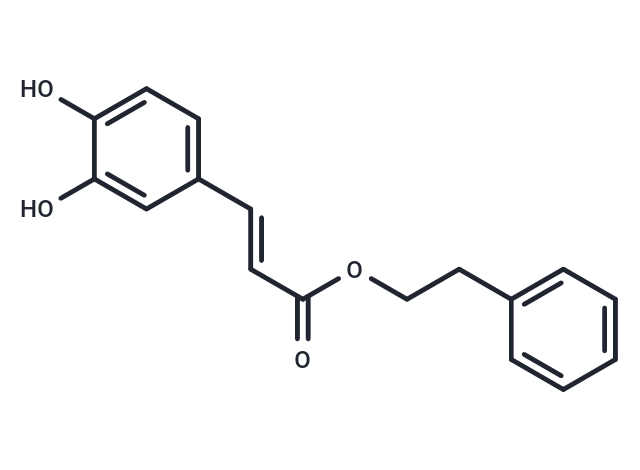
| Pack Size | Price | USA Stock | Global Stock | Quantity |
|---|---|---|---|---|
| 10 mg | $33 | In Stock | In Stock | |
| 25 mg | $50 | In Stock | In Stock | |
| 50 mg | $61 | In Stock | In Stock | |
| 100 mg | $74 | In Stock | In Stock | |
| 200 mg | $106 | In Stock | In Stock | |
| 500 mg | $173 | In Stock | In Stock | |
| 1 mL x 10 mM (in DMSO) | $39 | In Stock | In Stock |
| Description | Caffeic Acid Phenethyl Ester (Phenylethyl Caffeate) (CAPE) inhibits the activation of nuclear transcription factor NF-kappa B and may suppress p70S6K and Akt-driven signaling pathways, with antineoplastic, cytoprotective and immunomodulating activities. CAPE is the phenethyl alcohol ester of caffeic acid and a bioactive component of honeybee hive propolis. In addition, CAPE inhibits PDGF-induced proliferation of vascular smooth muscle cells through the activation of p38 mitogen-activated protein kinase (MAPK) and hypoxia-inducible factor (HIF)-1alpha and subsequent induction of heme oxygenase-1 (HO-1). |
| In vitro | Caffeic acid phenethyl ester blocks NF-κB activation induced by phorbol ester, ceramide, okadaic acid, and hydrogen peroxide by preventing the translocation of the p65 subunit of NF-κB to the nucleus. [1] In a series of tumor cell lines, Caffeic acid phenethyl ester shows promising antiproliferative activity with EC50 of 1.76, 3.16, 13.7, and 44.0 μM against murine colon 26-L5, murine B16-BL6 melanoma, human HT-1080 fibrosarcoma and human lung A549 adenocarcinoma cell lines, respectively. [2] Caffeic acid phenethyl ester, as a potent antioxidant, exerts its anti-apoptotic effect in cerebellar granule cells by blocking ROS formation and inhibiting caspase activity. [3] Moreover, Caffeic acid phenethyl ester attenuates the pro-inflammatory phenotype of LPS-stimulated HSCs, and LPS-induced sensitization of HSCs to fibrogenic cytokines by inhibiting NF-κB signaling. [4] |
| In vivo | In vivo, Caffeic acid phenethyl ester (10 mg/kg, i.p.) inhibits the growth and angiogenesis of primary tumors in C57BL/6 and BALB/c mice inoculated with Lewis lung carcinoma, colon carcinoma, and melanoma cells. [5] Caffeic acid phenethyl ester (5, 10, 20 mg/kg) also shows immunomodulatory effects in vivo by decreasing thymus weight and/or cellularity of thymus and spleen. [6] |
| Synonyms | Phenylethyl Caffeate, CAPE |
| Cell Research | Human HT-1080 fibrosarcoma, human lung A549 adenocarcinoma and murine B16-BL6 melanoma cell lines are maintained in EMEM medium supplemented with 10% FCS, 0.1% sodium bicarbonate and 2 mM glutamine. Murine colon 26-L5 carcinoma cell line, on the other hand, is maintained in RPMI medium containing the same supplements as in EMEM. These are all highly metastatic cell lines except for A-549 carcinoma. Cellular viability is determined using the standard MTT assay. In brief, exponentially growing cells are harvested and 100 μl of cell suspension containing 2000 cells is plated in 96-well microtiter plates. After 24 h of incubation to allow for cell attachment, the cells are treated with varying concentrations of test samples in medium (100 μl) and incubated for 72 h at 37°C under 5% CO2. Three hours after the addition of MTT, the amount of formazan formed is measured spectrophotometrically at 550 nm with a Perkin Elmer HTS-7000 plate reader. The test samples are first dissolved in DMSO and then diluted with medium; the final concentration of DMSO is less than 0.25%. Normal also had the same extent of DMSO. 5-Fluorouracil (5-FU) and doxorubicin HCl are used as positive controls, and EC50 values are calculated from the mean values of data from 4 wells. (Only for Reference) |
| Molecular Weight | 284.31 |
| Formula | C17H16O4 |
| Cas No. | 104594-70-9 |
| Smiles | Oc1ccc(\C=C\C(=O)OCCc2ccccc2)cc1O |
| Relative Density. | 1.266 g/cm3 |
| Storage | Powder: -20°C for 3 years | In solvent: -80°C for 1 year Shipping with blue ice/Shipping at ambient temperature. | ||||||||||||||||||||||||||||||||||||||||
| Solubility Information | DMSO: 247.5 mg/mL (870.53 mM), Sonication is recommended.  Ethanol: 28.4 mg/mL (99.89 mM), Sonication is recommended. | ||||||||||||||||||||||||||||||||||||||||
| In Vivo Formulation | 10% DMSO+40% PEG300+5% Tween 80+45% Saline: 2 mg/mL (7.03 mM), Sonication is recommended. Please add the solvents sequentially, clarifying the solution as much as possible before adding the next one. Dissolve by heating and/or sonication if necessary. Working solution is recommended to be prepared and used immediately. The formulation provided above is for reference purposes only. In vivo formulations may vary and should be modified based on specific experimental conditions. | ||||||||||||||||||||||||||||||||||||||||
Solution Preparation Table | |||||||||||||||||||||||||||||||||||||||||
Ethanol/DMSO
DMSO
Note : The dilution table applies only to solid products. For liquid products, please calculate the stock solution based on the stated concentration and/or density. | |||||||||||||||||||||||||||||||||||||||||
 For example, if the intended dosage is 10 mg/kg for animals weighing 20 g , with a dosing volume of 100 μL per animal, and a total of 10 animals are to be administered, using a formulation of
  10% DMSO+ 40% PEG300+ 5% Tween 80+ 45% Saline/PBS/ddH2O , the resulting working solution concentration would be 2 mg/mL.
Dissolve 2 mg of the compound in 100 μL DMSO to obtain a stock solution at a concentration of 20 mg/mL . If the required concentration exceeds the compound's known solubility, please contact us for technical support before proceeding.
1) Add 100 μL of the DMSO stock solution to 400 µL PEG300 and mix thoroughly until the solution becomes clear.
2) Add 50 µL Tween 80 and mix well until fully clarified.
3) Add 450 µL Saline,PBS or ddH2O and mix thoroughly until a homogeneous solution is obtained.
| Size | Quantity | Unit Price | Amount | Operation |
|---|
 Feedback
 Hello! How can I help you today?
Copyright © 2015-2026 TargetMol Chemicals Inc. All Rights Reserved.
