


Shopping Cart
Remove All Your shopping cart is currently empty

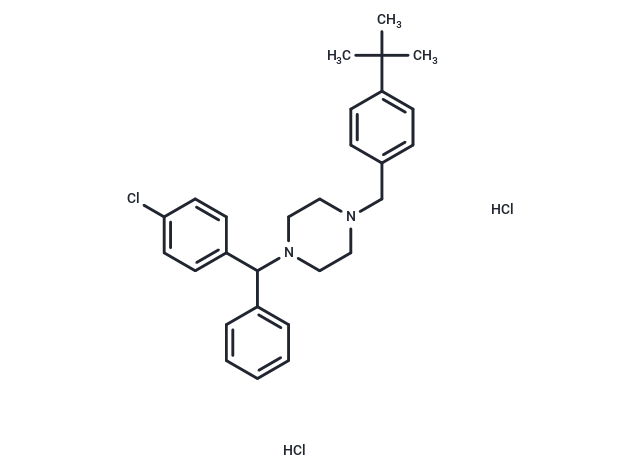
Synonyms: UCB-4445, Longifene, Buclizine HCl, Buclina
| Pack Size | Price | USA Stock | Global Stock | Quantity |
|---|---|---|---|---|
| 50 mg | $30 | In Stock | In Stock | |
| 100 mg | $42 | In Stock | In Stock | |
| 500 mg | $87 | In Stock | In Stock | |
| 1 g | $125 | - | In Stock | |
| 1 mL x 10 mM (in DMSO) | $45 | In Stock | In Stock |
| Description | Buclizine dihydrochloride (Buclina) is the hydrochloride salt form of buclizine, a piperazine histamine H1 receptor antagonist with primarily antiemetic and antivertigo activities. Buclizine dihydrochloride binds to and blocks the histamine H1 receptor, thereby preventing the symptoms that are caused by histamine activity. Buclizine dihydrochloride exerts its anti-emetic effect by binding to and blocking the muscarinic and histamine receptors in the vomiting center of the central nervous system (CNS). This may prevent activation of the chemoreceptor trigger zone (CTZ) and may reduce nausea and vomiting. |
| In vitro | Buclizine hydrochloride, a piperazine derivative, is a sedating antihistamine with antimuscarinic and moderate sedative action. Buclizine is used in the prevention and treatment of nausea, vomiting, and dizziness associated with motion sickness. Additionally, it has been used in the management of vertigo in diseases affecting the vestibular apparatus. Although the mechanism by which buclizine exerts its antiemetic and antivertigo effects has not been fully elucidated, its central anticholinergic properties are partially responsible. The drug depresses labyrinth excitability and vestibular stimulation, and it may affect the medullary chemoreceptor trigger zone. It also possesses anticholinergic, antihistaminic, central nervous system depressant, and local anesthetic effects. [1] |
| Synonyms | UCB-4445, Longifene, Buclizine HCl, Buclina |
| Kinase Assay | Topoisomerase I Catalytic Actioity Assay [1]: Topoisomerase I Catalytic Actioity Assay: The enzymatic activity is analyzed by the DNA unwinding assay. DNA topoisomerase I, from TopoGEN (1 unit, which is defined as the amount of enzyme that converts 0.5 μg of superhelical DNA to the relaxed state in 30 minutes at 37 °C), is incubated with 0.5 μg of 6x174 RF DNA, in the presence or absence of Beta-Lapachone, in 20 μL of relaxation buffer (50 mM Tris (pH 7.5). 50 mM KCI, 10 mM MgCl2, 0.5 mM dithiothreitol, 0.5 mM EDTA, 30 μg/mL bovine serum albumin) for 30 minutes at 37 °C. Reactions are stopped by adding 1% SDS and proteinase K (50 μg/mL). After an additional 1-hour incubation at 37 °C, the products are separated by electrophoresis in 1% agarose gel in TAE buffer (0.04 M tris acetate, 0.001 M EDTA). The gel is stained with ethidium bromide after electrophoresis. The photographic negative is scanned with an NIH image analysis system. |
| Molecular Weight | 505.95 |
| Formula | C28H33ClN2·2HCl |
| Cas No. | 129-74-8 |
| Smiles | CC(C)(C)c1ccc(cc1)CN1CCN(CC1)C(c1ccccc1)c1ccc(cc1)Cl.Cl.Cl |
| Relative Density. | no data available |
| Storage | Powder: -20°C for 3 years | In solvent: -80°C for 1 year Shipping with blue ice/Shipping at ambient temperature. | |||||||||||||||||||||||||
| Solubility Information | DMSO: 11 mg/mL (21.74 mM), Sonication is recommended.  | |||||||||||||||||||||||||
Solution Preparation Table | ||||||||||||||||||||||||||
DMSO
Note : The dilution table applies only to solid products. For liquid products, please calculate the stock solution based on the stated concentration and/or density. | ||||||||||||||||||||||||||
 For example, if the intended dosage is 10 mg/kg for animals weighing 20 g , with a dosing volume of 100 μL per animal, and a total of 10 animals are to be administered, using a formulation of
  10% DMSO+ 40% PEG300+ 5% Tween 80+ 45% Saline/PBS/ddH2O , the resulting working solution concentration would be 2 mg/mL.
Dissolve 2 mg of the compound in 100 μL DMSO to obtain a stock solution at a concentration of 20 mg/mL . If the required concentration exceeds the compound's known solubility, please contact us for technical support before proceeding.
1) Add 100 μL of the DMSO stock solution to 400 µL PEG300 and mix thoroughly until the solution becomes clear.
2) Add 50 µL Tween 80 and mix well until fully clarified.
3) Add 450 µL Saline,PBS or ddH2O and mix thoroughly until a homogeneous solution is obtained.
| Size | Quantity | Unit Price | Amount | Operation |
|---|
 Feedback
 Hello! How can I help you today?
Copyright © 2015-2026 TargetMol Chemicals Inc. All Rights Reserved.
