


Shopping Cart
Remove All Your shopping cart is currently empty

Synonyms: Principal bile pigment, Hemetoidin, Hematoidin, Bilibubin
| Pack Size | Price | USA Stock | Global Stock | Quantity |
|---|---|---|---|---|
| 25 mg | $31 | In Stock | In Stock | |
| 50 mg | $42 | In Stock | In Stock | |
| 100 mg | $59 | In Stock | In Stock | |
| 500 mg | $138 | Inquiry | Inquiry |

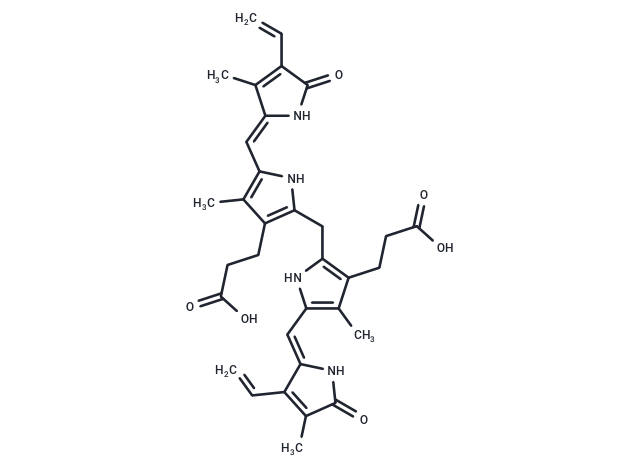
| Description | Bilirubin (Principal bile pigment) is a type of bile pigment, which is a metabolite of hemoglobin in the blood. Bilirubin has antimutagenic and antioxidant effects. Bilirubin is an important basis for clinical determination of jaundice, and is also an important indicator of liver function. |
| In vitro | METHODS: Hippocampal primary neurons were treated with Bilirubin (12-25 µM) for 24 h. Mitochondrial membrane potential (ΔΨm) was measured by JC-1 fluorescence staining.
RESULTS: Bilirubin treatment decreased ΔΨm in a dose-dependent manner. [1] METHODS: Neural stem cell NSC were treated with Bilirubin (6.25-50 µM) for 96 h. Cell viability was measured by MTT assay. RESULTS: Cell viability was significantly reduced after exposure to 50 µM Bilirubin concentration. The viability of cells exposed to Bilirubin was gradually and significantly reduced. [2] |
| In vivo | METHODS: To investigate the effects on atherosclerosis, Bilirubin (30 mg/kg, 50 mmol/L of K3PO4 plus 10% serum) was administered intraperitoneally to Ldlr-/- mice on Western diet once daily for eight weeks.
RESULTS: Bilirubin prevented atherosclerotic plaque formation but did not alter circulating cholesterol or chemokine levels. Bilirubin-treated animals had reduced lipid and collagen deposition in the aortic root, decreased monocyte and lymphocyte infiltration, fewer smooth muscle cells, decreased levels of chlorotyrosine and nitrotyrosine, and no changes in VCAM-1 or ICAM-1 expression. [3] |
| Synonyms | Principal bile pigment, Hemetoidin, Hematoidin, Bilibubin |
| Molecular Weight | 584.66 |
| Formula | C33H36N4O6 |
| Cas No. | 635-65-4 |
| Smiles | C(C1=C(CCC(O)=O)C(C)=C(/C=C\2/C(C=C)=C(C)C(=O)N2)N1)C3=C(CCC(O)=O)C(C)=C(/C=C\4/C(C)=C(C=C)C(=O)N4)N3 |
| Relative Density. | 1.374 g/cm3 |
| Storage | Store at low temperature,Keep away from direct sunlight Powder: -20°C for 3 years | In solvent: -80°C for 1 year Shipping with blue ice/Shipping at ambient temperature. | ||||||||||||||||||||
| Solubility Information | DMSO: 9 mg/mL (15.39 mM), Sonication is recommended.  | ||||||||||||||||||||
Solution Preparation Table | |||||||||||||||||||||
DMSO
Note : The dilution table applies only to solid products. For liquid products, please calculate the stock solution based on the stated concentration and/or density. | |||||||||||||||||||||
 For example, if the intended dosage is 10 mg/kg for animals weighing 20 g , with a dosing volume of 100 μL per animal, and a total of 10 animals are to be administered, using a formulation of
  10% DMSO+ 40% PEG300+ 5% Tween 80+ 45% Saline/PBS/ddH2O , the resulting working solution concentration would be 2 mg/mL.
Dissolve 2 mg of the compound in 100 μL DMSO to obtain a stock solution at a concentration of 20 mg/mL . If the required concentration exceeds the compound's known solubility, please contact us for technical support before proceeding.
1) Add 100 μL of the DMSO stock solution to 400 µL PEG300 and mix thoroughly until the solution becomes clear.
2) Add 50 µL Tween 80 and mix well until fully clarified.
3) Add 450 µL Saline,PBS or ddH2O and mix thoroughly until a homogeneous solution is obtained.
| Size | Quantity | Unit Price | Amount | Operation |
|---|
 Feedback
 Hello! How can I help you today?
Copyright © 2015-2026 TargetMol Chemicals Inc. All Rights Reserved.
