


Shopping Cart
Remove All Your shopping cart is currently empty


Synonyms: Targretin, Ro 26-4455, LGD1069
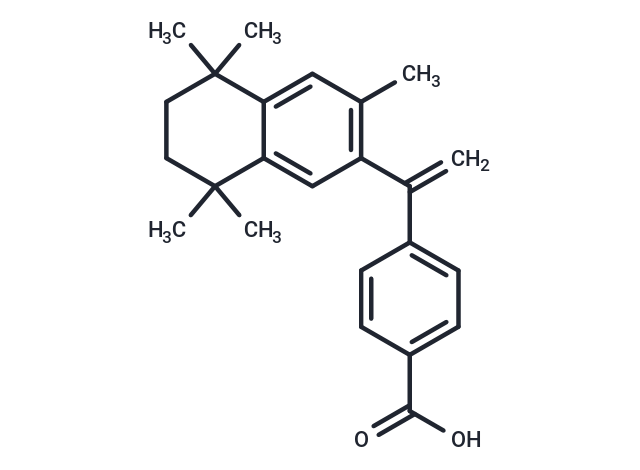
| Pack Size | Price | USA Stock | Global Stock | Quantity |
|---|---|---|---|---|
| 10 mg | $30 | In Stock | In Stock | |
| 25 mg | $44 | In Stock | In Stock | |
| 50 mg | $62 | In Stock | In Stock | |
| 100 mg | $91 | In Stock | In Stock | |
| 200 mg | $123 | In Stock | In Stock | |
| 500 mg | $261 | In Stock | In Stock | |
| 1 mL x 10 mM (in DMSO) | $39 | In Stock | In Stock |
| Description | Bexarotene (LGD1069) is a retinoid analogue that is used to treat the skin manifestations of cutaneous T cell lymphoma (CTCL). |
| In vitro | Bexarotene inhibited the expression of retinoid X receptor alpha and retinoic acid receptor alpha proteins in CTCL cell lines (MJ,HUT78 and 11 h).1 mM and 10 mM Bexarotene treatment of CTCL cell lines (MJ,HUT78 and 11 h) for 96 h increased cellular sub-G1 populations and membrane-bound protein V binding in a dose-dependent manner. Bexarotene treatment reduced the levels of surviving proteins, activated caspase-3 and cleaved poly (ADP-ribose) polymerase, but had no significant effect on the expression of Fas/Fas ligand and bcl-2 proteins in all three CTCL lines.Bexarotene induced a loss of viability and a more pronounced inhibition of clone formation in HH and Hut-78 cells proliferation, while the MJ line showed resistance. |
| In vivo | Bexarotene inhibited the expression of retinoid X receptor alpha and retinoic acid receptor alpha proteins in CTCL cell lines (MJ,HUT78 and 11 h).1 mM and 10 mM Bexarotene treatment of CTCL cell lines (MJ,HUT78 and 11 h) for 96 h increased cellular sub-G1 populations and membrane-bound protein V binding in a dose-dependent manner. Bexarotene treatment reduced the levels of surviving proteins, activated caspase-3 and cleaved poly (ADP-ribose) polymerase, but had no significant effect on the expression of Fas/Fas ligand and bcl-2 proteins in all three CTCL lines.Bexarotene induced a loss of viability and a more pronounced inhibition of clone formation in HH and Hut-78 cells proliferation, while the MJ line showed resistance. |
| Synonyms | Targretin, Ro 26-4455, LGD1069 |
| Kinase Assay | Biacore studies: Competition assays are performed on a Biacore S51. A Series S Sensor chip CM5 is derivatized for immobilization of a PentaHis antibody for capture of the His-tagged p53. The level of capture is ~ 200 response units (1 response unit corresponds to 1 pg of protein per mm 2). The concentration of MDM2 protein is kept constant at 300 nM. Test compounds are dissolved in DMSO at 10 mM and further diluted to make a concentration series of inhibitor in each MDM2 test sample. The assays are run at 25 °C in running buffer (10 mM Hepes, 0.15 M NaCl, 2% DMSO). MDM2-p53 binding in the presence of inhibitor is calculated as a percentage of binding in the absence of inhibitor and IC50 is calculated using Microsoft Excel |
| Molecular Weight | 348.48 |
| Formula | C24H28O2 |
| Cas No. | 153559-49-0 |
| Smiles | CC1(C)C=2C(C(C)(C)CC1)=CC(C)=C(C(=C)C3=CC=C(C(O)=O)C=C3)C2 |
| Relative Density. | 1.042 g/cm3 |
| Storage | Store at low temperature Powder: -20°C for 3 years | In solvent: -80°C for 1 year Shipping with blue ice/Shipping at ambient temperature. | |||||||||||||||||||||||||
| Solubility Information | DMSO: 9 mg/mL (25.83 mM), Sonication is recommended.  Ethanol: 7 mg/mL (20.09 mM), Heating is recommended. | |||||||||||||||||||||||||
| In Vivo Formulation | 10% DMSO+40% PEG300+5% Tween 80+45% Saline: 1 mg/mL (2.87 mM), Sonication is recommended. Please add the solvents sequentially, clarifying the solution as much as possible before adding the next one. Dissolve by heating and/or sonication if necessary. Working solution is recommended to be prepared and used immediately. The formulation provided above is for reference purposes only. In vivo formulations may vary and should be modified based on specific experimental conditions. | |||||||||||||||||||||||||
Solution Preparation Table | ||||||||||||||||||||||||||
Ethanol/DMSO
Note : The dilution table applies only to solid products. For liquid products, please calculate the stock solution based on the stated concentration and/or density. | ||||||||||||||||||||||||||
 For example, if the intended dosage is 10 mg/kg for animals weighing 20 g , with a dosing volume of 100 μL per animal, and a total of 10 animals are to be administered, using a formulation of
  10% DMSO+ 40% PEG300+ 5% Tween 80+ 45% Saline/PBS/ddH2O , the resulting working solution concentration would be 2 mg/mL.
Dissolve 2 mg of the compound in 100 μL DMSO to obtain a stock solution at a concentration of 20 mg/mL . If the required concentration exceeds the compound's known solubility, please contact us for technical support before proceeding.
1) Add 100 μL of the DMSO stock solution to 400 µL PEG300 and mix thoroughly until the solution becomes clear.
2) Add 50 µL Tween 80 and mix well until fully clarified.
3) Add 450 µL Saline,PBS or ddH2O and mix thoroughly until a homogeneous solution is obtained.
| Size | Quantity | Unit Price | Amount | Operation |
|---|
 Feedback
 Hello! How can I help you today?
Copyright © 2015-2026 TargetMol Chemicals Inc. All Rights Reserved.
