


Shopping Cart
Remove All Your shopping cart is currently empty

Synonyms:
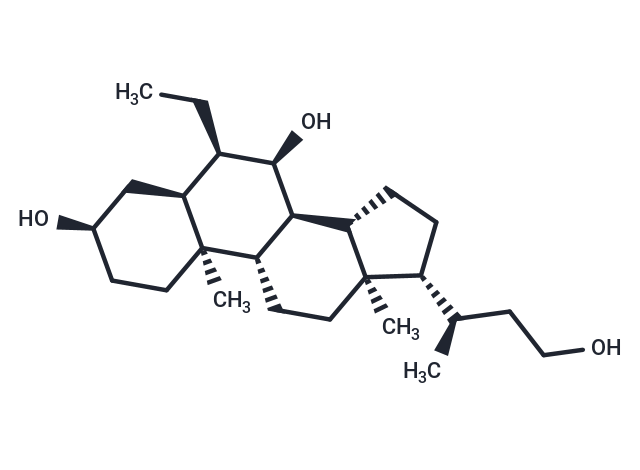

| Pack Size | Price | USA Stock | Global Stock | Quantity |
|---|---|---|---|---|
| 1 mg | $41 | In Stock | In Stock | |
| 5 mg | $103 | In Stock | In Stock | |
| 10 mg | $163 | In Stock | In Stock | |
| 25 mg | $328 | In Stock | In Stock | |
| 50 mg | $457 | In Stock | In Stock | |
| 100 mg | $622 | In Stock | In Stock | |
| 200 mg | $833 | - | In Stock |
| Description | BAR502 is a dual GPBAR1 and FXR agonist (IC50s: 0.4 μM and 2 μM). |
| Targets & IC50 | GPBAR1:0.4 μM, FXR:2 μM |
| In vitro | At the concentration of 10 μM, BAR502 fails to transactivate GR, PPARγ, and LXR, respectively, but it transactivates the nuclear receptor PXR. BAR502 is able to induce the expression of proglucagon mRNA in GLUTAg cells, an intestinal endocrine cell line, as well as to increase cAMP concentrations in THP-1 cells. BAR502 induces the expression of OSTα, BSEP, and SHP in HepG2 cells. BAR502 shows very potent activity in the recruitment of SRC-1 coactivator and high affinity to FXR [1]. |
| In vivo | In non-obstructive cholestasis models, BAR502 mitigates liver damage without inducing itching. Concurrently, BAR502 enhances survival, lowers serum alkaline phosphatase levels, and significantly alters the liver's expression of key FXR target genes such as OSTα, BSEP, SHP, and MDR1, without causing pruritus. Furthermore, BAR502 treatment results in a 10% body weight reduction, heightened insulin sensitivity, increased HDL levels, and decreased liver steatosis, inflammation, fibrosis scores, and the expression of liver genes like SREPB1c, FAS, PPARγ, CD36, and CYP7A1 mRNA. It also elevates SHP and ABCG5 expression in the liver, alongside SHP, FGF15, and GLP1 in the intestine. Additionally, BAR502 fosters epWAT browning and curtails CCl4-induced liver fibrosis. |
| Animal Research | C57BL6 mice 24 weeks old are fed a high-fat diet containing 60% kj fat and fructose in drinking water (42?g/L) or normal diet (6 mice) for 18 weeks. After 10 weeks of HFD, mice are randomized to receive HFD alone (9 mice) or HFD plus BAR502 (15?mg/kg/day) body weight by gavage (9 mice) for 8 weeks. Mice are housed under controlled temperatures (22?°C) and photoperiods (12:12-hour light/dark cycle), allowed unrestricted access to standard mouse chow and tap water and allowed to acclimate to these conditions for at least 5 days before inclusion in an experiment [3]. |
| Molecular Weight | 392.62 |
| Formula | C25H44O3 |
| Cas No. | 1612191-86-2 |
| Smiles | CC[C@H]1[C@@H](O)[C@H]2[C@@H]3CC[C@H]([C@H](C)CCO)[C@@]3(C)CC[C@@H]2[C@@]2(C)CC[C@@H](O)C[C@@H]12 |
| Relative Density. | 1.055 g/cm3 (Predicted) |
| Storage | Powder: -20°C for 3 years | In solvent: -80°C for 1 year Shipping with blue ice/Shipping at ambient temperature. | |||||||||||||||||||||||||||||||||||
| Solubility Information | DMF: 48 mg/mL (122.26 mM), Sonication is recommended. | |||||||||||||||||||||||||||||||||||
Solution Preparation Table | ||||||||||||||||||||||||||||||||||||
DMF
Note : The dilution table applies only to solid products. For liquid products, please calculate the stock solution based on the stated concentration and/or density. | ||||||||||||||||||||||||||||||||||||
 For example, if the intended dosage is 10 mg/kg for animals weighing 20 g , with a dosing volume of 100 μL per animal, and a total of 10 animals are to be administered, using a formulation of
  10% DMSO+ 40% PEG300+ 5% Tween 80+ 45% Saline/PBS/ddH2O , the resulting working solution concentration would be 2 mg/mL.
Dissolve 2 mg of the compound in 100 μL DMSO to obtain a stock solution at a concentration of 20 mg/mL . If the required concentration exceeds the compound's known solubility, please contact us for technical support before proceeding.
1) Add 100 μL of the DMSO stock solution to 400 µL PEG300 and mix thoroughly until the solution becomes clear.
2) Add 50 µL Tween 80 and mix well until fully clarified.
3) Add 450 µL Saline,PBS or ddH2O and mix thoroughly until a homogeneous solution is obtained.
| Size | Quantity | Unit Price | Amount | Operation |
|---|
 Feedback
 Hello! How can I help you today?
Copyright © 2015-2026 TargetMol Chemicals Inc. All Rights Reserved.
