


Shopping Cart
Remove All Your shopping cart is currently empty


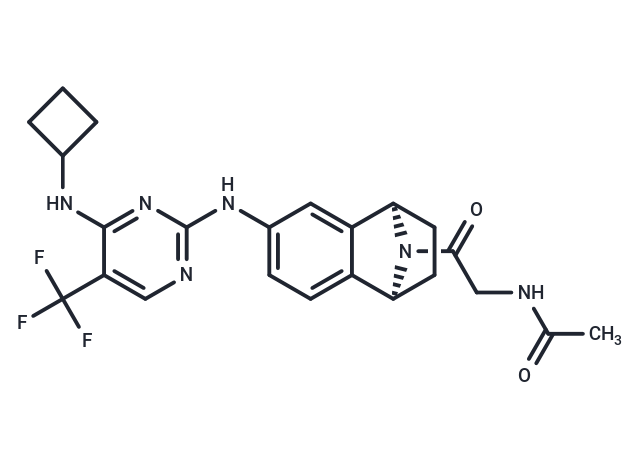
PF-03814735 is a novel, potent and reversible inhibitor of Aurora A/B with IC50of 0.8 nM/5 nM, is less potent to Flt3, FAK, TrkA, and minimally active to Met and FGFR1. Phase 1.
| Pack Size | Price | USA Warehouse | Global Warehouse | Quantity |
|---|---|---|---|---|
| 2 mg | $53 | - | In Stock |
| Description | PF-03814735 is a novel, potent and reversible inhibitor of Aurora A/B with IC50of 0.8 nM/5 nM, is less potent to Flt3, FAK, TrkA, and minimally active to Met and FGFR1. Phase 1. |
| Targets&IC50 | TrkA:30 nM, Aurora B:5 nM, FGFR1:100 nM, MET:100 nM, Aurora A:0.8 nM, FLT1:10 nM, FAK:22 nM |
| In vitro | In intact cells, the inhibitory activity of PF-03814735 on the Aurora1 and Aurora2 kinases reduces levels of phospho-Aurora1 (Thr 232, a sensitive marker of Aurora1 activity, with IC50 ~ 20 nM), phosphohistone H3 (with IC50 ~ 50 nM), and phospho-Aurora2 (with IC50 ~150 nM). PF-03814735 produces a block in cytokinesis, resulting in inhibition of cell proliferation and the formation of polyploid multinucleated cells. [1] A recent research indicates small cell lung cancer (SCLC) and, to a lesser extent, colon cancer lines are very sensitive to PF-03814735. The status of the Myc gene family and retinoblastoma pathway members significantly correlates with the efficacy of PF-03814735. [1] |
| In vivo | Once-daily oral dosing of ≥20 mg/kg of PF-03814735 for 10 days to mice bearing HCT-116 xenografts resulted in statistically significant and dose-dependent tumor growth inhibition of ≥50% relative to vehicle-treated mice. The inhibition is associated with a reduction in phosphorylated histone H3 levels. Significant single-agent antitumor efficacy is observed in five additional xenograft tumor models, including A2780 ovarian carcinoma, MDA-MB-231 breast carcinoma, colo-205 and SW620 colorectal carcinomas, and HL-60 acute promyelocytic leukemia. [1] In vivo experiments with two SCLC xenograft models confirms the sensitivity of Myc gene-driven models to PF-03814735 and a possible schedule dependence of MYC/c-Myc-driven tumors. [1] |
| Kinase Assay | Recombinant Kinase Assays: Aurora1 and Aurora2 proteins are produced as full-length His-tag recombinant proteins expressed in insect cells. For the Aurora2 kinase assay, phosphorylation of the substrate peptide by recombinant Aurora2 protein is assessed by a Z'-LYTE assay at 3 to 300 μM ATP and various concentrations of PF-03814735 over 60 minutes, at a substrate peptide concentration of 2 μM (biotinylated LRRWSLG, ×4). Phosphorylation is linear over this time for all conditions. For the Aurora1 kinase assay, phosphorylation of the substrate peptide by recombinant Aurora1 protein is assessed by a scintillation proximity assay in a 96-well plate format in which the incorporation of 33P into the peptide substrate (biotinylated LRRWSLG, ×4) is measured by capturing the peptide on a streptavidin scintillation proximity assay bead. |
| Cell Research | Cell lines are grown in appropriate media and evaluated after 48 h of exposure to either PF-03814735 or vehicle, followed by cell number determination in a Coulter Counter. Proliferation (as measured by an increase in cell number) is expressed as a percent of untreated controls. To evaluate the PF-03814735 exposure time required for antiproliferative activity, HL-60 cell cultures are cultured in RPMI medium supplemented with 15% heat-inactivated fetal bovine serum and exposed to various PF-03814735 concentrations for 4, 8, 12, 24, and 48 hours, followed by a washout step and incubation with growth media without PF-03814735 for the remainder of the 72-h assay period. Continuous exposure to PF-03814735 for 72 hours is also evaluated. Cell counts are determined by a Coulter Counter.(Only for Reference) |
| Molecular Weight | 474.48 |
| Formula | C23H25F3N6O2 |
| Cas No. | 942487-16-3 |
| Smiles | CC(=O)NCC(=O)N1[C@H]2CC[C@@H]1c1cc(Nc3ncc(c(NC4CCC4)n3)C(F)(F)F)ccc21 |
| Relative Density. | 1.443 g/cm3 |
| Storage | store at low temperature | Powder: -20°C for 3 years | In solvent: -80°C for 1 year | Shipping with blue ice/Shipping at ambient temperature. | ||||||||||||||||||||||||||||||||||||||||
| Solubility Information | DMSO: 47.5 mg/mL (100.11 mM), Sonication is recommended. Ethanol: 9.5 mg/mL (20.02 mM), Sonication is recommended. | ||||||||||||||||||||||||||||||||||||||||
| In Vivo Formulation | 10% DMSO+40% PEG300+5% Tween-80+45% Saline: 2 mg/mL (4.22 mM), Sonication is recommended. Please add the solvents sequentially, clarifying the solution as much as possible before adding the next one. Dissolve by heating and/or sonication if necessary. Working solution is recommended to be prepared and used immediately. The formulation provided above is for reference purposes only. In vivo formulations may vary and should be modified based on specific experimental conditions. | ||||||||||||||||||||||||||||||||||||||||
Solution Preparation Table | |||||||||||||||||||||||||||||||||||||||||
Ethanol/DMSO
DMSO
| |||||||||||||||||||||||||||||||||||||||||
 For example, if the intended dosage is 10 mg/kg for animals weighing 20 g , with a dosing volume of 100 μL per animal, and a total of 10 animals are to be administered, using a formulation of
  10% DMSO+ 40% PEG300+ 5% Tween 80+ 45% Saline/PBS/ddH2O , the resulting working solution concentration would be 2 mg/mL.
Dissolve 2 mg of the compound in 100 μL DMSO to obtain a stock solution at a concentration of 20 mg/mL . If the required concentration exceeds the compound's known solubility, please contact us for technical support before proceeding.
1) Add 100 μL of the DMSO stock solution to 400 μL PEG300 and mix thoroughly until the solution becomes clear.
2) Add 50 μL Tween 80 and mix well until fully clarified.
3) Add 450 μL Saline,PBS or ddH2O and mix thoroughly until a homogeneous solution is obtained.

| Size | Quantity | Unit Price | Amount | Operation |
|---|
 Feedback
 Hello! How can I help you today?
Copyright © 2015-2026 TargetMol Chemicals Inc. All Rights Reserved.
