


Shopping Cart
Remove All
  • TargetMol
    Your shopping cart is currently empty

DMBA (Alias: 7,12-DMBA, 7,12-Dimethylbenzanthracene, 7,12-Dimethylbenz[a]anthracene)

Catalog No. T36696 Copy Product Info
Purity: 99.79%
🥰Excellent
DMBA (7,12-Dimethylbenz[a]anthracene) is a carcinogenic polycyclic aromatic hydrocarbon (PAH) that can be used to induce animal models of leukemia, liver cancer, breast cancer, skin cancer, and lung cancer. It is also capable of inducing programmed cell death (apoptosis) in A20.1 murine B-cell lymphoma.

DMBA

Copy Product Info
🥰Excellent
Catalog No. T36696
Alias 7,12-DMBA, 7,12-Dimethylbenzanthracene, 7,12-Dimethylbenz[a]anthracene
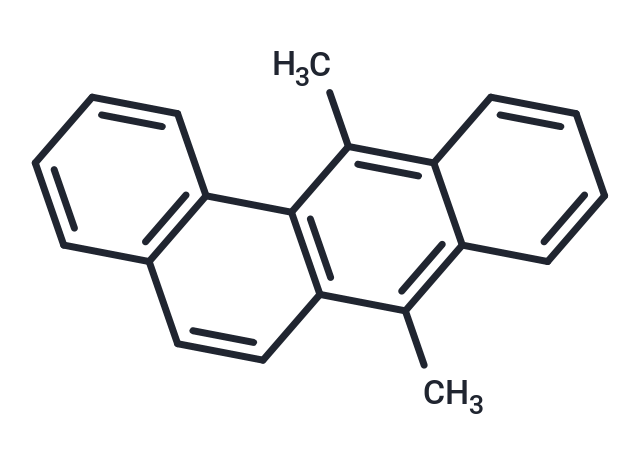
DMBA (7,12-Dimethylbenz[a]anthracene) is a carcinogenic polycyclic aromatic hydrocarbon (PAH) that can be used to induce animal models of leukemia, liver cancer, breast cancer, skin cancer, and lung cancer. It is also capable of inducing programmed cell death (apoptosis) in A20.1 murine B-cell lymphoma.

DMBA
Cas No. 57-97-6
TargetMol | Customer service
Customer service consultation
Pack SizePriceUSA StockGlobal StockQuantity
25 mg$30In StockIn Stock
50 mg$40In StockIn Stock
100 mg$64-In Stock
1 mL x 10 mM (in DMSO)$39In StockIn Stock
In stock · Estimated delivery: USA Stock (1-2 days) Global Stock (5-7 days)
Add to Cart
Add to Quotation
For research use only—not for human use. No sales to individuals. Use as intended only.
Questions
TargetMol
View More

Batch Information

Select Batch
Purity:99.79%
Appearance:Solid
Color:Yellow
Contact us for more batch information

Resource Download

Product Introduction

Bioactivity
Description
DMBA (7,12-Dimethylbenz[a]anthracene) is a carcinogenic polycyclic aromatic hydrocarbon (PAH) that can be used to induce animal models of leukemia, liver cancer, breast cancer, skin cancer, and lung cancer. It is also capable of inducing programmed cell death (apoptosis) in A20.1 murine B-cell lymphoma.
In vivo
DMBA (0-150 mg/kg, oral administration) induces a decrease in spleen weight and a reduction in the total number of lymphocytes recovered from the spleen in C57BL/6 mice. This model can be used to establish induced cancer models such as skin carcinogenesis, breast cancer, and lung cancer[5].
Disease Modeling Protocol
Immunosuppression model
  • Modeling Mechanism:

    DMBA is activated by CYP1B1 metabolism (mainly local metabolism in bone marrow, with no significant effect from liver metabolism), rapidly inhibiting the proliferation and differentiation of bone marrow lymphoid (CFU-preB) and myeloid (CFU-GM) progenitor cells, leading to a reduction in bone marrow cells; at the same time, it causes a sustained decrease in peripheral blood lymphocytes and an initial decrease followed by an increase in neutrophils, ultimately resulting in immunosuppression, and this process depends on TNF receptor signaling and p53-related stress responses.

  • Related Products:

    DMBA (T36696)

  • Modeling Method:

    Experimental Subject:

    Mice, C57BL/6 and Cyp1b1⁻/⁻ transgenic strains, Female, 6 weeks old

    Dosage and Administration Route:

    10–50 mg/kg DMBA (dissolved in olive oil) Intraperitoneal (IP) injection or oral gavage

    Dosing Frequency and Duration Model:

    Single dose

  • Validation:

    Hematopoietic function: CFU-preB and CFU-GM activities decreased by ≥50% within 6 hours, with the IP administration group showing sustained inhibition for up to 7 days, while myeloid progenitor cells recovered within 48 hours in the oral administration group; Bone marrow cells: The total cell count decreased by 60% within 48-72 hours after IP administration, with B220⁺ lymphocytes showing a sustained decrease (>90% within 7 days), and Gr-1⁺ myeloid cells showing an initial decrease followed by an increase; Peripheral blood: White blood cells, lymphocytes, and neutrophils all decreased by 50% within 6 hours, with lymphocytes showing sustained inhibition for up to 7 days, and neutrophils rebounding to 1.5 times the control group within 7 days; Specificity verification: Cyp1b1⁻/⁻ mice did not exhibit the above phenotypes, confirming that DMBA toxicity depends on CYP1B1 metabolism.

*Precautions: After the experiment, mice were euthanized with CO₂, and bone marrow cells were lysed with ACK buffer to remove red blood cells for use in CFU experiments or flow cytometry analysis.

*References:N'jai AU,et,al. Bone marrow lymphoid and myeloid progenitor cells are suppressed in 7,12-dimethylbenz(a)anthracene (DMBA) treated mice. Toxicology. 2010 Apr 30;271(1-2):27-35.

Skin cancer model
  • Modeling Mechanism:

    DMBA, a polycyclic aromatic hydrocarbon carcinogen, activates PXR (mainly in Langerhans cells and other Langerin⁺ dendritic cells) and AHR (mainly in keratinocytes) after absorption through the skin. PXR and AHR regulate the expression of cytochrome P450 enzymes such as CYP3A and CYP1 family, respectively, promoting DMBA metabolic activation and inducing DNA damage (such as γH2AX aggregation). PXR deficiency can promote Langerhans cell migration and reduce the transfer of DMBA metabolites to keratinocytes, thereby alleviating DNA damage. However, humanized PXR mice show significantly enhanced DNA damage.

  • Related Products:

    DMBA (T36696)

  • Modeling Method:

    Experimental Subject:

    Mice, C57BL/6 background (including Pxr⁻/⁻, Ahr⁻/⁻, Langerin-DTR-EGFP, Tg-3A4/hPXR humanised strains), Adult

    Dosage and Administration Route:

    0.05% DMBA (0.5 mg/ml dissolved in acetone), Topically applied to mouse ear skin, Left ear treated with acetone as control

    Dosing Frequency and Duration Model:

    Single dose

  • Validation:

    Molecular markers: Pxr, Cyp1a1, Cyp1b1, Cyp3a11 mRNA and PXR protein expression were upregulated in skin tissue, while Ahr mRNA showed no significant change; the number of γH2AX⁺ cells increased 5-fold after DMBA treatment in humanized PXR mice; Histology: γH2AX immunostaining showed DNA damage in basal keratinocytes, hair follicle cells, and Langerhans cells, with significantly reduced damage in Pxr⁻/⁻ and Ahr⁻/⁻ mice; Functional validation: Langerhans cells from Pxr⁻/⁻ mice migrated more towards draining lymph nodes, and Ccr7 mRNA expression was upregulated in the skin, while this phenotype was not observed in Ahr⁻/⁻ mice.

*Precautions: Mice were sacrificed 48 hours after modeling, and ear skin and drained lymph nodes were collected for gene expression detection, immunofluorescence staining, and flow cytometry analysis.

*References:Elentner A,et,al. Skin response to a carcinogen involves the xenobiotic receptor pregnane X receptor. Exp Dermatol. 2015 Nov;24(11):835-40.

Synonyms7,12-DMBA, 7,12-Dimethylbenzanthracene, 7,12-Dimethylbenz[a]anthracene
Chemical Properties
Molecular Weight256.34
FormulaC20H16
Cas No.57-97-6
SmilesCc1c2ccccc2c(C)c2c1ccc1ccccc21
Storage & Solubility Information
Storagestore at low temperature,keep away from moisture | Powder: -20°C for 3 years | In solvent: -80°C for 1 year | Shipping with blue ice/Shipping at ambient temperature.
Solubility Information
Ethanol: 2 mg/mL (7.8 mM), Sonication and heating are recommended.
DMSO: 23.18 mg/mL (90.43 mM), Sonication is recommended.

Acetone: 15 mg/mL (58.52 mM), Sonification is recommended.
DMF: 20 mg/mL (78.02 mM), Sonication is recommended.
In Vivo Formulation
10% DMSO+90% Corn Oil: 1.5 mg/mL (5.85 mM), Sonication is recommended.
Please add the solvents sequentially, clarifying the solution as much as possible before adding the next one. Dissolve by heating and/or sonication if necessary. Working solution is recommended to be prepared and used immediately. The formulation provided above is for reference purposes only. In vivo formulations may vary and should be modified based on specific experimental conditions.
Solution Preparation Table
Ethanol/Acetone/DMF/DMSO
1mg5mg10mg50mg
1 mM3.9011 mL19.5053 mL39.0107 mL195.0534 mL
5 mM0.7802 mL3.9011 mL7.8021 mL39.0107 mL
Acetone/DMF/DMSO
1mg5mg10mg50mg
10 mM0.3901 mL1.9505 mL3.9011 mL19.5053 mL
20 mM0.1951 mL0.9753 mL1.9505 mL9.7527 mL
50 mM0.0780 mL0.3901 mL0.7802 mL3.9011 mL
Note : The dilution table applies only to solid products. For liquid products, please calculate the stock solution based on the stated concentration and/or density.

Calculator

  • Molarity Calculator
  • Dilution Calculator
  • Reconstitution Calculator
  • Molecular Weight Calculator

In Vivo Formulation Calculator (Clear solution)

Please enter your animal experiment information in the following box and click Calculate to obtain the stock solution preparation method and in vivo formula preparation method:
TargetMol | Animal experiments For example, if the intended dosage is 10 mg/kg for animals weighing 20 g , with a dosing volume of 100 μL per animal, TargetMol | Animal experiments and a total of 10 animals are to be administered, using a formulation of TargetMol | reagent 10% DMSO+ 40% PEG300+ 5% Tween 80+ 45% Saline/PBS/ddH2O , the resulting working solution concentration would be 2 mg/mL.

Stock Solution Preparation:

Dissolve 2 mg of the compound in 100 μL DMSOTargetMol | reagent to obtain a stock solution at a concentration of 20 mg/mL . If the required concentration exceeds the compound's known solubility, please contact us for technical support before proceeding.

Preparation of the In Vivo Formulation:

1) Add 100 μL of the DMSOTargetMol | reagent stock solution to 400 μL PEG300TargetMol | reagent and mix thoroughly until the solution becomes clear.

2) Add 50 μL Tween 80 and mix well until fully clarified.

3) Add 450 μL Saline,PBS or ddH2OTargetMol | reagent and mix thoroughly until a homogeneous solution is obtained.

This example is provided solely to demonstrate the use of the In Vivo Formulation Calculator and does not constitute a recommended formulation for any specific compound. Please select an appropriate dissolution and formulation strategy based on your experimental model and route of administration.
All co-solvents required for this protocol, includingDMSO, PEG300/PEG400, Tween 80, SBE-β-CD, and Corn oil, are available for purchase on the TargetMol website.
1 Enter information below:
mg/kg
g
μL
2 Enter the in vivo formulation:
% DMSO
%
% Tween 80
% Saline/PBS/ddH2O

Dose Conversion

You can also refer to dose conversion for different animals. More Dose Conversion

Tech Support

Please see Inhibitor Handling Instructions for more frequently ask questions. Topics include: how to prepare stock solutions, how to store products, and cautions on cell-based assays & animal experiments, etc

Keywords

Related Tags: buy DMBA | purchase DMBA | DMBA cost | order DMBA | DMBA chemical structure | DMBA in vivo | DMBA formula | DMBA molecular weight




