


Shopping Cart
Remove All Your shopping cart is currently empty

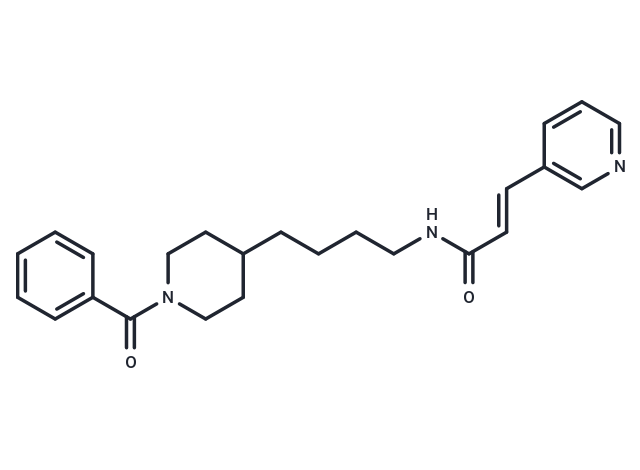
Synonyms: FK866, Daporinad, APO866, (E)-N-[4-(1-BENZOYL-PIPERIDIN-4-YL)-BUTYL]-3-PYRIDIN-3-YL-ACRYLAMIDE
| Pack Size | Price | USA Stock | Global Stock | Quantity |
|---|---|---|---|---|
| 2 mg | $36 | In Stock | In Stock | |
| 5 mg | $59 | In Stock | In Stock | |
| 10 mg | $97 | In Stock | In Stock | |
| 25 mg | $198 | In Stock | In Stock | |
| 50 mg | $387 | In Stock | In Stock | |
| 100 mg | $587 | In Stock | In Stock | |
| 500 mg | $1,230 | - | In Stock | |
| 1 mL x 10 mM (in DMSO) | $64 | In Stock | In Stock |
| Description | (E)-Daporinad (FK866) is a highly specific, non-competitive small molecule inhibitor of nicotinamide phosphoribosyltransferase (NAMPT) with potential anti-tumor and anti-angiogenic activities with an IC50 value of 0.09 nM. |
| Targets & IC50 | NAMPT:0.09 nM, NMPRTase:0.4 nM (Ki) |
| In vitro | METHODS: Hepatocytes were pretreated with (E)-Daporinad( FK866 ) (100 nM, 30 minutes) and then challenged with GaIN/LPS (G/L, 1 mg/mL /30 ng/mL, 24 hours) to observe whether (E)-Daporinad( FK866 ) could alleviate GaIN/LPS-induced hepatotoxicity. RESULTS Primary hepatocytes pretreated with (E)-Daporinad( FK866 ) showed a significant increase in autophagic activity after GaIN/LPS injury. (E)-Daporinad( FK866 ) could improve liver injury induced by GaIN/LPS and ConA. Its protective mechanism may involve its ability to induce autophagy by inhibiting JNK. [1] |
| In vivo | METHODS: (E)-Daporinad( FK866 )(10 mg/kg, intraperitoneal injection) was administered to mice 24, 12, and 0.5 hours before treatment with GaIN/LPS and ConA to test the potential effect of (E)-Daporinad( FK866 ) on ALF in mice. RESULTS (E)-Daporinad( FK866 ) treatment reduced the mortality of mice treated with GaIN/LPS or ConA. (E)-Daporinad( FK866 ) treatment before and after treatment attenuated GaIN/LPS and ConA-induced ALF in mice, and (E)-Daporinad( FK866 ) pretreatment resulted in a better response to GaIN/LPS or ConA challenge. [1] |
| Synonyms | FK866, Daporinad, APO866, (E)-N-[4-(1-BENZOYL-PIPERIDIN-4-YL)-BUTYL]-3-PYRIDIN-3-YL-ACRYLAMIDE |
| Kinase Assay | High Throughput Screening: FITC-MBM1 at 15 nM and menin at 150 nM in the FP buffer are mixed and incubated for 1h in the dark at room temperature. For point screening, the 0.2 μL of each compound (20 μM final concentration, 1% DMSO) is added to 20 μL of the aliquot of the protein-peptide mixture and incubated on 384-well plates in the dark at room temperature for 1h. In confirmation screening, the serial dilution plates with compounds in DMSO are prepared and used to titrate the menin-FITC-MBM1 complex. Change in fluorescence polarization is monitored at 525 nm after excitations at 495 nm using the PHERAstar microplate reader (BMG) and applied to determine IC50 values with the Origin 7.0 program. |
| Cell Research | For MTT assays, 0.5 × 10⁶ cells/mL is plated in triplicate on 96-well plates. APO866 (0.01 nM-100 nM) is added in 50 μL of culture medium, with culture medium alone serving as control. After 72 or 96 hours of incubation, 15 μL of dye solution is added to each well and cells are incubated for an additional 4 hours. Stop solution (100 μL/well) is added for 1 hour and the absorbance is read at 570 nm on a spectrophotometer. For trypan blue dye exclusion staining, 0.5 × 10⁵ cells/well is grown in 6-well plates with 1 mL media in the absence or presence of APO866 for 96 hours. Cells from each sample are incubated with 10 μL trypan blue solution (at a 1:1 ratio [vol/vol] for 1 minute). Cell survival is determined by calculating proportion of live (unstained) cells. (Only for Reference) |
| Molecular Weight | 391.51 |
| Formula | C24H29N3O2 |
| Cas No. | 658084-64-1 |
| Smiles | C(=O)(N1CCC(CCCCNC(/C=C/C=2C=CC=NC2)=O)CC1)C3=CC=CC=C3 |
| Relative Density. | 1.131 g/cm3 |
| Storage | Store at low temperature Powder: -20°C for 3 years | In solvent: -80°C for 1 year Shipping with blue ice/Shipping at ambient temperature. | |||||||||||||||||||||||||||||||||||
| Solubility Information | DMSO: 257.5 mg/mL (657.71 mM), Sonication is recommended.  Ethanol: 72 mg/mL (183.9 mM), Sonication is recommended. | |||||||||||||||||||||||||||||||||||
| In Vivo Formulation | 10% DMSO+90% Saline: 0.1 mg/mL (0.26 mM), Solution. Please add the solvents sequentially, clarifying the solution as much as possible before adding the next one. Dissolve by heating and/or sonication if necessary. Working solution is recommended to be prepared and used immediately. The formulation provided above is for reference purposes only. In vivo formulations may vary and should be modified based on specific experimental conditions. | |||||||||||||||||||||||||||||||||||
Solution Preparation Table | ||||||||||||||||||||||||||||||||||||
Ethanol/DMSO
Note : The dilution table applies only to solid products. For liquid products, please calculate the stock solution based on the stated concentration and/or density. | ||||||||||||||||||||||||||||||||||||
 For example, if the intended dosage is 10 mg/kg for animals weighing 20 g , with a dosing volume of 100 μL per animal, and a total of 10 animals are to be administered, using a formulation of
  10% DMSO+ 40% PEG300+ 5% Tween 80+ 45% Saline/PBS/ddH2O , the resulting working solution concentration would be 2 mg/mL.
Dissolve 2 mg of the compound in 100 μL DMSO to obtain a stock solution at a concentration of 20 mg/mL . If the required concentration exceeds the compound's known solubility, please contact us for technical support before proceeding.
1) Add 100 μL of the DMSO stock solution to 400 µL PEG300 and mix thoroughly until the solution becomes clear.
2) Add 50 µL Tween 80 and mix well until fully clarified.
3) Add 450 µL Saline,PBS or ddH2O and mix thoroughly until a homogeneous solution is obtained.
| Size | Quantity | Unit Price | Amount | Operation |
|---|
 Feedback
 Hello! How can I help you today?
Copyright © 2015-2026 TargetMol Chemicals Inc. All Rights Reserved.
