


Shopping Cart
Remove All Your shopping cart is currently empty


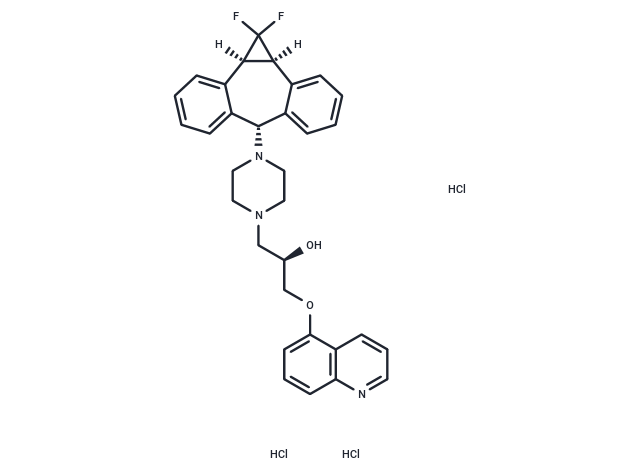
Synonyms: Zosuquidar 3HCl, Zosuquidar (LY335979) 3HCl, RS 33295-198 trihydrochloride, RS 33295-198 (D06387) 3HCl, LY-335979 trihydrochloride
| Pack Size | Price | USA Stock | Global Stock | Quantity |
|---|---|---|---|---|
| 1 mg | $30 | In Stock | In Stock | |
| 5 mg | $64 | In Stock | In Stock | |
| 10 mg | $90 | In Stock | In Stock | |
| 25 mg | $177 | In Stock | In Stock | |
| 50 mg | $263 | In Stock | In Stock | |
| 100 mg | $396 | In Stock | In Stock |
| Description | Zosuquidar trihydrochloride (LY-335979 trihydrochloride) is a highly selective, potent competitive inhibitor of P-glycoprotein (P-gp, ABCB1) with a Ki value of 59 nM. Zosuquidar trihydrochloride exhibits antitumor activity and can be used in research on tumors such as leukemia. |
| Targets & IC50 | MDR:6 μM-16 μM, SW620 cells:0.059 μM, P-gp:60 nM (Ki) |
| In vitro | Methods: Add P-gp inhibitor Zosuquidar trihydrochloride (0.3 μM) to P-gp-overexpressing cell lines, concurrently adding AVE9633 or DM4 (3.125, 6.25, 12.5, 25, 50, 100, and 200 nM). AVE9633 was administered for 4 days, and DM4 for 3 days. P-gp inhibition was assessed via monolayer efflux assays. Results: Zosuquidar trihydrochloride fully restored sensitivity to AVE9633 and DM4 in P-gp-expressing cells. [1] Methods: Crude membranes expressing wild-type or mutant P-gp were prepared from High-Five insect cells. Membrane proteins were incubated with various concentrations of inhibitors (Zosuquidar trihydrochloride, elacridar, tariquidar, concentration range 0–100 μM) at 37°C. The reaction was initiated by adding 5 mM ATP and terminated with SDS after 20 minutes. Inorganic phosphate release was measured colorimetrically. Results: In wild-type P-gp, inhibitors such as Zosuquidar trihydrochloride concentration-dependently inhibited basal ATPase activity, with IC₅₀ values ranging from 10 to 30 nM. [2] |
| In vivo | Methods: Wild-type mice underwent carotid artery cannulation for cerebral perfusion of physiological buffer containing drugs (imatinib, 0.05–50 μM; Zosuquidar trihydrochloride, 0.5 μM) at a constant flow rate (2.5 mL/min). Following perfusion, mice were immediately euthanized, and brain tissue was harvested for drug concentration measurement to calculate cerebral uptake rates. Results: Zosuquidar trihydrochloride increased imatinib brain uptake by 2.5-fold. [3] |
| Synonyms | Zosuquidar 3HCl, Zosuquidar (LY335979) 3HCl, RS 33295-198 trihydrochloride, RS 33295-198 (D06387) 3HCl, LY-335979 trihydrochloride |
| Kinase Assay | ATPase Assay : P-Glycoprotein ATPase activity is measured by the liberation of inorganic phosphate from ATP. The assay is measured in a 96-well plate for 90 min at 37 °C. Membranes (8 μg-10 μg protein) are incubated in a total volume of 100 μL of buffer A containing 5 mM sodium azide, 1 mM ouabain, 1 mM EGTA, 3 mM ATP, an ATP regenerating system composed of 5 mM phosphoenolpyruvate, and 3.6 units/mL pyruvate kinase in the presence and absence of 1 mM sodium vanadate. Pgp-ATPase activity is defined as the vanadate-sensitive portion of the total ATPase activity. Plates are read 3 minutes after the addition of the detection solution. The absorbance is measured at 690 nm by a microtiter dish reader. A phosphate standard curve is used to calculate the μMol of phosphate formed. Samples are measured in triplicate. |
| Cell Research | Cell viability is determined using a modified 3-(4,5-dimethylthiazol-2-yl)-2,5-diphenyltetrazolium bromide dye reduction method. Cells are harvested during logarithmic growth phase, and seeded in 96-well plates. The cells are then cultured for 72 hours in the presence of oncolytics with or without modulators. MCF-7 and MCF-7/ADR cells are incubated 24 hours before the addition of the drug with and without the LY335979. LY335979 is prepared as 2 mM DMSO stocks and added to wells to give final concentrations ranging from 0.05 to 5 μM. After 72 hours, 20 μL of freshly prepared 3-(4,5-dimethylthiazol-2-yl)-2,5-diphenyltetrazolium bromide (5 mg/mL in Dulbecco's PBS) is added to each well and incubated for 4 hours in a 37 °C incubator containing 5% CO2. Cells are pelleted in a Sorvall RT6000B centrifuge, 70 μL of medium is carefully removed from each well, and 100 μL of 2-propanol/0.04 N HC1 is added. Cells are resuspended 5-10 times with a Multipipettor or until no particulate matter is visible. Plates are immediately read on a Titertek Multiskan MCC/340 microplate reader Flow Laboratories with a test wavelength of 570 nm and a reference wavelength of 630 nm. Controls are measured in quadruplicate and modulators are measured in duplicate. Cytotoxicity analyses are also performed using the CeliTiter 96 AQueous assay kit.(Only for Reference) |
| Molecular Weight | 636.99 |
| Formula | C32H31F2N3O2·3HCl |
| Cas No. | 167465-36-3 |
| Smiles | FC1([C@@]2([H])[C@]1([H])C3=CC=CC=C3[C@H](N4CCN(CC4)C[C@@H](O)COC5=CC=CC6=C5C=CC=N6)C7=CC=CC=C72)F.Cl.Cl.Cl |
| Relative Density. | no data available |
| Storage | Store under nitrogen Powder: -20°C for 3 years Shipping with blue ice/Shipping at ambient temperature. | |||||||||||||||||||||||||||||||||||
| Solubility Information | DMSO: 80.83 mg/mL (126.89 mM), Sonication is recommended.  | |||||||||||||||||||||||||||||||||||
Solution Preparation Table | ||||||||||||||||||||||||||||||||||||
DMSO
Note : The dilution table applies only to solid products. For liquid products, please calculate the stock solution based on the stated concentration and/or density. | ||||||||||||||||||||||||||||||||||||
 For example, if the intended dosage is 10 mg/kg for animals weighing 20 g , with a dosing volume of 100 μL per animal, and a total of 10 animals are to be administered, using a formulation of
  10% DMSO+ 40% PEG300+ 5% Tween 80+ 45% Saline/PBS/ddH2O , the resulting working solution concentration would be 2 mg/mL.
Dissolve 2 mg of the compound in 100 μL DMSO to obtain a stock solution at a concentration of 20 mg/mL . If the required concentration exceeds the compound's known solubility, please contact us for technical support before proceeding.
1) Add 100 μL of the DMSO stock solution to 400 µL PEG300 and mix thoroughly until the solution becomes clear.
2) Add 50 µL Tween 80 and mix well until fully clarified.
3) Add 450 µL Saline,PBS or ddH2O and mix thoroughly until a homogeneous solution is obtained.
| Size | Quantity | Unit Price | Amount | Operation |
|---|
 Feedback
 Hello! How can I help you today?
Copyright © 2015-2026 TargetMol Chemicals Inc. All Rights Reserved.
