


Shopping Cart
Remove All Your shopping cart is currently empty

Synonyms: KW-2307 base
| Pack Size | Price | USA Stock | Global Stock | Quantity |
|---|---|---|---|---|
| 2 mg | $31 | In Stock | In Stock | |
| 5 mg | $46 | In Stock | In Stock | |
| 10 mg | $63 | In Stock | In Stock | |
| 25 mg | $98 | In Stock | In Stock | |
| 50 mg | $147 | In Stock | In Stock | |
| 100 mg | $215 | - | In Stock | |
| 1 mL x 10 mM (in DMSO) | $70 | In Stock | In Stock |
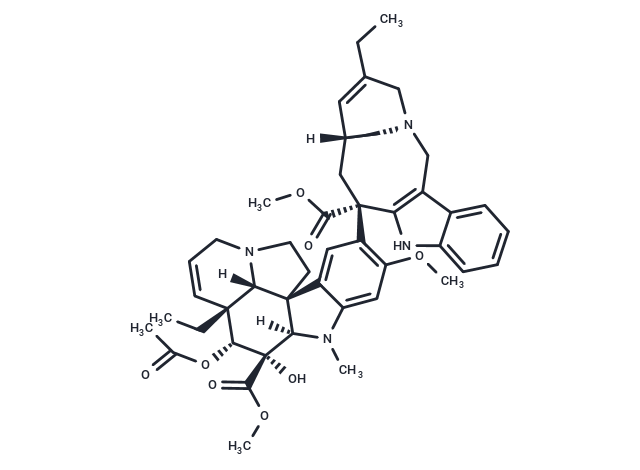
| Description | Vinorelbine (KW-2307 base) is a semisynthetic vinca alkaloid. Vinorelbine binds to tubulin and prevents the formation of the mitotic spindle, resulting in the arrest of tumor cell growth in metaphase. |
| Targets & IC50 | Proliferation (Hela cells):1.25 nM |
| In vitro | Vinorelbine (0.5-5 nM) inhibits cell proliferation by 50% (IC50) at 1.25 nM, with no cells in anaphase at 8 nM[1]. It time-dependently induces p53 and p21WAF1/CIP1 expression in androgen-dependent (AD) and -independent (AI) prostate cancer cell lines and stimulates reporter genes in a concentration-dependent manner[2]. |
| In vivo | After vinorelbine treatment, the initial neutropenic episode occurred after the first administration in four dogs, the second in one dog, and the sixth in another dog [3]. In tumor-bearing cats, vinorelbine is tolerated at a weekly interval with a maximum tolerated dose (MTD) of 11.5 mg/m2 [4]. |
| Synonyms | KW-2307 base |
| Kinase Assay | Reverse transcriptase assays: Reverse transcriptase assays are carried out in a reaction mixture (50 μL) containing 50 mM Tris-HCl (pH 7.5), 5 mM DTT, 100 mM potassium chloride, 0.01% Triton X-100 or NP40, 10 μg/ml (dT)15.(A)n as template primer and [3H] deoxythymidine triphospahate. The reaction mixture is incubated for 1 hr at 37 ℃ and stopped by the addition of 50 μg of yeast tRNA and 2 mL of 10% solution of trichloroacetic acid containing 1 mM sodium pyrophosphate. The samples are filtered on filters (0.45 μm), washed first with 5% TCA solution for 5 times and then with 2 ml of 70% ethanol. The filters are dried, scintillation fluid is added and the radioactivity counted in a counter. |
| Molecular Weight | 778.93 |
| Formula | C45H54N4O8 |
| Cas No. | 71486-22-1 |
| Smiles | C(C)[C@@]12[C@]3([C@@]4([C@]([C@](C(OC)=O)(O)[C@@H]1OC(C)=O)(N(C)C=5C4=CC(=C(OC)C5)[C@]6(C(OC)=O)C7=C(C=8C(N7)=CC=CC8)C[N@@]9C[C@](C6)(C=C(CC)C9)[H])[H])CCN3CC=C2)[H] |
| Relative Density. | 1.36 g/cm3 |
| Storage | Store at low temperature,Keep away from direct sunlight Powder: -20°C for 3 years | In solvent: -80°C for 1 year Shipping with blue ice/Shipping at ambient temperature. | ||||||||||||||||||||||||||||||||||||||||
| Solubility Information | H2O: 10 mg/mL (12.84 mM), Sonication is recommended. DMSO: 100 mg/mL (128.38 mM), Sonication is recommended. | ||||||||||||||||||||||||||||||||||||||||
Solution Preparation Table | |||||||||||||||||||||||||||||||||||||||||
H2O/DMSO
DMSO
Note : The dilution table applies only to solid products. For liquid products, please calculate the stock solution based on the stated concentration and/or density. | |||||||||||||||||||||||||||||||||||||||||
 For example, if the intended dosage is 10 mg/kg for animals weighing 20 g , with a dosing volume of 100 μL per animal, and a total of 10 animals are to be administered, using a formulation of
  10% DMSO+ 40% PEG300+ 5% Tween 80+ 45% Saline/PBS/ddH2O , the resulting working solution concentration would be 2 mg/mL.
Dissolve 2 mg of the compound in 100 μL DMSO to obtain a stock solution at a concentration of 20 mg/mL . If the required concentration exceeds the compound's known solubility, please contact us for technical support before proceeding.
1) Add 100 μL of the DMSO stock solution to 400 µL PEG300 and mix thoroughly until the solution becomes clear.
2) Add 50 µL Tween 80 and mix well until fully clarified.
3) Add 450 µL Saline,PBS or ddH2O and mix thoroughly until a homogeneous solution is obtained.
| Size | Quantity | Unit Price | Amount | Operation |
|---|
 Feedback
 Hello! How can I help you today?
Copyright © 2015-2026 TargetMol Chemicals Inc. All Rights Reserved.
