


Shopping Cart
Remove All Your shopping cart is currently empty


Synonyms:

| Pack Size | Price | USA Stock | Global Stock | Quantity |
|---|---|---|---|---|
| 2 mg | $35 | In Stock | In Stock | |
| 5 mg | $56 | In Stock | In Stock | |
| 10 mg | $98 | In Stock | In Stock | |
| 25 mg | $197 | In Stock | In Stock | |
| 50 mg | $355 | In Stock | In Stock | |
| 100 mg | $526 | In Stock | In Stock | |
| 1 mL x 10 mM (in DMSO) | $66 | In Stock | In Stock |
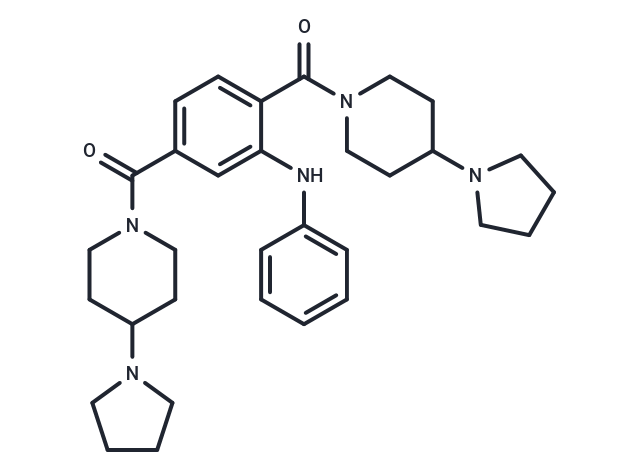
| Description | UNC1215, an effective and specific MBT (malignant brain tumor) antagonist, binds L3MBTL3 (IC50/Kd: 40/120 nM). The selectivity of UNC1215 for L3MBTL3 is 50-fold higher versus other members of the human MBT family. |
| Targets & IC50 | L3MBTL3:120 nM(Kd), L3MBTL3:40 nM |
| In vivo | UNC1215 binds to L3MBTL3 and competitively displaces peptides containing mono- or dimethyl-lysine.UNC1215 is approximately 75-fold more selective for L3MBTL3 than L3MBTL1.UNC1215 is non-cytotoxic and binds directly to L3MBTL3 through the Kme-binding pocket of the MBT domain.UNC1215 enables the cellular mobility of GFP-L3MBTL3 fusion proteins and the cellular mobility of the fusion protein. UNC1215 increased cell mobility and point mutations of the GFP-L3MBTL3 fusion protein, interfered with the Kme-binding function of the GFP-L3MBTL3 phenotypic mimic, and affected the localization of UNC1215.UNC1215 (30 μM) did not affect the tandem Tudor domain of UHRF1, the chromatin domain of CBX7, and the PHD domain of JARID1A. |
| Kinase Assay | AlphaScreen assay: Compound plates (1 μL at 10 or 30 mM highest concentration) are diluted in 1×assay buffer (20 mM Tris pH 8.0, 25 mM NaCl, 2 mM DTT and 0.05% Tween-20) over 2 steps using a Multimek robotic pipettor and 1 μL is spotted into the wells of 384-well assay Proxiplates. To these plates 9 μL of protein- peptide mix in 1× assay buffer is added by Multidrop and incubated for 30 min at room temperature. At this point 2 μL of streptavidin-conjugate donor and nickel-chelate acceptor beads (45 μg/mL in 1× assay buffer) are added, the plates are allowed to incubate for an additional 30 min in the dark at room temperature. After incubation the plates are read on EnVision mulilabel reader equipped with HTS alpha screen laser. The screens reported are performed up to 10 or 30 μM, and therefore it should be noted that those compounds referred to as inactive are indeed inactive only within the concentration range tested. PHF23 and JARID1A are GST tagged and consequently for these assays GST-acceptor beads are used. It should be noted that any positive binding curves for L3MBTL4 that are generated yielded curves with very shallow slopes, suggesting a nonspecific interaction. The data for the IC50 values is calculated from replicate runs in that the datapoints for each compound concentration are averaged and plotted using 4-parameters curve fitting. |
| Cell Research | CellTiter-Glo luminescent cell viability assay(Only for Reference) |
| Molecular Weight | 529.72 |
| Formula | C32H43N5O2 |
| Cas No. | 1415800-43-9 |
| Smiles | O=C(N1CCC(CC1)N1CCCC1)c1ccc(C(=O)N2CCC(CC2)N2CCCC2)c(Nc2ccccc2)c1 |
| Relative Density. | 1.224 g/cm3 (Predicted) |
| Storage | Powder: -20°C for 3 years | In solvent: -80°C for 1 year Shipping with blue ice/Shipping at ambient temperature. | |||||||||||||||||||||||||||||||||||
| Solubility Information | DMSO: 93 mg/mL (175.56 mM), Sonication is recommended. H2O: < 1 mg/mL (insoluble or slightly soluble) Ethanol: 93 mg/mL (175.56 mM), Sonication is recommended. | |||||||||||||||||||||||||||||||||||
| In Vivo Formulation | 10% DMSO+40% PEG300+5% Tween-80+45% Saline: 1 mg/mL (1.89 mM), Sonication is recommended. 10% DMSO+90% Saline: 10 mg/mL (18.88 mM), Suspension. Please add the solvents sequentially, clarifying the solution as much as possible before adding the next one. Dissolve by heating and/or sonication if necessary. Working solution is recommended to be prepared and used immediately. The formulation provided above is for reference purposes only. In vivo formulations may vary and should be modified based on specific experimental conditions. | |||||||||||||||||||||||||||||||||||
Solution Preparation Table | ||||||||||||||||||||||||||||||||||||
DMSO/Ethanol
Note : The dilution table applies only to solid products. For liquid products, please calculate the stock solution based on the stated concentration and/or density. | ||||||||||||||||||||||||||||||||||||
 For example, if the intended dosage is 10 mg/kg for animals weighing 20 g , with a dosing volume of 100 μL per animal, and a total of 10 animals are to be administered, using a formulation of
  10% DMSO+ 40% PEG300+ 5% Tween 80+ 45% Saline/PBS/ddH2O , the resulting working solution concentration would be 2 mg/mL.
Dissolve 2 mg of the compound in 100 μL DMSO to obtain a stock solution at a concentration of 20 mg/mL . If the required concentration exceeds the compound's known solubility, please contact us for technical support before proceeding.
1) Add 100 μL of the DMSO stock solution to 400 µL PEG300 and mix thoroughly until the solution becomes clear.
2) Add 50 µL Tween 80 and mix well until fully clarified.
3) Add 450 µL Saline,PBS or ddH2O and mix thoroughly until a homogeneous solution is obtained.
| Size | Quantity | Unit Price | Amount | Operation |
|---|
 Feedback
 Hello! How can I help you today?
Copyright © 2015-2026 TargetMol Chemicals Inc. All Rights Reserved.
