


Shopping Cart
Remove All Your shopping cart is currently empty

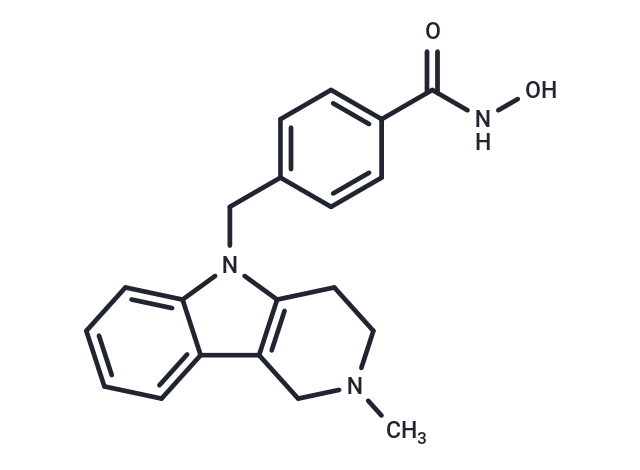
Synonyms: Tubastatin A BASE
| Pack Size | Price | USA Stock | Global Stock | Quantity |
|---|---|---|---|---|
| 10 mg | $41 | In Stock | In Stock | |
| 25 mg | $58 | In Stock | In Stock | |
| 50 mg | $72 | In Stock | In Stock | |
| 100 mg | $113 | In Stock | In Stock | |
| 200 mg | $172 | In Stock | In Stock | |
| 500 mg | $288 | - | In Stock | |
| 1 mL x 10 mM (in DMSO) | $35 | In Stock | In Stock |
| Description | Tubastatin A (Tubastatin A BASE) is an effective and specific HDAC6 inhibitor (IC50: 15 nM, in a cell-free assay). Its selectivity is 1000-fold against all the other isozymes except HDAC8. |
| Targets & IC50 | HDAC8:854 nM, HDAC1:16400 nM, HDAC6:15 nM |
| In vitro | Tubastatin A (5 μM) dose-dependently protected neuronal cells from homocysteine-induced death, which was completely avoided at 10 μM. Tubastatin A (10 μM) slightly induced histone acetylation. When applied to cholangiocarcinoma cell lines, Tubastatin A (10 μM) induced an increase in the level of acetylated α-tubulin and the restoration of primary cilia expression, which correlated with the down-regulation of Hedgehog and MAPK signaling pathways, and a decrease in the rate of cell proliferation (50% on average) and infiltration (40%). Tubastatin A significantly inhibited TNF-α and IL-6 when acting on lipopolysaccharide-stimulated human THP-1 macrophages (IC50: 272/712 nM). When acting on mouse Raw 264.7 macrophages, Tubastatin A dose-dependently inhibited nitric oxide secretion (IC50: 4.2 μM). |
| In vivo | Tubastatin A (5 μM) dose-dependently protected neuronal cells from homocysteine-induced death, which was completely avoided at 10 μM. Tubastatin A (10 μM) slightly induced histone acetylation. When applied to cholangiocarcinoma cell lines, Tubastatin A (10 μM) induced an increase in the level of acetylated α-tubulin and the restoration of primary cilia expression, which correlated with the down-regulation of Hedgehog and MAPK signaling pathways, and a decrease in the rate of cell proliferation (50% on average) and infiltration (40%). Tubastatin A significantly inhibited TNF-α and IL-6 when acting on lipopolysaccharide-stimulated human THP-1 macrophages (IC50: 272/712 nM). When acting on mouse Raw 264.7 macrophages, Tubastatin A dose-dependently inhibited nitric oxide secretion (IC50: 4.2 μM). |
| Synonyms | Tubastatin A BASE |
| Kinase Assay | HDAC enzymatic assays: Tubastatin A is dissolved and diluted in assay buffer (50 mM HEPES, pH 7.4, 100 mM KCl, 0.001% Tween-20, 0.05% BSA, and 20 μM tris(2-carboxyethyl)phosphine) to 6-fold of the final concentration. HDAC enzymes are diluted to 1.5-fold of the final concentration in assay buffer and pre-incubated with Tubastatin A for 10 minutes before the addition of the substrate. The amount of FTS (HDAC1, HDAC2, HDAC3, and HDAC6) or MAZ-1675 (HDAC4, HDAC5, HDAC7, HDAC8, and HDAC9) used for each enzyme is equal to the Michaelis constant (Km), as determined by a titration curve. FTS or MAZ-1675 is diluted in assay buffer to 6-fold the final concentration with 0.3 μM sequencing grade trypsin. The substrate/trypsin mix is added to the enzyme/compound mix and the plate is shaken for 60 seconds and then placed into a SpectraMax M5 microtiter plate reader. The enzymatic reaction is monitored for release of 7-amino-4-methoxy-coumarin over 30 minutes, after deacetylation of the lysine side chain in the peptide substrate, and the linear rate of the reaction is calculated. |
| Cell Research | Anchorage-independent growth is assessed by growing cells in soft agar. About 25,000 cells suspended in 0.4% agar in culture media are layered over a 1% agar layer in a 6-well plate. Media are added twice a week and pictures are taken after 21 days of incubation. The number and size of colonies are analyzed using the Gel-Pro software.(Only for Reference) |
| Molecular Weight | 335.4 |
| Formula | C20H21N3O2 |
| Cas No. | 1252003-15-8 |
| Smiles | CN1CCc2c(C1)c1ccccc1n2Cc1ccc(cc1)C(=O)NO |
| Relative Density. | 1.28 g/cm3 (Predicted) |
| Storage | Powder: -20°C for 3 years | In solvent: -80°C for 1 year Shipping with blue ice/Shipping at ambient temperature. | |||||||||||||||||||||||||||||||||||
| Solubility Information | DMSO: 35 mg/mL (104.35 mM), Sonication is recommended.  Ethanol: < 1 mg/mL (insoluble or slightly soluble) H2O: < 1 mg/mL (insoluble or slightly soluble) | |||||||||||||||||||||||||||||||||||
| In Vivo Formulation | 10% DMSO+40% PEG300+5% Tween 80+45% Saline: 1 mg/mL (2.98 mM), Sonication is recommended. Please add the solvents sequentially, clarifying the solution as much as possible before adding the next one. Dissolve by heating and/or sonication if necessary. Working solution is recommended to be prepared and used immediately. The formulation provided above is for reference purposes only. In vivo formulations may vary and should be modified based on specific experimental conditions. | |||||||||||||||||||||||||||||||||||
Solution Preparation Table | ||||||||||||||||||||||||||||||||||||
DMSO
Note : The dilution table applies only to solid products. For liquid products, please calculate the stock solution based on the stated concentration and/or density. | ||||||||||||||||||||||||||||||||||||
 For example, if the intended dosage is 10 mg/kg for animals weighing 20 g , with a dosing volume of 100 μL per animal, and a total of 10 animals are to be administered, using a formulation of
  10% DMSO+ 40% PEG300+ 5% Tween 80+ 45% Saline/PBS/ddH2O , the resulting working solution concentration would be 2 mg/mL.
Dissolve 2 mg of the compound in 100 μL DMSO to obtain a stock solution at a concentration of 20 mg/mL . If the required concentration exceeds the compound's known solubility, please contact us for technical support before proceeding.
1) Add 100 μL of the DMSO stock solution to 400 µL PEG300 and mix thoroughly until the solution becomes clear.
2) Add 50 µL Tween 80 and mix well until fully clarified.
3) Add 450 µL Saline,PBS or ddH2O and mix thoroughly until a homogeneous solution is obtained.
| Size | Quantity | Unit Price | Amount | Operation |
|---|
 Feedback
 Hello! How can I help you today?
Copyright © 2015-2026 TargetMol Chemicals Inc. All Rights Reserved.
