


Shopping Cart
Remove All Your shopping cart is currently empty


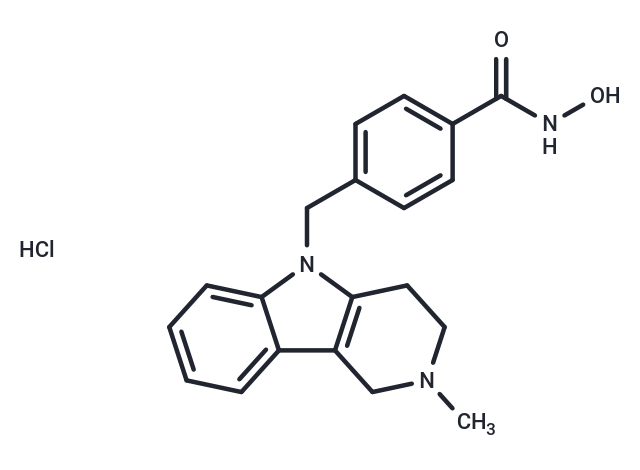
Synonyms: Tubastatin A HCl, TSA HCl
| Pack Size | Price | USA Stock | Global Stock | Quantity |
|---|---|---|---|---|
| 5 mg | $45 | In Stock | In Stock | |
| 10 mg | $53 | In Stock | In Stock | |
| 25 mg | $68 | In Stock | In Stock | |
| 50 mg | $77 | In Stock | In Stock | |
| 100 mg | $126 | In Stock | In Stock | |
| 200 mg | $207 | In Stock | In Stock | |
| 1 mL x 10 mM (in DMSO) | $50 | In Stock | In Stock |
| Description | Tubastatin A Hydrochloride (TSA HCl) is an effective and specific HDAC6 inhibitor (IC50: 15 nM). It has selectivity (>1000-fold) against all other isozymes except HDAC8 (>57-fold). |
| Targets & IC50 | HDAC8:854 nM, HDAC6:15 nM, HDAC1:16400 nM |
| In vitro | Tubastatin A exhibits high selectivity for all 11 HDAC isoforms, demonstrating over 1000-fold selectivity compared to all but HDAC8, for which it shows approximately 57-fold selectivity. In assays measuring neurodegeneration induced by homocysteic acid (HCA), Tubastatin A offers dose-dependent neuroprotection, achieving near-complete protection at concentrations of 10 μM, starting from 5 μM. Further, at a dosage of 100 ng/mL in vitro, it enhances the suppression of T cell proliferation by Foxp3+ T-regulatory cells (Tregs). In C2C12 cells, treatment with Tubastatin A disrupts myotube formation by causing early hyperacetylation of alpha-tubulin during the myogenic process, though it permits myotube elongation when hyperacetylation occurs within the myotubes. Additionally, recent studies have shown that Tubastatin A increases cell elasticity in mouse ovarian cancer cell lines, MOSE-E and MOSE-L, as determined by atomic force microscopy (AFM), without significantly altering the actin microfilament or microtubule networks. |
| In vivo | Daily administration of 0.5 mg/kg Tubastatin A inhibits HDAC6, enhancing Tregs suppressive activity in mouse models of inflammation and autoimmunity, including various forms of experimental colitis and fully major histocompatibility complex (MHC)-incompatible cardiac allograft rejection. [2] |
| Synonyms | Tubastatin A HCl, TSA HCl |
| Kinase Assay | Enzyme Inhibition Assays: Enzyme inhibition assays are performed by the Reaction Biology Corporation, Malvern, PA, using the Reaction Biology HDAC Spectrum platform. (www.reactionbiology.com) The HDAC1, 2, 4, 5, 6, 7, 8, 9, 10, and 11 assays use isolated recombinant human protein; HDAC3/NcoR2 complex is used for the HDAC3 assay. Substrate for HDAC1, 2, 3, 6, 10, and 11 assays is a fluorogenic peptide from p53 residues 379-382 (RHKKAc); substrate for HDAC8 is fluorogenic diacyl peptide based on residues 379-382 of p53 (RHKAcKAc). Acetyl-Lys (trifluoroacetyl)-AMC substrate is used for HDAC4, 5, 7, and 9 assays. Tubastatin A is dissolved in DMSO and tested in 10-dose IC50 mode with 3-fold serial dilution starting at 30 μM. Control Compound Trichostatin A (TSA) is tested in a 10-dose IC50 with 3-fold serial dilution starting at 5 μM. IC50 values are extracted by curve-fitting the dose/response slopes. |
| Cell Research | Primary cortical neuron cultures are obtained from the cerebral cortex of fetal Sprague-Dawley rats (embryonic day 17) as described previously. All experiments are initiated 24 hours after plating. Under these conditions, the cells are not susceptible to glutamate-mediated excitotoxicity. For cytotoxicity studies, cells are rinsed with warm PBS and then placed in minimum essential medium (Invitrogen) containing 5.5 g/L glucose, 10% fetal calf serum, 2 mM L-glutamine, and 100 μM cystine. Oxidative stress is induced by the addition of the glutamate analogue homocysteate (HCA; 5 mM) to the media. HCA is diluted from 100-fold concentrated solutions that are adjusted to pH 7.5. In combination with HCA, neurons are treated with Tubastatin A at the indicated concentrations. Viability is assessed after 24 hours by MTT assay (3-(4,5-dimethylthiazol-2-yl)-2,5-diphenyltetrazolium bromide) method.(Only for Reference) |
| Molecular Weight | 371.86 |
| Formula | C20H21N3O2·HCl |
| Cas No. | 1310693-92-5 |
| Smiles | Cl.CN1CCc2c(C1)c1ccccc1n2Cc1ccc(cc1)C(=O)NO |
| Relative Density. | no data available |
| Storage | Store at low temperature Powder: -20°C for 3 years | In solvent: -80°C for 1 year Shipping with blue ice/Shipping at ambient temperature. | |||||||||||||||||||||||||||||||||||
| Solubility Information | DMSO: 35.7 mg/mL (96 mM), Sonication is recommended.  H2O: 7.43 mg/mL (19.98 mM), Sonication and heating are recommended. | |||||||||||||||||||||||||||||||||||
| In Vivo Formulation | 10% DMSO+40% PEG300+5% Tween 80+45% Saline: 1 mg/mL (2.69 mM), Sonication is recommended. 10% DMSO+90% Saline: 3.57 mg/mL (9.6 mM), Solution. Please add the solvents sequentially, clarifying the solution as much as possible before adding the next one. Dissolve by heating and/or sonication if necessary. Working solution is recommended to be prepared and used immediately. The formulation provided above is for reference purposes only. In vivo formulations may vary and should be modified based on specific experimental conditions. | |||||||||||||||||||||||||||||||||||
Solution Preparation Table | ||||||||||||||||||||||||||||||||||||
H2O/DMSO
DMSO
Note : The dilution table applies only to solid products. For liquid products, please calculate the stock solution based on the stated concentration and/or density. | ||||||||||||||||||||||||||||||||||||
 For example, if the intended dosage is 10 mg/kg for animals weighing 20 g , with a dosing volume of 100 μL per animal, and a total of 10 animals are to be administered, using a formulation of
  10% DMSO+ 40% PEG300+ 5% Tween 80+ 45% Saline/PBS/ddH2O , the resulting working solution concentration would be 2 mg/mL.
Dissolve 2 mg of the compound in 100 μL DMSO to obtain a stock solution at a concentration of 20 mg/mL . If the required concentration exceeds the compound's known solubility, please contact us for technical support before proceeding.
1) Add 100 μL of the DMSO stock solution to 400 µL PEG300 and mix thoroughly until the solution becomes clear.
2) Add 50 µL Tween 80 and mix well until fully clarified.
3) Add 450 µL Saline,PBS or ddH2O and mix thoroughly until a homogeneous solution is obtained.
| Size | Quantity | Unit Price | Amount | Operation |
|---|
 Feedback
 Hello! How can I help you today?
Copyright © 2015-2026 TargetMol Chemicals Inc. All Rights Reserved.
