


Shopping Cart
Remove All Your shopping cart is currently empty

Synonyms: Zarnestra, R115777, IND 58359
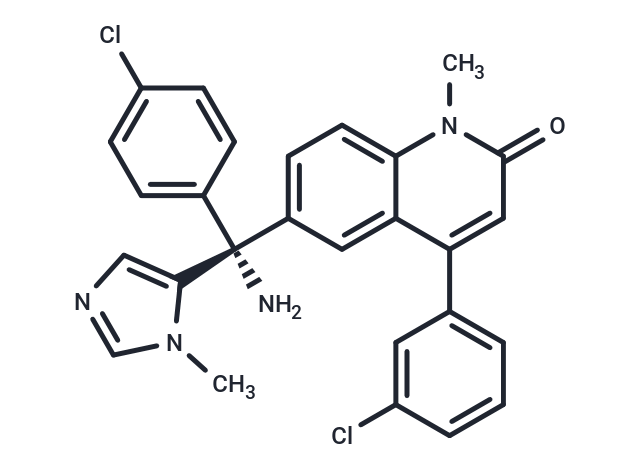
| Pack Size | Price | USA Stock | Global Stock | Quantity |
|---|---|---|---|---|
| 1 mg | $34 | In Stock | In Stock | |
| 2 mg | $48 | In Stock | In Stock | |
| 5 mg | $77 | In Stock | In Stock | |
| 10 mg | $133 | In Stock | In Stock | |
| 25 mg | $253 | In Stock | In Stock | |
| 50 mg | $458 | - | In Stock | |
| 1 mL x 10 mM (in DMSO) | $84 | In Stock | In Stock |
| Description | Tipifarnib (IND 58359) is a nonpeptidomimetic quinolinone with potential antineoplastic activity. Tipifarnib binds to and inhibits the enzyme farnesyl protein transferase, an enzyme involved in protein processing (farnesylation) for signal transduction. By inhibiting the farnesylation of proteins, this agent prevents the activation of Ras oncogenes, inhibits cell growth, induces apoptosis, and inhibits angiogenesis. |
| Targets & IC50 | FTase:0.6 nM |
| In vitro | Using Tipifarnib 5 μM for 72 hours, the percentage of apoptotic cells is significantly higher in drug-treated compared to DMSO-treated LGL T-cells. Using T-cells from healthy donors, Tipifarnib reduces the percentage of IFNγ-positive cells in a time-dependent manner. Tipifarnib reduces the amount of activated Ras in precipitates compared to DMSO. [2] Tipifarnib exerts selective in vitro toxicity against clonal MDS hematopoiesis at concentrations less than 10 nM the effect being more prominent in white cell progenitors. This action is not due to apoptosis induction as both normal and MDS progenitors displays equivalent DiOC3 and annexin V expression up to 72 hours after exposure to Tipifarnib. [3] Combining Tipifarnib with 10 nM 4-OH-tamoxifen in the presence of E2 reduces the IC50 8-fold from 400 to 50 nM. [4] Tipifarnib induces apoptosis in U937 cells. [5] In addition, Tipifarnib inhibits isolated human farnesyltransferase for a lamin B peptide and for the K-RasB peptide with IC50 of 0.86 nM and 7.9 nM, respectively. [6] |
| In vivo | Ki-67 is lower in the tumors treated with E2 withdrawal plus Tipifarnib compared with E2 withdrawal alone. The combination of tamoxifen and Tipifarnib results in significantly lower Ki-67 compared with either tamoxifen or Tipifarnib alone (mean of 5% versus 16.9% and 67.3%, respectively). [4] In contrast, no significant difference in apoptotic scores is seen between the treatment groups. Tipifarnib alone also reduces the CTI compared with control. The combination of tamoxifen and Tipifarnib or Tipifarnib coupled with E2 withdrawal is most effective at lowering the CTI (0.8 and 0.7, respectively), which may account for the decrease in tumor volume. [4] |
| Synonyms | Zarnestra, R115777, IND 58359 |
| Cell Research | MACS-selected CD34+ cells are seeded in Methocult 4435 'complete' 1% bovine serum albumin, 3 U/mL recombinant human (rh) erythropoietin, 0.1 mM 2-mercaptoethanol, 2 mM L-glutamine and the following cytokines: 50 ng/mL rh stem cell factor, 20 ng/mL rh GM-CSF, 20 ng/mL rh IL-3, 20 ng/mL rh IL-6 and 20 ng/mL h G-CSF. DMSO or Tipifarnib is added at the concentrations of 2.5, 10, 25 and 50 nM at day 1. All cultures are performed in duplicates and the numbers of colonies are scored after 14 days of incubation at 37 °C in a humidified incubator containing 5% CO2 |
| Molecular Weight | 489.4 |
| Formula | C27H22Cl2N4O |
| Cas No. | 192185-72-1 |
| Smiles | Cn1cncc1[C@@](N)(c1ccc(Cl)cc1)c1ccc2n(C)c(=O)cc(-c3cccc(Cl)c3)c2c1 |
| Relative Density. | 1.33g/cm3 |
| Storage | Powder: -20°C for 3 years | In solvent: -80°C for 1 year Shipping with blue ice/Shipping at ambient temperature. | |||||||||||||||||||||||||||||||||||
| Solubility Information | DMSO: 48.9 mg/mL (99.92 mM), Sonication is recommended. Ethanol: 9.8 mg/mL (20.02 mM), Sonication is recommended. | |||||||||||||||||||||||||||||||||||
| In Vivo Formulation | 10% DMSO+40% PEG300+5% Tween 80+45% Saline: 2 mg/mL (4.09 mM), Sonication is recommended. Please add the solvents sequentially, clarifying the solution as much as possible before adding the next one. Dissolve by heating and/or sonication if necessary. Working solution is recommended to be prepared and used immediately. The formulation provided above is for reference purposes only. In vivo formulations may vary and should be modified based on specific experimental conditions. | |||||||||||||||||||||||||||||||||||
Solution Preparation Table | ||||||||||||||||||||||||||||||||||||
Ethanol/DMSO
DMSO
Note : The dilution table applies only to solid products. For liquid products, please calculate the stock solution based on the stated concentration and/or density. | ||||||||||||||||||||||||||||||||||||
 For example, if the intended dosage is 10 mg/kg for animals weighing 20 g , with a dosing volume of 100 μL per animal, and a total of 10 animals are to be administered, using a formulation of
  10% DMSO+ 40% PEG300+ 5% Tween 80+ 45% Saline/PBS/ddH2O , the resulting working solution concentration would be 2 mg/mL.
Dissolve 2 mg of the compound in 100 μL DMSO to obtain a stock solution at a concentration of 20 mg/mL . If the required concentration exceeds the compound's known solubility, please contact us for technical support before proceeding.
1) Add 100 μL of the DMSO stock solution to 400 µL PEG300 and mix thoroughly until the solution becomes clear.
2) Add 50 µL Tween 80 and mix well until fully clarified.
3) Add 450 µL Saline,PBS or ddH2O and mix thoroughly until a homogeneous solution is obtained.
| Size | Quantity | Unit Price | Amount | Operation |
|---|
 Feedback
 Hello! How can I help you today?
Copyright © 2015-2026 TargetMol Chemicals Inc. All Rights Reserved.
