


Shopping Cart
Remove All Your shopping cart is currently empty

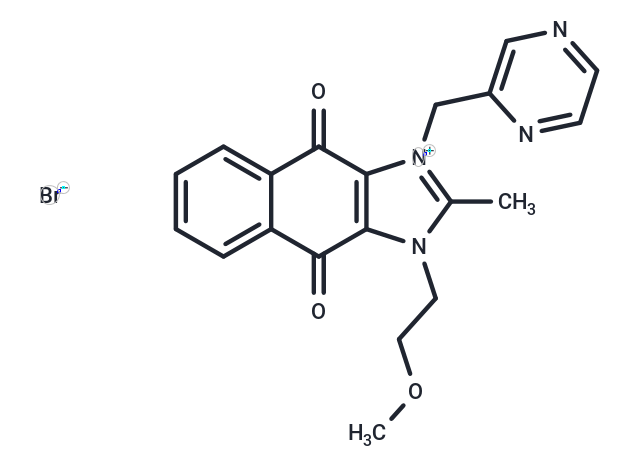
Synonyms: YM155
| Pack Size | Price | USA Stock | Global Stock | Quantity |
|---|---|---|---|---|
| 2 mg | $33 | In Stock | In Stock | |
| 5 mg | $50 | In Stock | In Stock | |
| 10 mg | $72 | In Stock | In Stock | |
| 25 mg | $151 | In Stock | In Stock | |
| 50 mg | $270 | In Stock | In Stock | |
| 100 mg | $441 | In Stock | In Stock | |
| 500 mg | $980 | - | In Stock | |
| 1 mL x 10 mM (in DMSO) | $50 | In Stock | In Stock |
| Description | Sepantronium bromide (YM-155) is a novel, highly selective Survivin inhibitor with good water solubility, exhibiting pro-apoptotic effects and antitumor activity. Sepantronium bromide is a Survivin inhibitor with an IC50 of 0.54 nM. |
| Targets & IC50 | Survivin:0.54 nM |
| In vitro | Methods: MM cell line RPMI8226 cells and NK cells were treated with gradient concentrations of Sepantronium bromide (0.1, 1, 2.5, 5, 10, 25, 50 nM) for 18 hours, followed by flow cytometric analysis for cytotoxicity. Results: For MM cells, 2.5 nM and 5 nM Sepantronium bromide exhibited strong cytotoxicity, while these concentrations were non-toxic to NK cells. [1] Methods: H9C2 rat cardiomyocytes were cultured with normal glucose (5.5 mM) (control group), high glucose (33 mM) (model group), and YAP1 overexpression ± HG ± Sepantronium bromide (1 μM) (intervention group) for 48 hours. Apoptosis rates were assessed via Hoechst 33342 staining. Results: High glucose (HG) induced increased cardiomyocyte apoptosis. YAP1 overexpression significantly reduced HG-induced apoptosis. Co-treatment with Sepantronium bromide partially inhibited the anti-apoptotic effect of YAP1 overexpression, leading to a rebound in apoptosis rates. [2] |
| In vivo | Methods: RAG2⁻/⁻γc⁻/⁻ mice received subcutaneous implantation of ceramic scaffolds loaded with human BMSCs, followed by loading with luciferase-labeled UM9 MM cells to establish a humanized bone marrow microenvironment. After successful establishment, continuous subcutaneous infusion of Sepantronium bromide (1 mg/kg/day for 10 days) via a subcutaneous osmotic pump, intraperitoneal injection of Daratumumab (8 mg/kg, twice weekly for 5 weeks), or combined administration of both drugs. Monitoring continued until day 63 post-treatment initiation. Results: The combination therapy group effectively controlled tumor growth throughout the entire experimental period (63 days), exhibiting significantly smaller tumor volumes compared to both the Sepantronium bromide monotherapy and Daratumumab monotherapy groups. [1] |
| Synonyms | YM155 |
| Kinase Assay | Promoter-luciferase reporter assay: A 2,767-bp sequence of human survivin gene promoter is isolated from human genomic DNA by PCR using Pyrobest polymerase and the following primers: 5 |
| Cell Research | Cells are seeded in 96-well plates at a density of 5-40 × 103. YM155 is dissolved in DMSO and added to cells for 48 hours. Then the cell count is determined by sulforhodamine B assay. (Only for Reference) |
| Molecular Weight | 443.26 |
| Formula | C20H19BrN4O3 |
| Cas No. | 781661-94-7 |
| Smiles | [Br-].COCCn1c(C)[n+](Cc2cnccn2)c2c1C(=O)c1ccccc1C2=O |
| Relative Density. | no data available |
| Storage | Store at low temperature Powder: -20°C for 3 years | In solvent: -80°C for 1 year Shipping with blue ice/Shipping at ambient temperature. | ||||||||||||||||||||||||||||||||||||||||
| Solubility Information | H2O: 82 mg/mL (184.99 mM), Sonication is recommended. Ethanol: 6 mg/mL (13.54 mM), Sonication is recommended. DMSO: 48 mg/mL (108.29 mM), Sonication is recommended.  | ||||||||||||||||||||||||||||||||||||||||
| In Vivo Formulation | 10% DMSO+40% PEG300+5% Tween 80+45% Saline: 1 mg/mL (2.26 mM), Sonication is recommended. 10% DMSO+90% Saline: 4.8 mg/mL (10.83 mM), Solution. Please add the solvents sequentially, clarifying the solution as much as possible before adding the next one. Dissolve by heating and/or sonication if necessary. Working solution is recommended to be prepared and used immediately. The formulation provided above is for reference purposes only. In vivo formulations may vary and should be modified based on specific experimental conditions. | ||||||||||||||||||||||||||||||||||||||||
Solution Preparation Table | |||||||||||||||||||||||||||||||||||||||||
Ethanol/DMSO/H2O
DMSO/H2O
Note : The dilution table applies only to solid products. For liquid products, please calculate the stock solution based on the stated concentration and/or density. | |||||||||||||||||||||||||||||||||||||||||
 For example, if the intended dosage is 10 mg/kg for animals weighing 20 g , with a dosing volume of 100 μL per animal, and a total of 10 animals are to be administered, using a formulation of
  10% DMSO+ 40% PEG300+ 5% Tween 80+ 45% Saline/PBS/ddH2O , the resulting working solution concentration would be 2 mg/mL.
Dissolve 2 mg of the compound in 100 μL DMSO to obtain a stock solution at a concentration of 20 mg/mL . If the required concentration exceeds the compound's known solubility, please contact us for technical support before proceeding.
1) Add 100 μL of the DMSO stock solution to 400 µL PEG300 and mix thoroughly until the solution becomes clear.
2) Add 50 µL Tween 80 and mix well until fully clarified.
3) Add 450 µL Saline,PBS or ddH2O and mix thoroughly until a homogeneous solution is obtained.
| Size | Quantity | Unit Price | Amount | Operation |
|---|
 Feedback
 Hello! How can I help you today?
Copyright © 2015-2026 TargetMol Chemicals Inc. All Rights Reserved.
