


Shopping Cart
Remove All Your shopping cart is currently empty


Synonyms: dl-Piperoxan hydrochloride, Benodaine hydrochloride
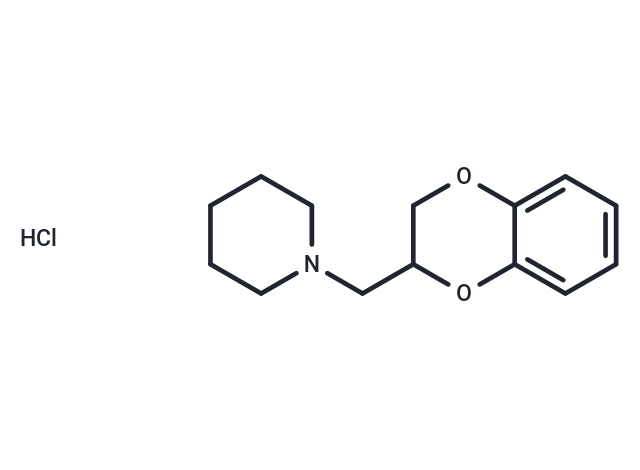

| Pack Size | Price | USA Stock | Global Stock | Quantity |
|---|---|---|---|---|
| 2 mg | $35 | In Stock | In Stock | |
| 5 mg | $59 | In Stock | In Stock | |
| 10 mg | $88 | In Stock | In Stock | |
| 25 mg | $137 | In Stock | In Stock | |
| 50 mg | $178 | In Stock | In Stock | |
| 100 mg | $223 | In Stock | In Stock | |
| 200 mg | $332 | In Stock | In Stock | |
| 1 mL x 10 mM (in DMSO) | $53 | In Stock | In Stock |
| Description | Piperoxan hydrochloride (Benodaine hydrochloride) is an α2 adrenoceptor antagonist. Piperoxan (benodaine) is a drug which was the very first antihistamine to be discovered. |
| In vitro | When superfusing the medulla with Piperoxan (50 μM; 5 min) and the pons with artificial cerebrospinal fluid (ACSF), three inactive preparations exhibit low-frequency rhythmic phrenic bursts (2-4 c/min), with the phrenic burst frequency in 12 active preparations significantly increasing to 163±12% of the previous average frequency in the final 3 minutes of Piperoxan application. In active preparations, the impact of norepinephrine (NA) applications (25 μM; 5 min) is assessed under conditions of superfusion with either ACSF (n=8) or α2 adrenoceptor antagonist Piperoxan (50 μM; PIP-ACSF; n=5). Both scenarios of NA application (NA-ACSF alone or combined with PIP-ACSF+NA) lead to a marked increase in phrenic burst frequency. Notably, inhibiting medullary α2 adrenoceptors with Piperoxan significantly enhances this effect: during NA application's fifth minute, phrenic burst frequency escalates to 171±11% with ACSF alone and 234±21% under PIP-ACSF, compared to the baseline control values. |
| Synonyms | dl-Piperoxan hydrochloride, Benodaine hydrochloride |
| Molecular Weight | 269.77 |
| Formula | C14H20ClNO2 |
| Cas No. | 135-87-5 |
| Smiles | Cl.C(C1COc2ccccc2O1)N1CCCCC1 |
| Relative Density. | 1.113g/cm3 |
| Storage | Powder: -20°C for 3 years | In solvent: -80°C for 1 year Shipping with blue ice/Shipping at ambient temperature. | |||||||||||||||||||||||||||||||||||
| Solubility Information | DMSO: 50 mg/mL (185.34 mM), Sonication is recommended.  | |||||||||||||||||||||||||||||||||||
Solution Preparation Table | ||||||||||||||||||||||||||||||||||||
DMSO
Note : The dilution table applies only to solid products. For liquid products, please calculate the stock solution based on the stated concentration and/or density. | ||||||||||||||||||||||||||||||||||||
 For example, if the intended dosage is 10 mg/kg for animals weighing 20 g , with a dosing volume of 100 μL per animal, and a total of 10 animals are to be administered, using a formulation of
  10% DMSO+ 40% PEG300+ 5% Tween 80+ 45% Saline/PBS/ddH2O , the resulting working solution concentration would be 2 mg/mL.
Dissolve 2 mg of the compound in 100 μL DMSO to obtain a stock solution at a concentration of 20 mg/mL . If the required concentration exceeds the compound's known solubility, please contact us for technical support before proceeding.
1) Add 100 μL of the DMSO stock solution to 400 µL PEG300 and mix thoroughly until the solution becomes clear.
2) Add 50 µL Tween 80 and mix well until fully clarified.
3) Add 450 µL Saline,PBS or ddH2O and mix thoroughly until a homogeneous solution is obtained.
| Size | Quantity | Unit Price | Amount | Operation |
|---|
 Feedback
 Hello! How can I help you today?
Copyright © 2015-2026 TargetMol Chemicals Inc. All Rights Reserved.
