


Shopping Cart
Remove All Your shopping cart is currently empty


Synonyms: Pefloxacinium mesylate dihydrate, 1589 RB
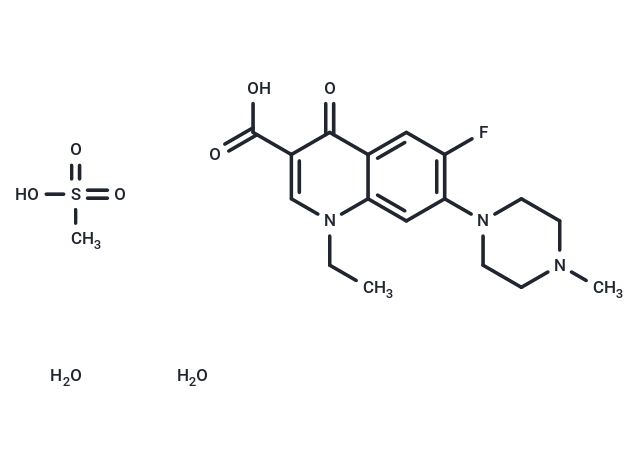
| Pack Size | Price | USA Stock | Global Stock | Quantity |
|---|---|---|---|---|
| 500 mg | $48 | In Stock | In Stock | |
| 1 g | $77 | In Stock | In Stock |
| Description | Pefloxacin Mesylate Dihydrate (1589 RB) , an antibacterial agent, restrains bacterial DNA replication by inhibiting DNA gyrase (topoisomerase). |
| In vivo | Pefloxacin exerts potent bactericidal activity through several pathways and exhibits biphasic action: its killing effect decreases with increased concentration following initial rapid bactericidal activity. In bacterial cells cultured with Pefloxacin, the SOS response (non-replicative DNA repair) is induced, which inhibits replication, disrupts spindle formation, and blocks cell division, ultimately proving detrimental to bacteria by interfering with their morphological and biochemical properties. Similar to other quinolone antibiotics, Pefloxacin primarily targets bacterial DNA gyrase (topoisomerase II), a critical bacterial enzyme. It effectively inhibits members of the Enterobacteriaceae family (E. coli, Citrobacter, Klebsiella, Proteus, Morganella) with minimum inhibitory concentrations (MICs) ranging from 0.03 to 8 mg/L; for Shigella, Salmonella, and Yersinia, the MIC50/MIC90 values are 0.06/0.06, 0.12/1.0, and 0.12/0.25 mg/L respectively. Pefloxacin has weaker activity against Legionella pneumophila (MIC50/MIC90: 1.0/1.0 mg/L), very weak activity against Vibrio cholerae and Eikenella corrodes, and Listeria monocytogenes, Helicobacter pylori, and Nocardia asteroides show resistance with MIC50 ≥8 mg/L. Mycobacterial sensitivity to Pefloxacin varies from moderate to none, and most anaerobes are resistant. Rickettsiae and Chlamydiae are sensitive at treatable concentrations, while Mycoplasma and Ureaplasma show poor sensitivity (MIC50/MIC90: 2/8 mg/L). Pefloxacin's MICs for Gram-negative aerobes such as Alcaligenes, Pseudomonas aeruginosa, Acinetobacter, and Klebsiella range from 1 to 4 mg/L. For Gram-positive cocci, including coagulase-negative staphylococci and Staphylococcus aureus, even those resistant to other antibiotics, Pefloxacin maintains some sensitivity with MICs spanning 0.125 to 0.5 mg/L. |
| Synonyms | Pefloxacinium mesylate dihydrate, 1589 RB |
| Molecular Weight | 465.49 |
| Formula | C17H20FN3O3·CH4O3S·2H2O |
| Cas No. | 149676-40-4 |
| Smiles | CS(=O)(=O)O.CCn1cc(c(=O)c2cc(F)c(N3CCN(CC3)C)cc12)C(=O)O.O.O |
| Relative Density. | no data available |
| Storage | Powder: -20°C for 3 years | In solvent: -80°C for 1 year Shipping with blue ice/Shipping at ambient temperature. | ||||||||||||||||||||||||||||||||||||||||
| Solubility Information | DMSO: 1 mg/mL (2.15 mM), Sonication is recommended.  Ethanol: < 1 mg/mL (insoluble or slightly soluble) H2O: 95 mg/mL (204.09 mM), Sonication is recommended. | ||||||||||||||||||||||||||||||||||||||||
Solution Preparation Table | |||||||||||||||||||||||||||||||||||||||||
DMSO/H2O
H2O
Note : The dilution table applies only to solid products. For liquid products, please calculate the stock solution based on the stated concentration and/or density. | |||||||||||||||||||||||||||||||||||||||||
 For example, if the intended dosage is 10 mg/kg for animals weighing 20 g , with a dosing volume of 100 μL per animal, and a total of 10 animals are to be administered, using a formulation of
  10% DMSO+ 40% PEG300+ 5% Tween 80+ 45% Saline/PBS/ddH2O , the resulting working solution concentration would be 2 mg/mL.
Dissolve 2 mg of the compound in 100 μL DMSO to obtain a stock solution at a concentration of 20 mg/mL . If the required concentration exceeds the compound's known solubility, please contact us for technical support before proceeding.
1) Add 100 μL of the DMSO stock solution to 400 µL PEG300 and mix thoroughly until the solution becomes clear.
2) Add 50 µL Tween 80 and mix well until fully clarified.
3) Add 450 µL Saline,PBS or ddH2O and mix thoroughly until a homogeneous solution is obtained.
| Size | Quantity | Unit Price | Amount | Operation |
|---|
 Feedback
 Hello! How can I help you today?
Copyright © 2015-2026 TargetMol Chemicals Inc. All Rights Reserved.
