


Shopping Cart
Remove All Your shopping cart is currently empty

Synonyms: α-Hypophamine, Oxytocin (Syntocinon), Oxytocic hormone
| Pack Size | Price | USA Stock | Global Stock | Quantity |
|---|---|---|---|---|
| 5 mg | $40 | - | In Stock | |
| 10 mg | $57 | - | In Stock | |
| 25 mg | $94 | - | In Stock | |
| 50 mg | $138 | - | In Stock | |
| 100 mg | $209 | In Stock | - | |
| 200 mg | $325 | Inquiry | Inquiry | |
| 500 mg | $626 | Inquiry | Inquiry | |
| 1 g | $997 | Inquiry | Inquiry |

| Description | Oxytocin (Syntocinon) is a mammalian neuropituitary hormone, a pleiotropic hypothalamic peptide and ligand for the oxytocin receptor, which contributes to labor, lactation, and pro-social behavior. Oxytocin has the ability to stimulate mammary secretion of breast milk, promote contraction of uterine smooth muscle during labor, and facilitate mothering. |
| Targets & IC50 | CHO cells:24.5 nM (EC50), CHO-K1 cells:2.3 nM (EC50), COS-1 cells:15 nM (EC50) |
| In vitro | METHODS: KGN, MA-10 and C18-4 cells were treated with Tris(2,4-di-tert-butylphenyl)phosphate (0.1-100 µM) for 48 h. Cell counts were measured by Hoechst 33342 stained. RESULTS: Tris(2,4-di-tert-butylphenyl)phosphate was not cytotoxic to any of the 3 cell lines. [1] |
| In vivo | METHODS: To assay acute anti-inflammatory activity in vivo, Tris(2,4-di-tert-butylphenyl)phosphate (50-70 mg/kg, 0.1% sodium carboxymethyl cellulose in 1M phosphate buffer pH 7.2) was administered to a carrageenan-induced rat foot-plantar edema model. RESULTS: Tris(2,4-di-tert-butylphenyl)phosphate at the doses of 50 mg/kg and 70 mg/kg showed significant anti-inflammatory activity in the carrageenan-induced foot-plantar edema model. Tris(2,4-di-tert-butylphenyl)phosphate significantly reduced the volume of raw paw edema. [2] |
| Synonyms | α-Hypophamine, Oxytocin (Syntocinon), Oxytocic hormone |
| Molecular Weight | 1007.19 |
| Formula | C43H66N12O12S2 |
| Cas No. | 50-56-6 |
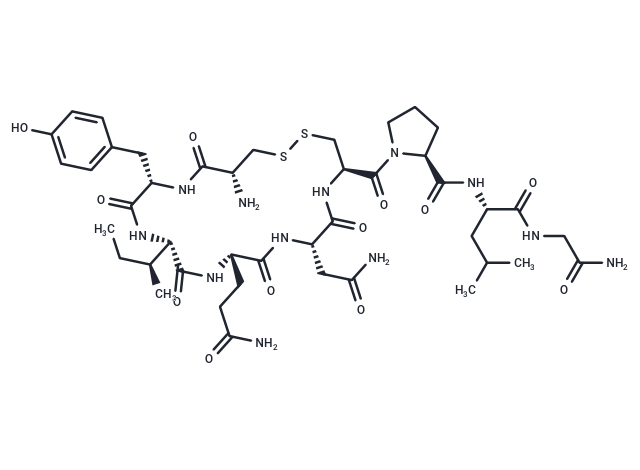
| Smiles | CC[C@H](C)[C@@H]1NC(=O)[C@H](Cc2ccc(O)cc2)NC(=O)[C@@H](N)CSSC[C@H](NC(=O)[C@H](CC(N)=O)NC(=O)[C@H](CCC(N)=O)NC1=O)C(=O)N1CCC[C@H]1C(=O)N[C@@H](CC(C)C)C(=O)NCC(N)=O |
| Relative Density. | 1.27 g/cm3 |
| Storage | Keep away from moisture,Keep away from direct sunlight,Store at low temperature Powder: -20°C for 3 years | In solvent: -80°C for 1 year Shipping with blue ice/Shipping at ambient temperature. | ||||||||||||||||||||||||||||||
| Solubility Information | DMSO: 100 mg/mL (99.29 mM), Sonication is recommended.  Ethanol: < 1 mg/mL (insoluble or slightly soluble) | ||||||||||||||||||||||||||||||
Solution Preparation Table | |||||||||||||||||||||||||||||||
DMSO
Note : The dilution table applies only to solid products. For liquid products, please calculate the stock solution based on the stated concentration and/or density. | |||||||||||||||||||||||||||||||
 For example, if the intended dosage is 10 mg/kg for animals weighing 20 g , with a dosing volume of 100 μL per animal, and a total of 10 animals are to be administered, using a formulation of
  10% DMSO+ 40% PEG300+ 5% Tween 80+ 45% Saline/PBS/ddH2O , the resulting working solution concentration would be 2 mg/mL.
Dissolve 2 mg of the compound in 100 μL DMSO to obtain a stock solution at a concentration of 20 mg/mL . If the required concentration exceeds the compound's known solubility, please contact us for technical support before proceeding.
1) Add 100 μL of the DMSO stock solution to 400 µL PEG300 and mix thoroughly until the solution becomes clear.
2) Add 50 µL Tween 80 and mix well until fully clarified.
3) Add 450 µL Saline,PBS or ddH2O and mix thoroughly until a homogeneous solution is obtained.
| Size | Quantity | Unit Price | Amount | Operation |
|---|
 Feedback
 Hello! How can I help you today?
Copyright © 2015-2026 TargetMol Chemicals Inc. All Rights Reserved.
