


Shopping Cart
Remove All Your shopping cart is currently empty

Synonyms: Vanillyl-N-nonylamide, Pseudocapsaicin, Pelargonic acid vanillylamide, Nonanoic acid vanillylamide
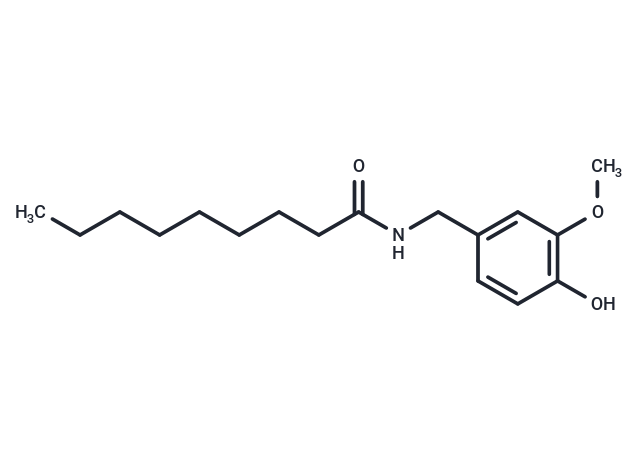
| Pack Size | Price | USA Stock | Global Stock | Quantity |
|---|---|---|---|---|
| 500 mg | $37 | In Stock | In Stock | |
| 1 g | $50 | - | In Stock | |
| 5 g | $97 | - | In Stock | |
| 10 g | $138 | - | In Stock |
| Description | Nonivamide (Nonanoic acid vanillylamide) is found in herbs and spices. Nonivamide is an alkaloid from Capsicum species Nonivamide is a flavoring ingredient. Nonivamide is an organic compound and a capsaicinoid. It is an amide of pelargonic acid and vanillylamine. It is present in chili peppers, but is commonly manufactured synthetically. It is more heat-stable than capsaicin. |
| In vitro | Nonivamide, a synthetic derivative of natural capsaicin, demonstrates effective antifouling activity. Capsaicin exhibits 4d-EC50 values of 5.5±0.5 mg/L, 23±2 mg/L, 6.9±0.2 mg/L, and 15.6±0.4 mg/L in static toxicity tests with Pseudomonas putida, Lake Erie bacteria, Vibrio natriegens, and Vibrio parahaemolyticus, respectively. When treated with 1 mg/L of Nonivamide for 4 days, a significant growth inhibitory effect (p<0.01) is observed, with an EC50 value (4d-EC50) of 5.1 mg/L [1]. Nonivamide triggers calcium release from the ER and alters the transcription of growth arrest- and DNA damage-inducible transcripts (GADD153, GADD45α, GRP78/BiP, ATF3, CCND1, and CCNG2) similarly to ER stress-inducing agents. ER calcium flux is assessed by pretreating cells with 2.5 μM thapsigargin for 5 min, followed by 2.5 μM Nonivamide. TRPV1-overexpressing cells treated with 2.5 μM Nonivamide show marked increases in cytosolic calcium due to ER calcium release, and treatment with 1 μM Nonivamide results in approximately 50% loss in cell viability after 24 hours. BEAS-2B cells treated with 100 and 200 μM Nonivamide exhibit a shift in EIF2α-P levels and increased GADD153 mRNA and protein expression [2]. Nonivamide also reduces lipid accumulation comparably to CAP, with significant reductions of 5.34±1.03% (P<0.05) at 0.01 μM and 10.4±2.47% (P<0.001) at 1 μM [3]. |
| Synonyms | Vanillyl-N-nonylamide, Pseudocapsaicin, Pelargonic acid vanillylamide, Nonanoic acid vanillylamide |
| Cell Research | Nonivamide is dissolved in ethanol to 1,000× stock solutions freshly each time and final ethanol concentration during the assays never exceeded 0.2% (v/v)[3]. In the MTT assay, the reduction of yellow tetrazolium salt MTT to a purple formazan by mitochondrial and ER enzymes is used as a measure for cell viability. Cells are seeded in 96‐well plates and treated with 1?nM-10?μM CAP or Nonivamide with or without addition of 25-100?μM BCH or the corresponding ethanol concentration (0.1-0.2% (v/v), solvent control) for 12 days after initiation of differentiation. Cell culture media is exchanged every second day. On Day 12, 100?μL of the MTT working reagent (0.83?mg/mL MTT diluted in PBS/serum-free media (1:5)), is added to each well, and cells are incubated at 37°C for approximately 15?min. The MTT working solution is removed and the purple formazan formed during incubation is dissolved in 150?μL DMSO per well. Absorbance is measured at 550?nm with 690?nm as reference wavelength using multiwell plate reader. The number of metabolically active cells is calculated relative to untreated control cells or the corresponding solvent control (100%)[3]. |
| Molecular Weight | 293.40 |
| Formula | C17H27NO3 |
| Cas No. | 2444-46-4 |
| Smiles | CCCCCCCCC(=O)NCC1=CC(OC)=C(O)C=C1 |
| Relative Density. | 1.037 g/cm3 |
| Storage | Powder: -20°C for 3 years | In solvent: -80°C for 1 year Shipping with blue ice/Shipping at ambient temperature. | |||||||||||||||||||||||||||||||||||
| Solubility Information | DMSO: 255 mg/mL (869.12 mM), Sonication is recommended.  | |||||||||||||||||||||||||||||||||||
| In Vivo Formulation | 10% DMSO+40% PEG300+5% Tween 80+45% Saline: 2 mg/mL (6.82 mM), Sonication is recommended. Please add the solvents sequentially, clarifying the solution as much as possible before adding the next one. Dissolve by heating and/or sonication if necessary. Working solution is recommended to be prepared and used immediately. The formulation provided above is for reference purposes only. In vivo formulations may vary and should be modified based on specific experimental conditions. | |||||||||||||||||||||||||||||||||||
Solution Preparation Table | ||||||||||||||||||||||||||||||||||||
DMSO
Note : The dilution table applies only to solid products. For liquid products, please calculate the stock solution based on the stated concentration and/or density. | ||||||||||||||||||||||||||||||||||||
 For example, if the intended dosage is 10 mg/kg for animals weighing 20 g , with a dosing volume of 100 μL per animal, and a total of 10 animals are to be administered, using a formulation of
  10% DMSO+ 40% PEG300+ 5% Tween 80+ 45% Saline/PBS/ddH2O , the resulting working solution concentration would be 2 mg/mL.
Dissolve 2 mg of the compound in 100 μL DMSO to obtain a stock solution at a concentration of 20 mg/mL . If the required concentration exceeds the compound's known solubility, please contact us for technical support before proceeding.
1) Add 100 μL of the DMSO stock solution to 400 µL PEG300 and mix thoroughly until the solution becomes clear.
2) Add 50 µL Tween 80 and mix well until fully clarified.
3) Add 450 µL Saline,PBS or ddH2O and mix thoroughly until a homogeneous solution is obtained.
| Size | Quantity | Unit Price | Amount | Operation |
|---|
 Feedback
 Hello! How can I help you today?
Copyright © 2015-2026 TargetMol Chemicals Inc. All Rights Reserved.
