


Shopping Cart
Remove All Your shopping cart is currently empty

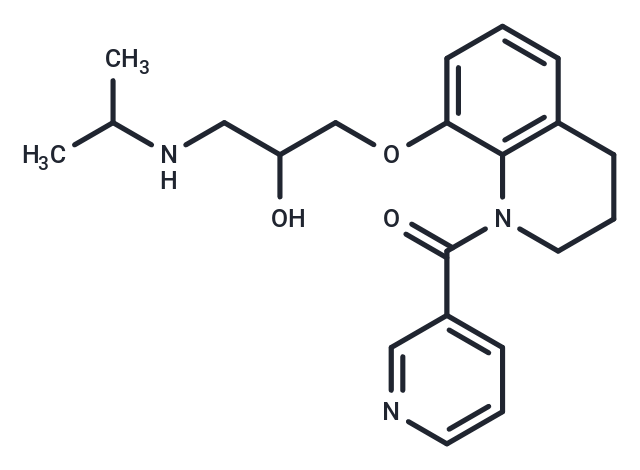
Synonyms: RU-42924

| Pack Size | Price | USA Stock | Global Stock | Quantity |
|---|---|---|---|---|
| 1 mg | $143 | In Stock | In Stock | |
| 5 mg | $363 | In Stock | In Stock | |
| 10 mg | $538 | In Stock | In Stock | |
| 25 mg | $855 | In Stock | In Stock | |
| 50 mg | $1,150 | In Stock | In Stock | |
| 100 mg | $1,550 | - | In Stock | |
| 1 mL x 10 mM (in DMSO) | $369 | In Stock | In Stock |
| Description | Nicainoprol (RU-42924) is a fast-sodium-channel blocking drug. Nicainoprol is a potent antiarrhythmic agent. |
| In vitro | The antiarrhythmic agent Nicainoprol is a fast-sodium-channel blocking drug that also protects isolated rat hearts against reperfusion arrhythmias. However, it is without beneficial effects on cardiac hemodynamics and biochemical parameters, in contrast to the ACE inhibitor[1]. |
| In vivo | The study investigates the efficacy of Nicainoprol, a novel antiarrhythmic agent, in mitigating coronary occlusion and reperfusion arrhythmias in both isolated working rat hearts and anesthetized rats. In isolated hearts, Nicainoprol demonstrates a concentration-dependent protective effect against reperfusion arrhythmia without altering cardiodynamics, except for a decrease in heart rate at the highest tested concentration (100 μM). Key cardiac biochemical markers (lactate dehydrogenase and creatine kinase) and metabolite levels (glycogen, lactate, ATP, and creatine phosphate) remain unchanged by Nicainoprol treatment. In anesthetized rats, Nicainoprol administration (5 and 10 mg/kg, i.v.) significantly diminishes the incidence of premature ventricular complexes and ventricular tachycardia during the early post-occlusion phase (0-30 minutes), and entirely prevents ventricular fibrillation. During reperfusion, Nicainoprol-treated rats show a marked reduction in premature ventricular complexes compared to control rats, alongside reductions in heart rate, blood pressure, and myocardial oxygen consumption. Furthermore, Nicainoprol significantly decreases the ratio of infarct mass to ventricular mass by 20% and 28% at doses of 5 mg/kg and 10 mg/kg, respectively, indicating potential benefits in preventing and treating arrhythmias associated with acute myocardial infarction. |
| Synonyms | RU-42924 |
| Molecular Weight | 369.46 |
| Formula | C21H27N3O3 |
| Cas No. | 76252-06-7 |
| Smiles | CC(C)NCC(O)COc1cccc2CCCN(C(=O)c3cccnc3)c12 |
| Relative Density. | 1.187g/cm3 |
| Storage | Powder: -20°C for 3 years | In solvent: -80°C for 1 year Shipping with blue ice/Shipping at ambient temperature. | |||||||||||||||||||||||||||||||||||
| Solubility Information | DMSO: 55 mg/mL (148.87 mM), Sonication is recommended.  | |||||||||||||||||||||||||||||||||||
Solution Preparation Table | ||||||||||||||||||||||||||||||||||||
DMSO
Note : The dilution table applies only to solid products. For liquid products, please calculate the stock solution based on the stated concentration and/or density. | ||||||||||||||||||||||||||||||||||||
 For example, if the intended dosage is 10 mg/kg for animals weighing 20 g , with a dosing volume of 100 μL per animal, and a total of 10 animals are to be administered, using a formulation of
  10% DMSO+ 40% PEG300+ 5% Tween 80+ 45% Saline/PBS/ddH2O , the resulting working solution concentration would be 2 mg/mL.
Dissolve 2 mg of the compound in 100 μL DMSO to obtain a stock solution at a concentration of 20 mg/mL . If the required concentration exceeds the compound's known solubility, please contact us for technical support before proceeding.
1) Add 100 μL of the DMSO stock solution to 400 µL PEG300 and mix thoroughly until the solution becomes clear.
2) Add 50 µL Tween 80 and mix well until fully clarified.
3) Add 450 µL Saline,PBS or ddH2O and mix thoroughly until a homogeneous solution is obtained.
| Size | Quantity | Unit Price | Amount | Operation |
|---|
 Feedback
 Hello! How can I help you today?
Copyright © 2015-2026 TargetMol Chemicals Inc. All Rights Reserved.
