Shopping Cart
Remove All
  • TargetMol
    Your shopping cart is currently empty

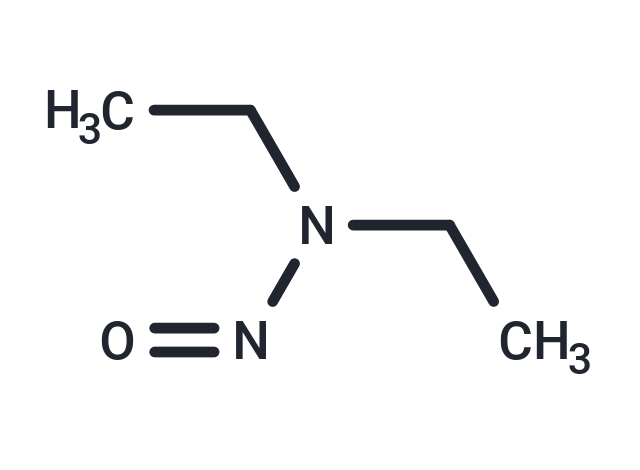
N-Nitrosodiethylamine

Copy Product Info
😃Good
Catalog No. T35455Cas No. 55-18-5
Alias NDEA, Diethylnitrosamine

N-Nitrosodiethylamine (NDEA) is a carcinogenic dialkylnitrosamine commonly found in water, tobacco smoke, cheddar cheese, pickled foods, fried foods, and various alcoholic beverages; it is associated with alterations in nucleases involved in DNA repair and replication, targets organs such as the nasal cavity, trachea, lungs, esophagus, and liver to induce tumors in animals, and is most commonly used to induce liver cancer models.

N-Nitrosodiethylamine

N-Nitrosodiethylamine

Copy Product Info
😃Good
Purity: 99.99%
Catalog No. T35455Alias NDEA, DiethylnitrosamineCas No. 55-18-5
N-Nitrosodiethylamine (NDEA) is a carcinogenic dialkylnitrosamine commonly found in water, tobacco smoke, cheddar cheese, pickled foods, fried foods, and various alcoholic beverages; it is associated with alterations in nucleases involved in DNA repair and replication, targets organs such as the nasal cavity, trachea, lungs, esophagus, and liver to induce tumors in animals, and is most commonly used to induce liver cancer models.
Pack SizePriceUSA WarehouseGlobal WarehouseQuantity
500 mg$41In StockIn Stock
1 g$56In StockIn Stock
5 g$129-In Stock
1 mL x 10 mM (in DMSO)$44-In Stock
Add to Cart
Add to Quotation
In Stock Estimated shipping dateUSA Warehouse[1-2 days] Global Warehouse[5-7 days]
All TargetMol products are for research purposes only and cannot be used for human consumption. We do not provide products or services to individuals. Please comply with the intended use and do not use TargetMol products for any other purpose.
Questions
TargetMol
View More

Batch Information

Select Batch
Purity:99.99%
Appearance:Liquid
Color:Transparent to Yellow
Contact us for more batch information

Resource Download

Product Introduction

Bioactivity
Description
N-Nitrosodiethylamine (NDEA) is a carcinogenic dialkylnitrosamine commonly found in water, tobacco smoke, cheddar cheese, pickled foods, fried foods, and various alcoholic beverages; it is associated with alterations in nucleases involved in DNA repair and replication, targets organs such as the nasal cavity, trachea, lungs, esophagus, and liver to induce tumors in animals, and is most commonly used to induce liver cancer models.
In vivo
Mice with N-Nitrosodiethylamine (25mg/kg) intraperitonially resulted in fatty liver disease leading to progress of cancer disease.
Disease Modeling Protocol
Liver tumor model
  • Modeling Mechanism:

    N-Nitrosodiethylamine (DEN), a classic N-nitroso compounds that are liver carcinogens, is activated by hepatic cytochrome P450 enzymes after entering the rat body, producing an alkylating intermediate. This intermediate can bind to hepatocyte DNA to form adducts, leading to base damage and gene mutations. It also triggers oxidative stress (accumulation of reactive oxygen species, ROS), activates the nuclear factor-κB (NF-κB) signaling pathway, promotes the release of pro-inflammatory factors (TNF-α, IL-6), and induces hepatocyte inflammation, necrosis, and abnormal proliferation, gradually progressing to liver fibrosis, hepatocellular adenoma, and ultimately hepatocellular carcinoma (HCC), mimicking the complete pathological process of chemically induced liver tumors in humans.

  • Related Products:

    N-Nitrosodiethylamine (T35455)

  • Modeling Method:

    Experimental Subject:

    Rats, Male, Body weight 200–250 g, Age 3–4 months

    Dosage and Administration Route:

    ① Core modelling: N-Nitrosodiethylamine, 200 mg/kg, dissolved in sterile saline, administered intraperitoneally;
    ② Promoter combination (optional): Post-modelling, combine with phenobarbital (50 mg/kg/day, mixed into feed) to accelerate liver tumour progression;
    ③ Control treatment: Control group administered 10% Tween 80 solution (oral) or equal volume saline (intraperitoneal injection), with all other housing and treatment conditions identical;
    ④ Intervention validation group (optional): Administer hepatoprotective agent (e.g., 5-benzylidene-2-thioethanamide) concurrently with modelling , 50 mg/kg, Oral administration, Continuous for 3–6 weeks

    Dosing Frequency and Duration Model:

    Single dose

  • Validation:

    1. Biochemical Indicators: - Liver Function: 3-6 weeks after modeling, serum alanine aminotransferase (ALT), aspartate aminotransferase (AST), and alkaline phosphatase (ALP) were significantly elevated (p<0.05), indicating hepatocellular damage; - Inflammatory Factors: Serum TNF-α and IL-6 levels were significantly upregulated (p<0.05), reflecting liver inflammation activation; 2. Pathological Indicators: - Liver Injury/Precancerous Lesions (3-6 weeks): HE staining showed destruction of liver lobular structure, sinusoidal dilation, periportal fibrosis, and inflammatory cell infiltration; hepatocellular adenoma and peliosis hepatis were visible at 6 weeks; - Liver Tumors (6-12 months): Typical pathological features of hepatocellular carcinoma were formed, with tumor tissue arranged in nests or cords and significant cellular atypia; 3. Immunohistochemical Indicators: - Proliferation Markers: Ki-67 (a cell proliferation marker) was strongly positively expressed in hepatocytes (dark brown staining); Hepatocyte-specific markers: Strong positive expression of HSA (hepatocyte-specific antigen) in the cytoplasm (golden yellow granules) indicates abnormal hepatocyte proliferation.

*Precautions: After being kept alive for 14 days, i.e., on day 15, the mice were sacrificed to measure serum biochemical (liver and kidney) parameters according to standard methods.

*References:Akree LS,et,al. In silico and in vivo hepatoprotective activity of the synthesized 5-benzylidene-2-thiohydantoin against diethylnitrosamine-induced liver injury in a rat model. Sci Rep. 2023 Mar 22;13(1):4681.

SynonymsNDEA, Diethylnitrosamine
Chemical Properties
Molecular Weight102.14
FormulaC4H10N2O
Cas No.55-18-5
SmilesCCN(CC)N=O
Storage & Solubility Information
Storagekeep away from direct sunlight,keep away from moisture | Powder: -20°C for 3 years | In solvent: -80°C for 1 year | Shipping with blue ice/Shipping at ambient temperature.
Solubility Information
H2O: 98 mg/mL (959.47 mM), Sonication is recommended.
DMSO: 50 mg/mL (489.52 mM), Sonication is recommended.

In Vivo Formulation
10% DMSO+40% PEG300+5% Tween 80+45% Saline: 2 mg/mL (19.58 mM), Sonication is recommended.
Please add the solvents sequentially, clarifying the solution as much as possible before adding the next one. Dissolve by heating and/or sonication if necessary. Working solution is recommended to be prepared and used immediately. The formulation provided above is for reference purposes only. In vivo formulations may vary and should be modified based on specific experimental conditions.
Solution Preparation Table
DMSO/H2O
1mg5mg10mg50mg
1 mM9.7905 mL48.9524 mL97.9048 mL489.5242 mL
5 mM1.9581 mL9.7905 mL19.5810 mL97.9048 mL
10 mM0.9790 mL4.8952 mL9.7905 mL48.9524 mL
20 mM0.4895 mL2.4476 mL4.8952 mL24.4762 mL
50 mM0.1958 mL0.9790 mL1.9581 mL9.7905 mL
100 mM0.0979 mL0.4895 mL0.9790 mL4.8952 mL

Calculator

  • Molarity Calculator
  • Dilution Calculator
  • Reconstitution Calculator
  • Molecular Weight Calculator

In Vivo Formulation Calculator (Clear solution)

Please enter your animal experiment information in the following box and click Calculate to obtain the stock solution preparation method and in vivo formula preparation method:
TargetMol | Animal experiments For example, if the intended dosage is 10 mg/kg for animals weighing 20 g , with a dosing volume of 100 μL per animal, TargetMol | Animal experiments and a total of 10 animals are to be administered, using a formulation of TargetMol | reagent 10% DMSO+ 40% PEG300+ 5% Tween 80+ 45% Saline/PBS/ddH2O , the resulting working solution concentration would be 2 mg/mL.

Stock Solution Preparation:

Dissolve 2 mg of the compound in 100 μL DMSOTargetMol | reagent to obtain a stock solution at a concentration of 20 mg/mL . If the required concentration exceeds the compound's known solubility, please contact us for technical support before proceeding.

Preparation of the In Vivo Formulation:

1) Add 100 μL of the DMSOTargetMol | reagent stock solution to 400 μL PEG300TargetMol | reagent and mix thoroughly until the solution becomes clear.

2) Add 50 μL Tween 80 and mix well until fully clarified.

3) Add 450 μL Saline,PBS or ddH2OTargetMol | reagent and mix thoroughly until a homogeneous solution is obtained.

This example is provided solely to demonstrate the use of the In Vivo Formulation Calculator and does not constitute a recommended formulation for any specific compound. Please select an appropriate dissolution and formulation strategy based on your experimental model and route of administration.
All co-solvents required for this protocol, includingDMSO, PEG300/PEG400, Tween 80, SBE-β-CD, and Corn oil, are available for purchase on the TargetMol website.
1 Enter information below:
mg/kg
g
μL
2 Enter the in vivo formulation:
% DMSO
%
% Tween 80
% Saline/PBS/ddH2O

Dose Conversion

You can also refer to dose conversion for different animals. More Dose Conversion

Tech Support

Please see Inhibitor Handling Instructions for more frequently ask questions. Topics include: how to prepare stock solutions, how to store products, and cautions on cell-based assays & animal experiments, etc

Keywords

Related Tags: buy N-Nitrosodiethylamine | purchase N-Nitrosodiethylamine | N-Nitrosodiethylamine cost | order N-Nitrosodiethylamine | N-Nitrosodiethylamine chemical structure | N-Nitrosodiethylamine in vivo | N-Nitrosodiethylamine formula | N-Nitrosodiethylamine molecular weight