Shopping Cart
Remove All
  • TargetMol
    Your shopping cart is currently empty

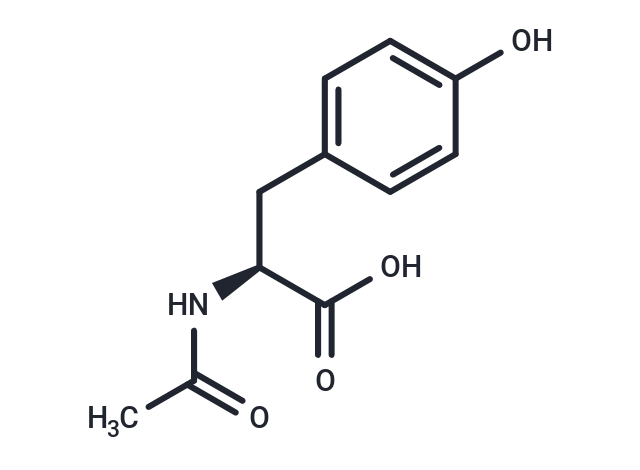
N-Acetyl-L-tyrosine

Copy Product Info
😃Good
Catalog No. T5292Cas No. 537-55-3
Alias N-Acetyltyrosine, Ac-Tyr-OH

N-Acetyl-L-tyrosine (Ac-Tyr-OH) is a side chain reaction of tyrosine. It converts to tyrosine and then can be used in neurotransmitter treatment as a precursor of cathecholamine.

N-Acetyl-L-tyrosine

N-Acetyl-L-tyrosine

Copy Product Info
😃Good
Purity: 99.4%
Catalog No. T5292Alias N-Acetyltyrosine, Ac-Tyr-OHCas No. 537-55-3
N-Acetyl-L-tyrosine (Ac-Tyr-OH) is a side chain reaction of tyrosine. It converts to tyrosine and then can be used in neurotransmitter treatment as a precursor of cathecholamine.
Pack SizePriceUSA WarehouseGlobal WarehouseQuantity
200 mg$34-In Stock
500 mg$53-In Stock
1 g$77-In Stock
5 g$188-In Stock
1 mL x 10 mM (in DMSO)$29-In Stock
Add to Cart
Add to Quotation
In Stock Estimated shipping dateUSA Warehouse[1-2 days] Global Warehouse[5-7 days]
All TargetMol products are for research purposes only and cannot be used for human consumption. We do not provide products or services to individuals. Please comply with the intended use and do not use TargetMol products for any other purpose.
Questions
TargetMol
View More

Batch Information

Select Batch
Purity:99.4%
Appearance:Solid
Color:White
Contact us for more batch information

Resource Download

Product Introduction

N-Acetyl-L-tyrosine AI Summary
N-Acetyl-L-tyrosine has been explored for various bioactivities and exhibits diverse inhibitory effects. It has shown weak in vitro inhibition of the recombinant stromelysin catalytic domain with an IC50 greater than 500,000 nM, indicating minimal impact on the enzyme at the tested concentration. In antibacterial assays, N-Acetyl-L-tyrosine inhibits the growth of Staphylococcus aureus MN8 at both 0.50% and 0.10% concentrations after 24 hours, with activity percentages of 19.9% and 47.5%, respectively. It also significantly reduces toxin TSST-1 production in S. aureus at the same concentrations by 47.1% and 71.5%. In a primary qHTS assay targeting the malarial parasite plastid, N-Acetyl-L-tyrosine exhibits a potency of 21331.3 nM for delayed death inhibitors, and in a cell-based assay for B-Galactocerebrosidase, its potency is 707.9 nM. The compound inhibits L-tryptophan uptake in Xenopus laevis oocytes, with activity rates reported as both 100.0% and 90.0%. For antiviral properties, N-Acetyl-L-tyrosine displays activity against SARS-CoV-2, showing inhibited cytotoxicity in various cellular models. In Caco-2 cells, it achieves an 8.83% inhibition at 10 µM after 48 hours. It also demonstrates a 10.28% inhibition of SARS-CoV-2 3CL-Pro protease activity at 20 µM. Additionally, in VERO-6 cells, the compound has a weak inhibitory effect with an IC50 greater than 20,000 nM and an inhibition rate of 0.03% at 10 µM concentration after 48 hours exposure to 0.01 MOI SARS-CoV-2 virus. Despite these activities, the compound's hit score of 0.135 suggests limited efficacy against the SARS-CoV-2 virus in the tested conditions..
Note: Summary generated by AI. Data source: ChEMBL
Bioactivity
Description
N-Acetyl-L-tyrosine (Ac-Tyr-OH) is a side chain reaction of tyrosine. It converts to tyrosine and then can be used in neurotransmitter treatment as a precursor of cathecholamine.
SynonymsN-Acetyltyrosine, Ac-Tyr-OH
Chemical Properties
Molecular Weight223.23
FormulaC11H13NO4
Cas No.537-55-3
SmilesC([C@H](NC(C)=O)C(O)=O)C1=CC=C(O)C=C1
Relative Density.1.2446 g/cm3 (Estimated)
Storage & Solubility Information
StoragePowder: -20°C for 3 years | In solvent: -80°C for 1 year | Shipping with blue ice/Shipping at ambient temperature.
Solubility Information
DMSO: 60 mg/mL (268.78 mM), Sonication is recommended.
In Vivo Formulation
10% DMSO+40% PEG300+5% Tween 80+45% Saline: 2 mg/mL (8.96 mM), Sonication is recommended.
Please add the solvents sequentially, clarifying the solution as much as possible before adding the next one. Dissolve by heating and/or sonication if necessary. Working solution is recommended to be prepared and used immediately. The formulation provided above is for reference purposes only. In vivo formulations may vary and should be modified based on specific experimental conditions.
Solution Preparation Table
DMSO
1mg5mg10mg50mg
1 mM4.4797 mL22.3984 mL44.7968 mL223.9842 mL
5 mM0.8959 mL4.4797 mL8.9594 mL44.7968 mL
10 mM0.4480 mL2.2398 mL4.4797 mL22.3984 mL
20 mM0.2240 mL1.1199 mL2.2398 mL11.1992 mL
50 mM0.0896 mL0.4480 mL0.8959 mL4.4797 mL
100 mM0.0448 mL0.2240 mL0.4480 mL2.2398 mL

Calculator

  • Molarity Calculator
  • Dilution Calculator
  • Reconstitution Calculator
  • Molecular Weight Calculator

In Vivo Formulation Calculator (Clear solution)

Please enter your animal experiment information in the following box and click Calculate to obtain the stock solution preparation method and in vivo formula preparation method:
TargetMol | Animal experiments For example, if the intended dosage is 10 mg/kg for animals weighing 20 g , with a dosing volume of 100 μL per animal, TargetMol | Animal experiments and a total of 10 animals are to be administered, using a formulation of TargetMol | reagent 10% DMSO+ 40% PEG300+ 5% Tween 80+ 45% Saline/PBS/ddH2O , the resulting working solution concentration would be 2 mg/mL.

Stock Solution Preparation:

Dissolve 2 mg of the compound in 100 μL DMSOTargetMol | reagent to obtain a stock solution at a concentration of 20 mg/mL . If the required concentration exceeds the compound's known solubility, please contact us for technical support before proceeding.

Preparation of the In Vivo Formulation:

1) Add 100 μL of the DMSOTargetMol | reagent stock solution to 400 μL PEG300TargetMol | reagent and mix thoroughly until the solution becomes clear.

2) Add 50 μL Tween 80 and mix well until fully clarified.

3) Add 450 μL Saline,PBS or ddH2OTargetMol | reagent and mix thoroughly until a homogeneous solution is obtained.

This example is provided solely to demonstrate the use of the In Vivo Formulation Calculator and does not constitute a recommended formulation for any specific compound. Please select an appropriate dissolution and formulation strategy based on your experimental model and route of administration.
All co-solvents required for this protocol, includingDMSO, PEG300/PEG400, Tween 80, SBE-β-CD, and Corn oil, are available for purchase on the TargetMol website.
1 Enter information below:
mg/kg
g
μL
2 Enter the in vivo formulation:
% DMSO
%
% Tween 80
% Saline/PBS/ddH2O

Dose Conversion

You can also refer to dose conversion for different animals. More Dose Conversion

Tech Support

Please see Inhibitor Handling Instructions for more frequently ask questions. Topics include: how to prepare stock solutions, how to store products, and cautions on cell-based assays & animal experiments, etc

Keywords

Related Tags: buy N-Acetyl-L-tyrosine | purchase N-Acetyl-L-tyrosine | N-Acetyl-L-tyrosine cost | order N-Acetyl-L-tyrosine | N-Acetyl-L-tyrosine chemical structure | N-Acetyl-L-tyrosine formula | N-Acetyl-L-tyrosine molecular weight