


Shopping Cart
Remove All Your shopping cart is currently empty


Synonyms:
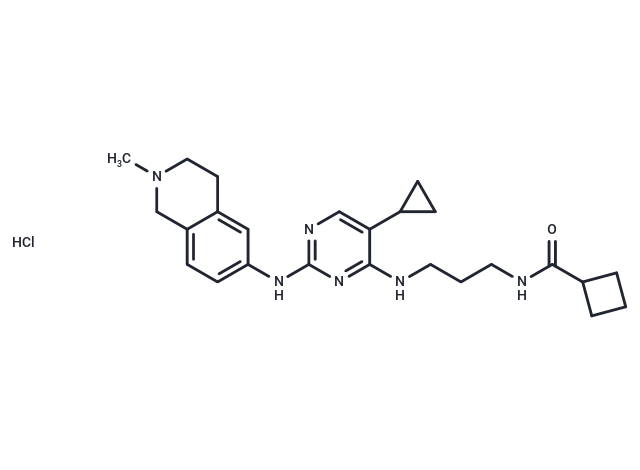
| Pack Size | Price | USA Stock | Global Stock | Quantity |
|---|---|---|---|---|
| 1 mg | $37 | In Stock | In Stock | |
| 5 mg | $60 | In Stock | In Stock | |
| 10 mg | $95 | In Stock | In Stock | |
| 25 mg | $198 | In Stock | In Stock | |
| 50 mg | $358 | In Stock | In Stock | |
| 100 mg | $446 | In Stock | In Stock | |
| 1 mL x 10 mM (in DMSO) | $61 | In Stock | In Stock |
| Description | MRT68921 hydrochloride is a potent inhibitor of both ULK1 and ULK2 [IC50s: 2.9 and 1.1 nM, respectively]. |
| Targets & IC50 | ULK2:1.1 nM, ULK1:2.9 nM |
| In vitro | MRT68921 is the most potent inhibitor of both ULK1 and ULK2, with greater than a 15-fold reduction in the IC50 for ULK1 (2.9 nM) and greater than a 30-fold reduction for ULK2 (1.1 nM). MRT68921 (1 μM) was sufficient to reduce phospho-ATG13 to control levels, and in line with the in vitro IC50 values [1]. Pre-incubating the cells for 30 min with the ULK1 inhibitor MRT68921 at the optimal concentration of 100 nM prevented the forskolin-induced CYTO-ID staining. The same effect was observed with siRNA against ULK1 [2]. |
| Kinase Assay | Initial ULK1 kinase assays were performed with GST-ULK1, produced in Sf9 cells. For other experiments, recombinant GST-ULK1 (wild type, kinase-dead (K46I), and M92T and M92Q) was expressed in 293T cells, purified, and eluted from a glutathione-Sepharose column. Kinase assays were carried out in 50 mM Tris-HCl, pH 7.4, 10 mM magnesium acetate, 0.1 mM EGTA, and 0.1% β-mercaptoethanol, containing 30 μM cold ATP, and 0.5 μCi of [γ-32P]ATP for 5 min at 25 °C. Prior to ATP addition, reaction mixes were prewarmed to 25 °C for 5 min. Reactions were stopped by the addition of sample buffer, followed by SDS-PAGE, transfer to nitrocellulose, and analysis by autoradiography and immunoblot. For IC50 curve measurements, kinase assays were performed, using myelin basic protein as a substrate [1]. |
| Cell Research | Immortalized wild-type mouse embryonic fibroblasts (MEFs) have been described previously. MEFs and 293T cells were grown in DMEM, supplemented with 10% fetal bovine serum and penicillin/streptomycin, and cultured at 37 °C, 5% CO2. For induction of autophagy, cells were typically grown to 75% confluency, washed twice, and incubated in Earle's balanced salt solution (EBSS) for 1 h (or complete medium as a control) unless indicated. MRT67307 (10 μM), MRT68921 (1 μM), AZD8055 (1 μM), or bafilomycin A1 (50 nM) was included where indicated. Transfection and transduction were as described [1]. |
| Molecular Weight | 471.04 |
| Formula | C25H34N6O·HCl |
| Cas No. | 2070014-87-6 |
| Smiles | Cl.CN1CCc2cc(Nc3ncc(C4CC4)c(NCCCNC(=O)C4CCC4)n3)ccc2C1 |
| Relative Density. | no data available |
| Storage | Powder: -20°C for 3 years | In solvent: -80°C for 1 year Shipping with blue ice/Shipping at ambient temperature. | ||||||||||||||||||||||||||||||
| Solubility Information | DMSO: 4.72 mg/mL (10.02 mM), Sonication is recommended.  H2O: 10 mg/mL (21.23 mM), Sonication is recommended. | ||||||||||||||||||||||||||||||
Solution Preparation Table | |||||||||||||||||||||||||||||||
DMSO/H2O
H2O
Note : The dilution table applies only to solid products. For liquid products, please calculate the stock solution based on the stated concentration and/or density. | |||||||||||||||||||||||||||||||
 For example, if the intended dosage is 10 mg/kg for animals weighing 20 g , with a dosing volume of 100 μL per animal, and a total of 10 animals are to be administered, using a formulation of
  10% DMSO+ 40% PEG300+ 5% Tween 80+ 45% Saline/PBS/ddH2O , the resulting working solution concentration would be 2 mg/mL.
Dissolve 2 mg of the compound in 100 μL DMSO to obtain a stock solution at a concentration of 20 mg/mL . If the required concentration exceeds the compound's known solubility, please contact us for technical support before proceeding.
1) Add 100 μL of the DMSO stock solution to 400 µL PEG300 and mix thoroughly until the solution becomes clear.
2) Add 50 µL Tween 80 and mix well until fully clarified.
3) Add 450 µL Saline,PBS or ddH2O and mix thoroughly until a homogeneous solution is obtained.
| Size | Quantity | Unit Price | Amount | Operation |
|---|
 Feedback
 Hello! How can I help you today?
Copyright © 2015-2026 TargetMol Chemicals Inc. All Rights Reserved.
