


Shopping Cart
Remove All Your shopping cart is currently empty


Synonyms:

| Pack Size | Price | USA Stock | Global Stock | Quantity |
|---|---|---|---|---|
| 2 mg | $63 | In Stock | In Stock | |
| 5 mg | $97 | In Stock | In Stock | |
| 10 mg | $129 | In Stock | In Stock | |
| 25 mg | $198 | In Stock | In Stock | |
| 50 mg | $297 | In Stock | In Stock | |
| 100 mg | $479 | In Stock | In Stock | |
| 1 mL x 10 mM (in DMSO) | $98 | In Stock | In Stock |
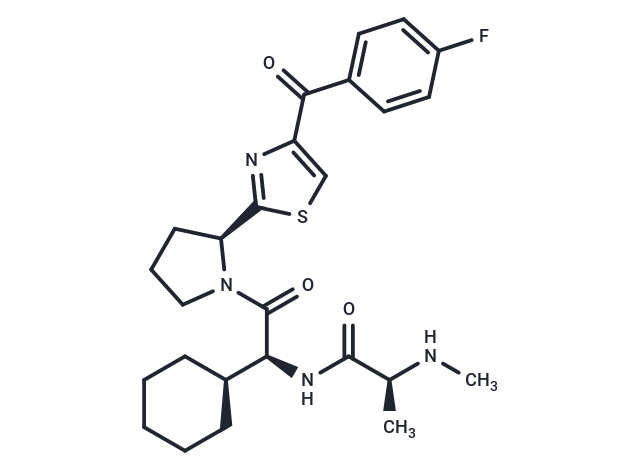
| Description | LCL161 is a SMAC mimetic, an IAP antagonist with oral activity that inhibits XIAP (IC50=35 nM) in HEK293 cells and also inhibits cIAP1 (IC50=0.4 nM) in MDA-MB-231 cells. LCL161 has potential antitumor activity. |
| Targets & IC50 | CIAP1 (MDA-MB-231 cells):0.4 nM, XIAP (HEK293 cells):35 nM |
| In vitro | METHODS: MOLM13 cells were treated with LCL161 (1000-160,000 nM) and PKC412 (2.5-40 nM) for 3 days and cell viability was measured by trypan blue exclusion. RESULTS: LCL161 moderately inhibited cell growth when administered alone.Combined treatment of MOLM13-luc+ cells with LCL161 and PKC412 killed significantly more cells than either drug alone, and the Calcusyn Combination Index suggests a synergistic effect. [1] METHODS: NSCLC cells A549 and H460 were treated with LCL161 (10 µM) and paclitaxel (10 µM) for 48 h. Apoptosis was detected by flow cytometry. RESULTS: Apoptosis was significantly reduced in the LCL161/paclitaxel combination treatment group compared to cells treated with LCL161 or paclitaxel alone. [2] |
| In vivo | METHODS: To test the antitumor activity in vivo, LCL161 (50 mg/kg twice daily) and PKC412 (40 mg/kg once daily) were administered by gavage to NCr nude mice injected with Ba/F3-FLT3-ITD-luc+ tumor cells for seven days. RESULTS: LCL161 significantly enhanced the ability of PKC412 to inhibit the growth of Ba/F3-FLT3-ITD-luc+ cells in vivo.The difference between the inhibition of leukemia growth by PKC412 or LCL161 alone and the combination of PKC412+LCL161 was also significant.The percentage of spleen weights in mice treated with PKC412+LCL161 was smaller than that in mice treated with PKC412. Mice treated with PKC412+LCL161 had a smaller percent spleen weight than mice treated with the vector or either drug alone. [1] |
| Kinase Assay | CYP3A activity is assessed using the probe reactions, midazolam-1′-hydroxylation and testosterone 6β-hydroxylation. For reversible inhibition, incubations (37°C, 10 min) are composed of (final concentrations): potassium phosphate buffer (100 mM, pH 7.4), β-NADPH (1 mM), magnesium chloride (5 mM), microsomal protein (0.025 mg/mL), probe substrate (1 μM midazolam or 25 μM testosterone), LCL161 (0, 0.5, 1, 5, 10, 25, 50, or 100 μM) and organic solvent (0.2% acetonitrile for midazolam, 0.2% methanol for testosterone). After a 3-minute preincubation, the reactions are initiated by addition of β-NADPH and terminated by addition of acetonitrile (two volumes). Reactions are previously shown to be linear with respect to time and protein concentration (results not shown) with midazolam and testosterone turnover of 8.7±1.3% (n=3) and 2.6±0.20%, respectively. Formation of 1′-hydroxymidazolam and 6β-hydroxytestosterone is determined by LC-MS/MS as described below[3]. |
| Cell Research | In vitro testing is performed using DIMSCAN (Only for Reference) |
| Molecular Weight | 500.63 |
| Formula | C26H33FN4O3S |
| Cas No. | 1005342-46-0 |
| Smiles | C([C@@H](NC([C@@H](NC)C)=O)[C@H]1CCCCC1)(=O)N2[C@@H](CCC2)C3=NC(C(=O)C4=CC=C(F)C=C4)=CS3 |
| Relative Density. | 1.245 g/cm3 (Predicted) |
| Storage | Keep away from direct sunlight,Store at low temperature,Store under nitrogen Powder: -20°C for 3 years | In solvent: -80°C for 1 year Shipping with blue ice/Shipping at ambient temperature. | ||||||||||||||||||||||||||||||||||||||||
| Solubility Information | DMSO: 93 mg/mL (185.77 mM), Sonication is recommended. Ethanol: 16 mg/mL (31.96 mM), Sonication is recommended. H2O: < 1 mg/mL (insoluble or slightly soluble) | ||||||||||||||||||||||||||||||||||||||||
Solution Preparation Table | |||||||||||||||||||||||||||||||||||||||||
Ethanol/DMSO
DMSO
Note : The dilution table applies only to solid products. For liquid products, please calculate the stock solution based on the stated concentration and/or density. | |||||||||||||||||||||||||||||||||||||||||
 For example, if the intended dosage is 10 mg/kg for animals weighing 20 g , with a dosing volume of 100 μL per animal, and a total of 10 animals are to be administered, using a formulation of
  10% DMSO+ 40% PEG300+ 5% Tween 80+ 45% Saline/PBS/ddH2O , the resulting working solution concentration would be 2 mg/mL.
Dissolve 2 mg of the compound in 100 μL DMSO to obtain a stock solution at a concentration of 20 mg/mL . If the required concentration exceeds the compound's known solubility, please contact us for technical support before proceeding.
1) Add 100 μL of the DMSO stock solution to 400 µL PEG300 and mix thoroughly until the solution becomes clear.
2) Add 50 µL Tween 80 and mix well until fully clarified.
3) Add 450 µL Saline,PBS or ddH2O and mix thoroughly until a homogeneous solution is obtained.
| Size | Quantity | Unit Price | Amount | Operation |
|---|
 Feedback
 Hello! How can I help you today?
Copyright © 2015-2026 TargetMol Chemicals Inc. All Rights Reserved.
