


Shopping Cart
Remove All Your shopping cart is currently empty


Synonyms:

| Pack Size | Price | USA Stock | Global Stock | Quantity |
|---|---|---|---|---|
| 5 mg | $40 | In Stock | In Stock | |
| 10 mg | $64 | In Stock | In Stock | |
| 25 mg | $129 | In Stock | In Stock | |
| 50 mg | $222 | In Stock | In Stock | |
| 100 mg | $355 | In Stock | In Stock | |
| 1 mL x 10 mM (in DMSO) | $44 | In Stock | In Stock |
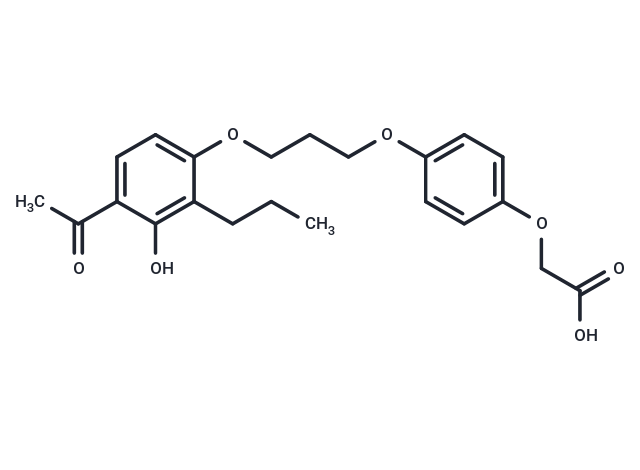
| Description | L-165041 is a potent and selective agonist of the nuclear receptor PPARβ and PPARδ(Ki = 9 nM, EC50 = ~500 nM ,respectively) |
| Targets & IC50 | PPARδ:500 nM(EC50), PPARβ:9 nM(Ki), PPARγ:730 nM (Ki) |
| In vitro | L-165041 inhibited VEGF-induced cell proliferation and migration in human umbilical vein ECs (HUVECs). L-165041 also inhibited angiogenesis in the Matrigel plug assay and aortic ring assay. Flow cytometric analysis indicated that L-165041 reduced the number of ECs in the S phase and the expression levels of cell cycle regulatory proteins such as cyclin A, cyclin E, CDK2, and CDK4; phosphorylation of the retinoblastoma protein was suppressed by pretreatment with L-165041. The PPARδ ligand L-165041 inhibits VEGF-stimulated angiogenesis by suppressing the cell cycle progression independently of PPARδ[1]. |
| In vivo | L-165041 lowered hepatic expression of PPARgamma, apolipoprotein B, interleukin 1 beta (IL-1beta), and interleukin-6. In contrast, L-165041 increased hepatic expressions of PPARdelta, lipoprotein lipase (LPL), and ATP-binding cassette transporter G1 (ABCG1).L-165041 might be effective in preventing Western diet-induced hepatic steatosis by regulating genes involved in lipid metabolism and the inflammatory response[2]. |
| Cell Research | Cell cycle distribution was determined by flow cytometry. Synchronized HUVECs were pretreated with L-165041 (1 or 5μM) 6 h prior to the addition of VEGF (10 ng/ml). The cells were harvested 16 h after VEGF addition and washed with PBS. The cells were then incubated with buffer containing 0.1% Triton X-100 and 0.1% trisodium citrate for 30 min. Cells were rinsed with PBS and then stained with 50 μg/ml propidium iodide for 20 min at room temperature. In total, 1*10^4 cells were analyzed with the FACScan system . At least three independent experiments were performed[1]. |
| Animal Research | The effect of PPARdelta ligand L-165041 on Western diet-induced fatty liver using low-density lipoprotein receptor-deficient (LDLR(-/-)) mice. LDLR(-/-) mice received either L-165041 (5mg/kg/day) or vehicle (0.1N NaOH) with Western diet for 16 weeks. L-165041 drastically reduced lipid accumulation in the liver, decreasing total hepatic cholesterol and triglyceride content compared to the vehicle group[1]. |
| Molecular Weight | 402.44 |
| Formula | C22H26O7 |
| Cas No. | 79558-09-1 |
| Smiles | CCCc1c(O)c(ccc1OCCCOc1ccc(OCC(O)=O)cc1)C(C)=O |
| Relative Density. | 1.222 g/cm3 (Predicted) |
| Storage | Powder: -20°C for 3 years | In solvent: -80°C for 1 year Shipping with blue ice/Shipping at ambient temperature. | |||||||||||||||||||||||||||||||||||
| Solubility Information | DMSO: 60 mg/mL (149.09 mM), Sonication is recommended.  | |||||||||||||||||||||||||||||||||||
| In Vivo Formulation | 10% DMSO+40% PEG300+5% Tween 80+45% Saline: 6 mg/mL (14.91 mM), Solution. 10% DMSO+90% Saline: < 6 mg/mL (14.91 mM), Lower concentrations may be soluble, but exact solubility limit is unknown. Please add the solvents sequentially, clarifying the solution as much as possible before adding the next one. Dissolve by heating and/or sonication if necessary. Working solution is recommended to be prepared and used immediately. The formulation provided above is for reference purposes only. In vivo formulations may vary and should be modified based on specific experimental conditions. | |||||||||||||||||||||||||||||||||||
Solution Preparation Table | ||||||||||||||||||||||||||||||||||||
DMSO
Note : The dilution table applies only to solid products. For liquid products, please calculate the stock solution based on the stated concentration and/or density. | ||||||||||||||||||||||||||||||||||||
 For example, if the intended dosage is 10 mg/kg for animals weighing 20 g , with a dosing volume of 100 μL per animal, and a total of 10 animals are to be administered, using a formulation of
  10% DMSO+ 40% PEG300+ 5% Tween 80+ 45% Saline/PBS/ddH2O , the resulting working solution concentration would be 2 mg/mL.
Dissolve 2 mg of the compound in 100 μL DMSO to obtain a stock solution at a concentration of 20 mg/mL . If the required concentration exceeds the compound's known solubility, please contact us for technical support before proceeding.
1) Add 100 μL of the DMSO stock solution to 400 µL PEG300 and mix thoroughly until the solution becomes clear.
2) Add 50 µL Tween 80 and mix well until fully clarified.
3) Add 450 µL Saline,PBS or ddH2O and mix thoroughly until a homogeneous solution is obtained.
| Size | Quantity | Unit Price | Amount | Operation |
|---|
 Feedback
 Hello! How can I help you today?
Copyright © 2015-2026 TargetMol Chemicals Inc. All Rights Reserved.
