Shopping Cart
Remove All
  • TargetMol
    Your shopping cart is currently empty

Indomethacin sodium hydrate (Alias: Indometacin sodium hydrate)

Catalog No. T22346 Copy Product Info
Purity: 99.45%
🥰Excellent
Indomethacin sodium hydrate is an effective orally active, competitive, and reversible inhibitor of COX-1 and COX-2, with IC50 values of 18 nM and 26 nM, respectively. It possesses anti-inflammatory, anticancer, and antimicrobial activities and is commonly used in research related to cancer, inflammation, and viral infections. Additionally, it can induce migraines and gastrointestinal injury and is used to study increased intracranial pressure secondary to severe traumatic brain injury in adults, as well as rheumatoid arthritis. It can also be used to induce gastric ulcer models.

Indomethacin sodium hydrate

Copy Product Info
🥰Excellent
Catalog No. T22346
Alias Indometacin sodium hydrate

Indomethacin sodium hydrate is an effective orally active, competitive, and reversible inhibitor of COX-1 and COX-2, with IC50 values of 18 nM and 26 nM, respectively. It possesses anti-inflammatory, anticancer, and antimicrobial activities and is commonly used in research related to cancer, inflammation, and viral infections. Additionally, it can induce migraines and gastrointestinal injury and is used to study increased intracranial pressure secondary to severe traumatic brain injury in adults, as well as rheumatoid arthritis. It can also be used to induce gastric ulcer models.

Indomethacin sodium hydrate
Cas No. 74252-25-8
Pack SizePriceUSA StockGlobal StockQuantity
500 mg$40-In Stock
1 g$48-In Stock
1 mL x 10 mM (in DMSO)$39-In Stock
In stock · Estimated delivery: USA Stock (1-2 days) Global Stock (5-7 days)
Add to Cart
Add to Quotation
For research use only—not for human use. No sales to individuals. Use as intended only.
Questions
TargetMol
View More

Batch Information

Select Batch
Purity:99.45%
Color:White
Contact us for more batch information

Resource Download

Product Introduction

Bioactivity
Description
Indomethacin sodium hydrate is an effective orally active, competitive, and reversible inhibitor of COX-1 and COX-2, with IC50 values of 18 nM and 26 nM, respectively. It possesses anti-inflammatory, anticancer, and antimicrobial activities and is commonly used in research related to cancer, inflammation, and viral infections. Additionally, it can induce migraines and gastrointestinal injury and is used to study increased intracranial pressure secondary to severe traumatic brain injury in adults, as well as rheumatoid arthritis. It can also be used to induce gastric ulcer models.
In vitro
In 3LL-D122 cells, Indomethacin sodium hydrate (0, 20, 50, 100, and 150 μM; 24 hours) inhibited cell viability, with inhibition observed at 20 mM and 50% inhibition at 60 mM[2].
In vivo
In male Sprague-Dawley rats, Indomethacin sodium hydrate (0.01-10 mg/kg; oral administration; for 3 hours) inhibited carrageenan-induced paw edema and hyperalgesia in a dose-dependent manner, with an ED50 of 2.0 mg/kg for paw edema and 1.5 mg/kg for hyperalgesia[1].
Disease Modeling Protocol
Small intestine inflammation model
  • Modeling Mechanism:

    Indomethacin inhibits cyclooxygenase (COX) activity, reduces prostaglandin (PGE) synthesis, and disrupts the small intestinal mucosal repair function. Simultaneously, it damages tight junction proteins, increases intestinal permeability, and triggers local inflammation mediated by gut microbiota and intestinal contents, inducing the release of pro-inflammatory factors such as TNF-α and IL-6. Furthermore, it induces oxidative stress, reduces glutathione (GSH) and antioxidant enzyme (SOD, GPX) activity, and increases lipid peroxidation products (MDA) and total oxygen saturation (TOS), ultimately leading to small intestinal villus structure destruction, erosion, ulceration, and inflammatory infiltration.

  • Related Products:

    Indomethacin sodium hydrate (T22346)

  • Modeling Method:

    Experimental Subject:

    Rats, Wistar, Female, 15 weeks old, Weight 160-200g

    Dosage and Administration Route:

    25 mg/kg indomethacin, Dissolved in 0.9% saline solution, Administered via gavage

    Dosing Frequency and Duration Model:

    Single dose

  • Validation:

    The small intestinal tissue showed disordered villus structure, erosion and ulceration, and inflammatory cell infiltration, with a significantly elevated total pathological damage score; the levels of TNF-α and IL-6 in the small intestinal tissue were significantly elevated; the content of GSH and the activities of SOD and GPX were decreased, while the levels of MDA and TOS were increased; and the total antioxidant level (TAS) of the tissue was decreased.

*Precautions: All rats were anesthetized and sacrificed 6 hours after modeling, and the small intestine tissue was rapidly separated.

*References:Secgin S, et,al. Thiamine pyrophosphate may protect indomethacin-induced small intestinal enteropathy in rats by inhibiting intestinal inflammation and oxidative stress. Naunyn Schmiedebergs Arch Pharmacol. 2025 Oct;398(10):14441-14450.

Gastric ulcer model
  • Modeling Mechanism:

    Indomethacin sodium hydrate inhibits the synthesis of COX-1/COX-2 prostaglandins, leading to decreased gastric mucosal defense, increased inflammation and oxidative stress, and thus causing gastric mucosal damage and ulcer formation.

  • Related Products:

    Indomethacin sodium hydrate (T22346)

  • Modeling Method:

    Experimental Subject:

    Rats, Wistar, Equal numbers of males and females, 200-220 g

    Dosage and Administration Route:

    Indomethacin 30 mg/kg, Dissolved in distilled water and administered by gavage

    Dosing Frequency and Duration Model:

    Single dose

  • Validation:

    Serum EGF and PGE2 concentrations were significantly decreased. Immunohistochemical results showed that the expression levels of COX-1 and COX-2 in the gastric mucosa were significantly downregulated, and there was significant gastric mucosal epithelial shedding, edema, and inflammatory cell infiltration. The gastric mucosal injury index was significantly increased.

*Precautions: Before administration to all animals 24 hFasting was implemented. In the prevention experiment, animals were sacrificed 6 hours after gavage administration of indomethacin; in the treatment experiment, animals were administered the drug for 3 days after modeling, followed by a 24-hour fast before being sacrificed.

*References:Fang YF,et,al.Effect of Hydrotalcite on Indometacin-Induced Gastric Injury in Rats. Biomed Res Int. 2019 Apr 11;2019:4605748.

SynonymsIndometacin sodium hydrate
Chemical Properties
Molecular Weight433.82
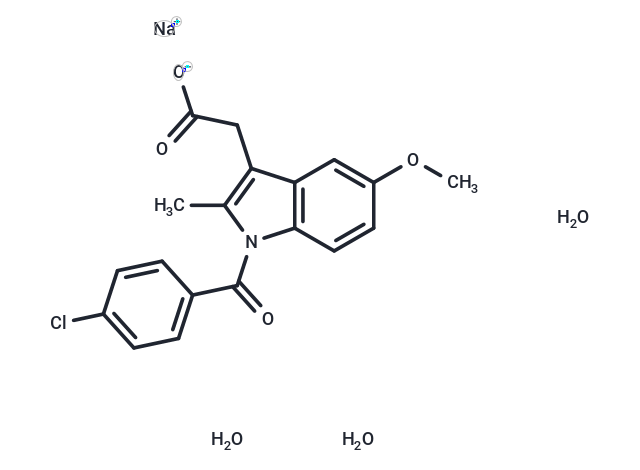
FormulaC19H21ClNNaO7
Cas No.74252-25-8
SmilesO=C([O-])CC1=C(N(C2=C1C=C(OC)C=C2)C(C3=CC=C(Cl)C=C3)=O)C.[Na+].O.O.O
Relative Density.no data available
Storage & Solubility Information
Storagestore under nitrogen,keep away from direct sunlight | Powder: -20°C for 3 years | In solvent: -80°C for 1 year | Shipping with blue ice/Shipping at ambient temperature.
Solubility Information
DMSO: 5 mg/mL (11.53 mM), Sonification is recommended.
H2O: 20 mg/mL (46.1 mM), Sonification is recommended.
In Vivo Formulation
10% DMSO+40% PEG300+5% Tween 80+45% Saline: 1 mg/mL (2.31 mM), Sonication is recommended.
Please add the solvents sequentially, clarifying the solution as much as possible before adding the next one. Dissolve by heating and/or sonication if necessary. Working solution is recommended to be prepared and used immediately. The formulation provided above is for reference purposes only. In vivo formulations may vary and should be modified based on specific experimental conditions.
Solution Preparation Table
DMSO/H2O
1mg5mg10mg50mg
1 mM2.3051 mL11.5255 mL23.0510 mL115.2552 mL
5 mM0.4610 mL2.3051 mL4.6102 mL23.0510 mL
10 mM0.2305 mL1.1526 mL2.3051 mL11.5255 mL
H2O
1mg5mg10mg50mg
20 mM0.1153 mL0.5763 mL1.1526 mL5.7628 mL
Note : The dilution table applies only to solid products. For liquid products, please calculate the stock solution based on the stated concentration and/or density.

Calculator

  • Molarity Calculator
  • Dilution Calculator
  • Reconstitution Calculator
  • Molecular Weight Calculator

In Vivo Formulation Calculator (Clear solution)

Please enter your animal experiment information in the following box and click Calculate to obtain the stock solution preparation method and in vivo formula preparation method:
TargetMol | Animal experiments For example, if the intended dosage is 10 mg/kg for animals weighing 20 g , with a dosing volume of 100 μL per animal, TargetMol | Animal experiments and a total of 10 animals are to be administered, using a formulation of TargetMol | reagent 10% DMSO+ 40% PEG300+ 5% Tween 80+ 45% Saline/PBS/ddH2O , the resulting working solution concentration would be 2 mg/mL.

Stock Solution Preparation:

Dissolve 2 mg of the compound in 100 μL DMSOTargetMol | reagent to obtain a stock solution at a concentration of 20 mg/mL . If the required concentration exceeds the compound's known solubility, please contact us for technical support before proceeding.

Preparation of the In Vivo Formulation:

1) Add 100 μL of the DMSOTargetMol | reagent stock solution to 400 μL PEG300TargetMol | reagent and mix thoroughly until the solution becomes clear.

2) Add 50 μL Tween 80 and mix well until fully clarified.

3) Add 450 μL Saline,PBS or ddH2OTargetMol | reagent and mix thoroughly until a homogeneous solution is obtained.

This example is provided solely to demonstrate the use of the In Vivo Formulation Calculator and does not constitute a recommended formulation for any specific compound. Please select an appropriate dissolution and formulation strategy based on your experimental model and route of administration.
All co-solvents required for this protocol, includingDMSO, PEG300/PEG400, Tween 80, SBE-β-CD, and Corn oil, are available for purchase on the TargetMol website.
1 Enter information below:
mg/kg
g
μL
2 Enter the in vivo formulation:
% DMSO
%
% Tween 80
% Saline/PBS/ddH2O

Dose Conversion

You can also refer to dose conversion for different animals. More Dose Conversion

Tech Support

Please see Inhibitor Handling Instructions for more frequently ask questions. Topics include: how to prepare stock solutions, how to store products, and cautions on cell-based assays & animal experiments, etc

Keywords

Related Tags: buy Indomethacin sodium hydrate | purchase Indomethacin sodium hydrate | Indomethacin sodium hydrate cost | order Indomethacin sodium hydrate | Indomethacin sodium hydrate chemical structure | Indomethacin sodium hydrate in vivo | Indomethacin sodium hydrate in vitro | Indomethacin sodium hydrate formula | Indomethacin sodium hydrate molecular weight