


Shopping Cart
Remove All Your shopping cart is currently empty


Synonyms: Indirubin-3'-oxime
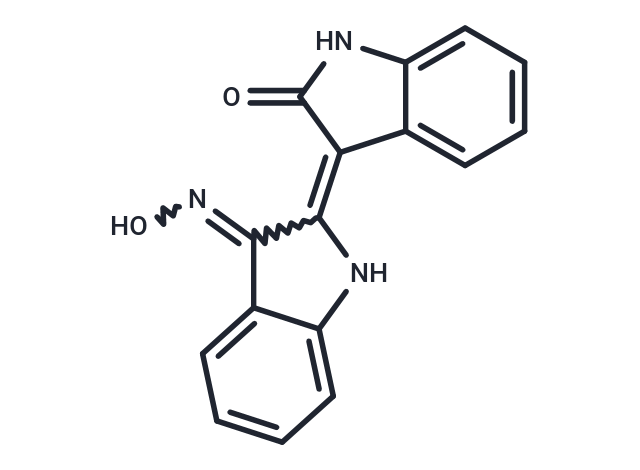
| Pack Size | Price | USA Stock | Global Stock | Quantity |
|---|---|---|---|---|
| 2 mg | $30 | In Stock | In Stock | |
| 5 mg | $48 | In Stock | In Stock | |
| 10 mg | $77 | In Stock | In Stock | |
| 25 mg | $158 | In Stock | In Stock | |
| 50 mg | $247 | In Stock | In Stock | |
| 100 mg | $367 | In Stock | In Stock | |
| 1 mL x 10 mM (in DMSO) | $53 | In Stock | In Stock |
| Description | Indirubin-3'-monoxime (Indirubin-3'-oxime) is a potent inhibitor of GSK3β (IC50: 22 nM) and also inhibits CDKs ( (IC50s: 100/180/250 nM for Cdk5/p35, Cdk1/cyclin B, Cdk2/cyclin E). |
| Targets & IC50 | CDK1-CyclinB:180 nM (cell free), 5-LOX:7.8-10 μM, CDK5-p25:100 nM (cell free), CDK2-CyclinE:250 nM (cell free), GSK-3β:22 nM (cell free) |
| In vitro | Indirubins are powerful inhibitors (IC50: 5-50 nM) of GSK-3 beta. Bacterially expressed recombinant human tau was indeed phosphorylated in vitro by GSK-3β, and this phosphorylation was inhibited in a dose-dependent manner by indirubin-3′-monoxime, with an IC50 value of around 100 nM [1]. Indirubin-3'-monoxime reversibly arrests asynchronous HBL-100 cells in G2. Indirubin-3'-monoxime inhibits the phosphorylation of consensus CDK phosphorylation sites as well as of nucleolin at a specific CDK1/cyclin B phosphorylation site [2]. In cell-based and cell-free assays, Indirubin-3'-monoxime selectively inhibited 5-lipoxygenase (5-LO), the key enzyme in LT biosynthesis, with an IC50 in the low micromolar range [3]. |
| In vivo | The mice treated with IMX showed a significant reduction in plasma glucose, triglycerides, cholesterol, insulin levels and improvement in learning and memory performance, attenuated the oxidative stress and AChE activity. Moreover, IMX dose-dependently augments the brain insulin and BDNF levels in HFD fed mice [4]. |
| Synonyms | Indirubin-3'-oxime |
| Kinase Assay | Kinase activities were assayed in Buffer A or C (unless otherwise stated), at 30?°C, at a final ATP concentration of 15 μM. Blank values were subtracted, and activities were calculated as picomoles of phosphate incorporated for a 10-min incubation. The activities are usually expressed in percentage of the maximal activity, i.e. in the absence of inhibitors. Controls were performed with appropriate dilutions of dimethyl sulfoxide. In a few cases, phosphorylation of the substrate was assessed by autoradiography after SDS-PAGE [1]. |
| Cell Research | To determine the effects of aminopurvalanol and indirubin-3′-monoxime on tau phosphorylation, Sf9 cells infected with baculovirus expressing htau23 protein were treated 36 h post-infection (when cells have already expressed levels of tau sufficient for the outgrowth of cell processes) with 20 μM inhibitors for 3 h before being harvested [1]. |
| Animal Research | Male mice (5–6 weeks old) were randomly assigned into five groups (n = 10). Group 1: received normal pellet diet (NPD); Group 2: received a HFD; Group 3–5 received HFD for 8 weeks followed by Indirubin-3'-monoxime (IMX) treatment (0.1, 0.2 and 0.4 mg/kg i.p, respectively) once daily for 1 week. IMX was dissolved in (2.5% v/v) DMSO in saline. The mice in NPD and HFD groups received an equivalent volume of vehicle (2.5% v/v DMSO in saline). The composition of HFD was similar as described by Srinivasan. Doses of IMX were selected based on the reports available in literature. Mice were kept under standard husbandry conditions (22 ± 1 C and 60% humidity) and maintained on a 12/12-h light/dark schedule with free access to food and water for 8 weeks. Body weight was recorded weekly throughout the experimental period [4]. |
| Molecular Weight | 277.28 |
| Formula | C16H11N3O2 |
| Cas No. | 160807-49-8 |
| Smiles | ON=C1C(Nc2ccccc12)=C1C(=O)Nc2ccccc12 |
| Relative Density. | 1.50 g/cm3 |
| Storage | Powder: -20°C for 3 years | In solvent: -80°C for 1 year Shipping with blue ice/Shipping at ambient temperature. | ||||||||||||||||||||||||||||||||||||||||
| Solubility Information | H2O: Insoluble Ethanol: 15 mg/mL (54.1 mM), Sonication is recommended. DMSO: 81.67 mg/mL (294.54 mM), Sonication is recommended.  | ||||||||||||||||||||||||||||||||||||||||
| In Vivo Formulation | 10% DMSO+90% Saline: < 8.17 mg/mL (29.46 mM), Lower concentrations may be soluble, but exact solubility limit is unknown. 10% DMSO+40% PEG300+5% Tween 80+45% Saline: 8.17 mg/mL (29.46 mM), Solution. Please add the solvents sequentially, clarifying the solution as much as possible before adding the next one. Dissolve by heating and/or sonication if necessary. Working solution is recommended to be prepared and used immediately. The formulation provided above is for reference purposes only. In vivo formulations may vary and should be modified based on specific experimental conditions. | ||||||||||||||||||||||||||||||||||||||||
Solution Preparation Table | |||||||||||||||||||||||||||||||||||||||||
Ethanol/DMSO
DMSO
Note : The dilution table applies only to solid products. For liquid products, please calculate the stock solution based on the stated concentration and/or density. | |||||||||||||||||||||||||||||||||||||||||
 For example, if the intended dosage is 10 mg/kg for animals weighing 20 g , with a dosing volume of 100 μL per animal, and a total of 10 animals are to be administered, using a formulation of
  10% DMSO+ 40% PEG300+ 5% Tween 80+ 45% Saline/PBS/ddH2O , the resulting working solution concentration would be 2 mg/mL.
Dissolve 2 mg of the compound in 100 μL DMSO to obtain a stock solution at a concentration of 20 mg/mL . If the required concentration exceeds the compound's known solubility, please contact us for technical support before proceeding.
1) Add 100 μL of the DMSO stock solution to 400 µL PEG300 and mix thoroughly until the solution becomes clear.
2) Add 50 µL Tween 80 and mix well until fully clarified.
3) Add 450 µL Saline,PBS or ddH2O and mix thoroughly until a homogeneous solution is obtained.
| Size | Quantity | Unit Price | Amount | Operation |
|---|
 Feedback
 Hello! How can I help you today?
Copyright © 2015-2026 TargetMol Chemicals Inc. All Rights Reserved.
