


Shopping Cart
Remove All Your shopping cart is currently empty

Synonyms: PD 0332991
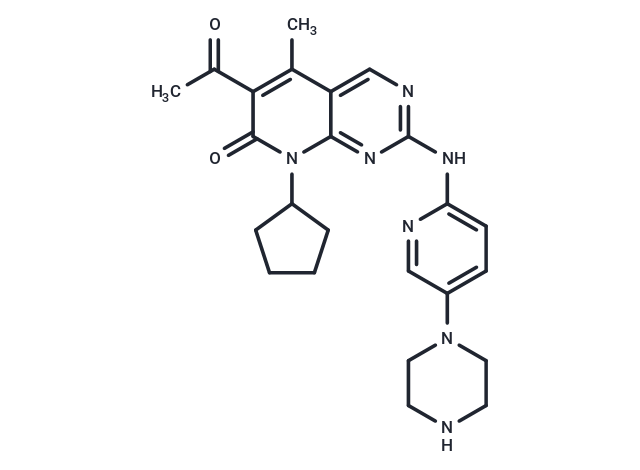
| Pack Size | Price | USA Stock | Global Stock | Quantity |
|---|---|---|---|---|
| 2 mg | $30 | In Stock | In Stock | |
| 5 mg | $44 | In Stock | In Stock | |
| 10 mg | Inquiry | In Stock | In Stock | |
| 25 mg | Inquiry | In Stock | In Stock | |
| 50 mg | Inquiry | Inquiry | Inquiry | |
| 100 mg | Inquiry | Inquiry | Inquiry | |
| 500 mg | Inquiry | Inquiry | Inquiry |
| Description | Palbociclib (PD 0332991) is a CDK inhibitor that inhibits CDK4 and CDK6 (IC50=11/16 nM) and is orally active. Palbociclib has anti-tumorigenic activity and has investigational potential for use in ER-positive and HER2-negative breast cancer. |
| Targets & IC50 | CDK6:16 nM, MAPK:8000 nM, ICNI cells:8 µM, CDK4-CyclinD1:11 nM, KB-C2 cells:22.573 µM, DYRK1A:2000 nM, CDK6-CyclinD2:16 nM, CDK4-CyclinD3:9 nM, CDK4:11 nM |
| In vitro | METHODS: Malignant rhabdomyosarcoma cells G401, MP-MRT-AN (AN), KP-MRT-RY (RY), KP-MRT-NS (NS), and KP-MRT-YM (YM) were treated with Palbociclib (0-1 mM) for 24 h, and cell viability was assayed by WST. RESULTS: Palbociclib effectively inhibited AN, RY, G401 and NS cell lines in a concentration-dependent manner, with IC50s of 0.01 μM, 0.01 μM, 0.06 μM and 0.6 μM, respectively; on the contrary, the YM cell line was resistant to Palbociclib, with an IC50 >10 μM.[1] METHODS: Human breast cancer cells MDA-MB-453 were treated with Palbociclib (0.02-10 μmol/L) for 24 h, and the cell cycle was examined by Flow Cytometry. RESULTS: Palbociclib caused G1 phase block. [2] |
| In vivo | METHODS: To detect antitumor activity in vivo, Palbociclib (12.5-150 mg/kg, sodium lactate buffer (50 mmol/L, pH 4.0)) was administered orally to immunodeficient mice harboring the tumors Colo-205 or MDA-MB-435 once daily for fourteen days. RESULTS: Palbociclib showed significant anti-tumor efficacy in multiple human tumor xenograft models. In Colo-205 tumors, PD 0332991 administered for 14 days produced rapid tumor regression. [2] METHODS: To assay antitumor activity in vivo, Palbociclib (150 mg/kg, sodium lactate buffer (50 mM, pH = 4.0)) was administered once daily for two weeks by gavage to nu/nu BALB/c mice bearing esophageal squamous cell carcinoma (ESCC) tumors EC109 or KYSE150. RESULTS: Palbociclib effectively inhibited ESCC tumor growth and lung metastasis. [3] |
| Synonyms | PD 0332991 |
| Kinase Assay | CDK assays are performed in 96-well filter plates. All CDK-cyclin kinase complexes are expressed in insect cells through baculovirus infection and purified. The substrate for the assays is a fragment (amino acids 792-928) of pRb fused to GST (GST·RB-Cterm). The total volume in each well is 0.1 mL containing a final concentration of 20 mM Tris-HCl, pH 7.4, 50 mM NaCl, 1 mM dithiothreitol, 10 mM MgCl2, 25 μM ATP (for CDK4-cyclin D1, CDK6-cyclin D2, and CDK6-cyclin D3) or 12 μM ATP (for CDK2-cyclin E, CDK2-cyclin A, and CDC2-cyclin B) containing 0.25 μCi of [γ-32P]ATP, 20 ng of enzyme, 1 μg of GST·RB-Cterm, and Palbociclib (0.001-0.1 μM). All components except the [γ-32P]ATP are added to the wells, and the plate is placed on a plate mixer for 2 min. The reaction is started by adding the [γ-32P]ATP and the plate is incubated at 25°C for 15 min. The reaction is terminated by addition of 0.1 mL of 20% trichloroacetic acid and the plate is kept at 4°C for at least 1 hour to allow the substrate to precipitate. The wells are then washed 5 times with 0.2 mL of 10% trichloroacetic acid and radioactive incorporation is determined with a β plate counter. |
| Cell Research | Palbociclib (PD) is prepared in DMSO and stored (?80°C), and then diluted with appropriate media before use[1]. MRT cell lines, G401, MP-MRT-AN (AN), KP-MRT-RY (RY), KP-MRT-NS (NS), and KP-MRT-YM (YM) cell lines are seeded in normal growth medium into 96-well cell plates. After 24 h, the culture medium is replaced with culture medium containing Palbociclib (0.05 or 1 μM) or DMSO. Cells are cultured and treated in triplicate. Cell proliferation is determined 8 days after the treatment by WST-8 assay using a Cell Counting Kit-8. |
| Molecular Weight | 447.53 |
| Formula | C24H29N7O2 |
| Cas No. | 571190-30-2 |
| Smiles | O=C1N(C=2C(C(C)=C1C(C)=O)=CN=C(NC3=CC=C(C=N3)N4CCNCC4)N2)C5CCCC5 |
| Relative Density. | 1.313g/cm3 |
| Storage | Keep away from direct sunlight Powder: -20°C for 3 years | In solvent: -80°C for 1 year Shipping with blue ice/Shipping at ambient temperature. | ||||||||||
| Solubility Information | 0.1 M HCl: 1.25 mg/mL (2.79 mM), Sonication is recommended.  DMSO: < 1 mg/mL (insoluble or slightly soluble) Ethanol: insoluble | ||||||||||
Solution Preparation Table | |||||||||||
0.1 M HCl
Note : The dilution table applies only to solid products. For liquid products, please calculate the stock solution based on the stated concentration and/or density. | |||||||||||
 For example, if the intended dosage is 10 mg/kg for animals weighing 20 g , with a dosing volume of 100 μL per animal, and a total of 10 animals are to be administered, using a formulation of
  10% DMSO+ 40% PEG300+ 5% Tween 80+ 45% Saline/PBS/ddH2O , the resulting working solution concentration would be 2 mg/mL.
Dissolve 2 mg of the compound in 100 μL DMSO to obtain a stock solution at a concentration of 20 mg/mL . If the required concentration exceeds the compound's known solubility, please contact us for technical support before proceeding.
1) Add 100 μL of the DMSO stock solution to 400 µL PEG300 and mix thoroughly until the solution becomes clear.
2) Add 50 µL Tween 80 and mix well until fully clarified.
3) Add 450 µL Saline,PBS or ddH2O and mix thoroughly until a homogeneous solution is obtained.
| Size | Quantity | Unit Price | Amount | Operation |
|---|
 Feedback
 Hello! How can I help you today?
Copyright © 2015-2026 TargetMol Chemicals Inc. All Rights Reserved.
