


Shopping Cart
Remove All Your shopping cart is currently empty

Synonyms: Protein kinase inhibitor H-89 dihydrochloride, H 89 2HCl
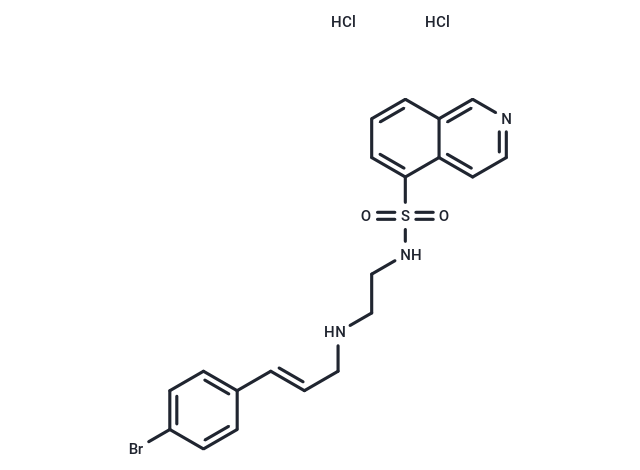
| Pack Size | Price | USA Stock | Global Stock | Quantity |
|---|---|---|---|---|
| 5 mg | $33 | In Stock | In Stock | |
| 10 mg | $53 | In Stock | In Stock | |
| 25 mg | $108 | In Stock | In Stock | |
| 50 mg | $213 | In Stock | In Stock | |
| 100 mg | $363 | In Stock | In Stock | |
| 200 mg | $538 | In Stock | In Stock | |
| 500 mg | $857 | - | In Stock | |
| 1 mL x 10 mM (in DMSO) | $39 | In Stock | In Stock |
| Description | H-89 dihydrochloride (5-Isoquinolinesulfonamide) is a selective inhibitor of cAMP-dependent protein kinase A (PKA) with an IC50 value of 48 nM. It also mildly inhibits PKG, PKC, and casein kinase activity. H-89 dihydrochloride can be used in research areas such as cell proliferation, apoptosis, metabolism, neurotransmission, and endocrine regulation. |
| Targets & IC50 | PKA:48 nM (Ki, cell free), S6K1:80 nM (cell free) |
| In vitro | Methods: HCT116 cells were treated with H-89 dihydrochloride at concentrations ranging from 1.56 to 50 μM for 72 hours. The MTT colorimetric assay was used to evaluate the effect of H-89 dihydrochloride on cell viability. Results: H-89 dihydrochloride exhibited concentration-dependent growth inhibition in HCT116 cells. [1] Methods: In LS174T cells, the TCF/LEF luciferase reporter plasmid was added. After transfection, cells were treated with 20 μM H-89 dihydrochloride for 1 hour. Subsequently, cells were stimulated with PGE2 (concentrations 1–10 μM) and cultured for an additional 6 hours. The TCF/LEF luciferase reporter assay was employed to evaluate the effect of H-89 dihydrochloride on Wnt/β-catenin signaling pathway transcriptional activity. Results: In LS174T cells, 20 μM H-89 dihydrochloride treatment effectively blocked PGE2-stimulated TCF/LEF transcriptional activity. [2] |
| In vivo | Methods: Adult SD rats were used to establish a fever model via intraperitoneal injection of lipopolysaccharide (LPS, 80 μg/kg). Thirty minutes prior to LPS injection, H-89 dihydrochloride (0.5, 1.0, 1.5 μg/site) was administered via lateral ventricle catheter implantation to inhibit central PKA activity. Rats were euthanized and tissues collected 4.5 hours after LPS injection. Results: H-89 dihydrochloride treatment significantly suppressed p-TRPV1 levels while minimally affecting total TRPV1. Administration alone had no significant effect on basal body temperature in normal rats. [3] |
| Synonyms | Protein kinase inhibitor H-89 dihydrochloride, H 89 2HCl |
| Kinase Assay | All protein kinase activities were linear with respect to time in every incubation. Assays were performed either manually for 10 min at 30 °C in 50 μl incubations using [γ-32P]ATP or with a Biomek 2000 Laboratory Automation Workstation in a 96-well format for 40 min at ambient temperature in 25 μl incubations using [γ-33P]ATP. The concentrations of ATP and magnesium acetate were 0.1 mM and 10 mM respectively unless stated otherwise. This concentration of ATP is 5–10-fold higher than the Km for ATP of most of the protein kinases studied in the present paper, but lower than the normal intracellular concentration, which is in the millimolar range. All assays were initiated with MgATP. Manual assays were terminated by spotting aliquots of each incubation on to phosphocellulose paper, followed by immersion in 50 mM phosphoric acid. Robotic assays were terminated by the addition of 5 μl of 0.5 M phosphoric acid before spotting aliquots on to P30 filter mats. All papers were then washed four times in 50 mM phosphoric acid to remove ATP, once in acetone (manual incubations) or methanol (robotic incubations), and then dried and counted for radioactivity [2]. |
| Cell Research | After 48 h in culture, PCl2D cells are cultured in a test medium containing 30 μM H-89 for 1 h and then exposed to a fresh medium that contained both 10 μM forskolin and 30 μM H-89. Cells are scraped off with a rubber policeman and sonicated in the presence of 0.5 mL of 6% trichloroacetic acid. To extract trichloroacetic acid, 2 mL of petroleum ether is added, the preparation mixed and centrifuged at 3000 rpm for 10 min. After aspiration of the upper layer, the residue sample solution is used for determination [1]. |
| Animal Research | H89 (N-[2-(p-Bromocinnamylamino)ethyl]-5-isoquinolinesulfonamide], di-HCl Salt) (10 mg/kg) suspended in 5% DMSO in saline was administered i.p. two hours before each OVA challenge (or two hours before the last OVA challenge). Control animals received equivalent volumes (200 μl) of 5% DMSO in saline [5]. |
| Molecular Weight | 519.28 |
| Formula | C20H20BrN3O2S·2HCl |
| Cas No. | 130964-39-5 |
| Smiles | Cl.Cl.Brc1ccc(\C=C\CNCCNS(=O)(=O)c2cccc3cnccc23)cc1 |
| Relative Density. | no data available |
| Storage | Powder: -20°C for 3 years | In solvent: -80°C for 1 year Shipping with blue ice/Shipping at ambient temperature. | |||||||||||||||||||||||||||||||||||
| Solubility Information | H2O: < 1 mg/mL (insoluble or slightly soluble)  DMSO: 104 mg/mL (200.28 mM), Sonication is recommended. | |||||||||||||||||||||||||||||||||||
| In Vivo Formulation | 5% DMSO+95% Saline: 3.16 mg/mL (6.09 mM), Solution. Please add the solvents sequentially, clarifying the solution as much as possible before adding the next one. Dissolve by heating and/or sonication if necessary. Working solution is recommended to be prepared and used immediately. The formulation provided above is for reference purposes only. In vivo formulations may vary and should be modified based on specific experimental conditions. | |||||||||||||||||||||||||||||||||||
Solution Preparation Table | ||||||||||||||||||||||||||||||||||||
DMSO
Note : The dilution table applies only to solid products. For liquid products, please calculate the stock solution based on the stated concentration and/or density. | ||||||||||||||||||||||||||||||||||||
 For example, if the intended dosage is 10 mg/kg for animals weighing 20 g , with a dosing volume of 100 μL per animal, and a total of 10 animals are to be administered, using a formulation of
  10% DMSO+ 40% PEG300+ 5% Tween 80+ 45% Saline/PBS/ddH2O , the resulting working solution concentration would be 2 mg/mL.
Dissolve 2 mg of the compound in 100 μL DMSO to obtain a stock solution at a concentration of 20 mg/mL . If the required concentration exceeds the compound's known solubility, please contact us for technical support before proceeding.
1) Add 100 μL of the DMSO stock solution to 400 µL PEG300 and mix thoroughly until the solution becomes clear.
2) Add 50 µL Tween 80 and mix well until fully clarified.
3) Add 450 µL Saline,PBS or ddH2O and mix thoroughly until a homogeneous solution is obtained.
| Size | Quantity | Unit Price | Amount | Operation |
|---|
 Feedback
 Hello! How can I help you today?
Copyright © 2015-2026 TargetMol Chemicals Inc. All Rights Reserved.
