


Shopping Cart
Remove All Your shopping cart is currently empty

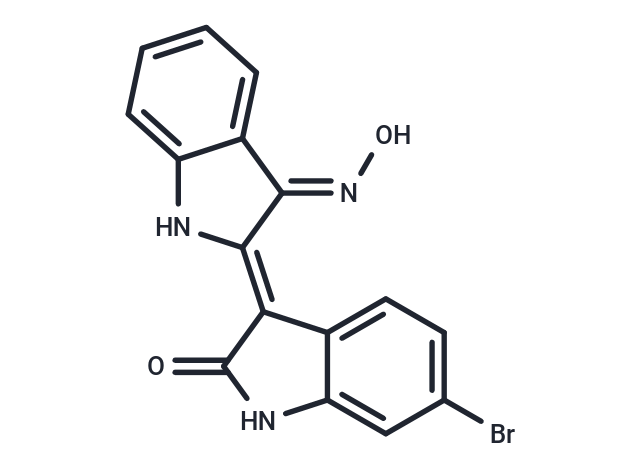
Synonyms: MLS 2052, GSK 3 IX, BIO, 6-bromoindirubin-3-oxime, 6-Bromoindirubin-3'-oxime, 6-BIO

| Pack Size | Price | USA Stock | Global Stock | Quantity |
|---|---|---|---|---|
| 1 mg | $37 | In Stock | In Stock | |
| 2 mg | $50 | In Stock | In Stock | |
| 5 mg | $75 | In Stock | In Stock | |
| 10 mg | $103 | In Stock | In Stock | |
| 25 mg | $240 | In Stock | In Stock | |
| 50 mg | $433 | In Stock | In Stock | |
| 100 mg | $642 | In Stock | In Stock | |
| 500 mg | $1,370 | - | In Stock | |
| 1 mL x 10 mM (in DMSO) | $83 | In Stock | In Stock |
| Description | GSK 3 Inhibitor IX (6-BIO) is a selective reversible, ATP-competitive inhibitor of GSK-3α/β and CDK1-cyclinB complex. It inhibits (GSK-3α/β)/CDK1/CDK5 activity with IC50 values of 5 nM/320 nM/83 nM, respectively. |
| Targets & IC50 | CDK5-p35:0.08 μM, TYK2:30 nM, CDK1-CyclinB:0.32 μM, CDK2-CyclinA:0.30 μM, GSK-3:5 nM |
| In vitro | BIO inhibits the growth of melanoma in murine xenograft models. |
| In vivo | BIO is a pan-JAK inhibitor targeting TYK2, JAK1, JAK2, and JAK3 with IC50 values of 0.03, 1.5, 8.0, and 0.5 μM, respectively. It also acts as a specific inhibitor of glycogen synthase kinase-3 (GSK-3), with an IC50 of 5 nM for GSK-3α/β, demonstrating over 16-fold higher selectivity than for CDK5. BIO interacts with the ATP-binding pockets of these kinases, reducing phosphorylation at GSK-3 specific sites on β-catenin in cell models and promoting the proliferation of mammalian cardiomyocytes. Moreover, BIO selectively inhibits STAT3 phosphorylation, inducing apoptosis in human melanoma cells. In human and mouse embryonic stem cells, BIO preserves the undifferentiated phenotype and maintains the expression of pluripotency-specific transcription factors Oct-3/4, Rex-1, and Nanog. |
| Synonyms | MLS 2052, GSK 3 IX, BIO, 6-bromoindirubin-3-oxime, 6-Bromoindirubin-3'-oxime, 6-BIO |
| Kinase Assay | Kinase assay: Kinase activities are assayed in Buffer A or C at 30°C, at a final ATP concentration of 15 μM. Blank values are subtracted and activities calculated as pmoles of phosphate incorporated during a 10 min incubation. Controls are performed with appropriate dilutions of dimethylsulfoxide. In a few cases phosphorylation of the substrate is assessed by autoradiography after SDS-PAGE. GSK-3α/β is purified from porcine brain by affinity chromatography on immobilized axin. It is assayed, following a 1/100 dilution in 1 mg BSA/ml 10 mM DTT, with 5 μl 40 μM GS-1 peptide, a specific GSK-3 substrate, (YRRAAVPPSPSLSRHSSPHQSpEDEEE), in buffer A, in the presence of 15 μM [γ-32P] ATP (3,000 Ci/mmol; 1 mCi/ml) in a final volume of 30 μl. After 30 min incubation at 30°C, 25 μl aliquots of supernatant are spotted onto 2.5 × 3 cm pieces of Whatman P81 phosphocellulose paper, and 20 seconds later, the filters are washed five times (for at least 5 min each time) in a solution of 10 ml phosphoric acid/liter of water. The wet filters are counted in the presence of 1 ml ACS scintillation fluid. |
| Cell Research | COS1, Hepa (wild-type, CEM/LM AhR deficient and ELB1 ARNT deficient), or SH-SY5Y cells are grown in 6 cm culture dishes in Dulbecco's Modified Medium (DMEM) containing 10% fetal bovine serum. For treatment, IO (5 μM), BIO (5 or 10 μM), MeBIO (5 or 50 μM), LiCl (20 or 40 mM), or mock solution (DMSO, 0.5% final concentration) is added to medium when cell density reaches ~70% confluence. After 12 (SH-SY5Y) or 24 hours, the cells, while still in plate, are lysed with lysis buffer (1% SDS, 1 mM sodium orthovanadate, 10 mM Tris [pH 7.4]). The lysate is passed several times through a 26 g needle, centrifuged at 10,000 × g for 5 min, and adjusted to equal protein concentration. About 8 μg of each sample is loaded for immunoblotting. Enhanced chemiluminescence is used for detection. The following primary antibodies are used: mouse anti-β-catenin CT (Upstate Biotechnolgies, Clone 7D8, recognizes total β-catenin), mouse anti-phospho-β-catenin (Upstate Biotechnologies, Clone 8E7, recognizes dephosphorylated β-catenin), mouse anti-GSK-3 β, mouse anti-GSK-3 phosphoTyr216, rabbit anti-AhR (Aryl hydrocarbon receptor), and rabbit anti-actin.(Only for Reference) |
| Molecular Weight | 356.17 |
| Formula | C16H10BrN3O2 |
| Cas No. | 667463-62-9 |
| Smiles | O\N=C1\C(\Nc2ccccc\12)=C1\C(=O)Nc2cc(Br)ccc12 |
| Relative Density. | 1.8g/cm3 |
| Storage | Powder: -20°C for 3 years | In solvent: -80°C for 1 year Shipping with blue ice/Shipping at ambient temperature. | ||||||||||||||||||||||||||||||||||||||||
| Solubility Information | DMSO: 45 mg/mL (126.34 mM), Sonication is recommended.  Ethanol: 21 mg/mL (58.96 mM), Sonication is recommended. | ||||||||||||||||||||||||||||||||||||||||
Solution Preparation Table | |||||||||||||||||||||||||||||||||||||||||
Ethanol/DMSO
DMSO
Note : The dilution table applies only to solid products. For liquid products, please calculate the stock solution based on the stated concentration and/or density. | |||||||||||||||||||||||||||||||||||||||||
 For example, if the intended dosage is 10 mg/kg for animals weighing 20 g , with a dosing volume of 100 μL per animal, and a total of 10 animals are to be administered, using a formulation of
  10% DMSO+ 40% PEG300+ 5% Tween 80+ 45% Saline/PBS/ddH2O , the resulting working solution concentration would be 2 mg/mL.
Dissolve 2 mg of the compound in 100 μL DMSO to obtain a stock solution at a concentration of 20 mg/mL . If the required concentration exceeds the compound's known solubility, please contact us for technical support before proceeding.
1) Add 100 μL of the DMSO stock solution to 400 µL PEG300 and mix thoroughly until the solution becomes clear.
2) Add 50 µL Tween 80 and mix well until fully clarified.
3) Add 450 µL Saline,PBS or ddH2O and mix thoroughly until a homogeneous solution is obtained.
| Size | Quantity | Unit Price | Amount | Operation |
|---|
 Feedback
 Hello! How can I help you today?
Copyright © 2015-2026 TargetMol Chemicals Inc. All Rights Reserved.
