


Shopping Cart
Remove All Your shopping cart is currently empty

Synonyms:

| Pack Size | Price | USA Stock | Global Stock | Quantity |
|---|---|---|---|---|
| 1 mg | $56 | In Stock | In Stock | |
| 5 mg | $129 | In Stock | In Stock | |
| 10 mg | $198 | In Stock | In Stock | |
| 25 mg | $372 | In Stock | In Stock | |
| 50 mg | $596 | In Stock | In Stock | |
| 100 mg | $847 | In Stock | In Stock | |
| 200 mg | $1,130 | - | In Stock |
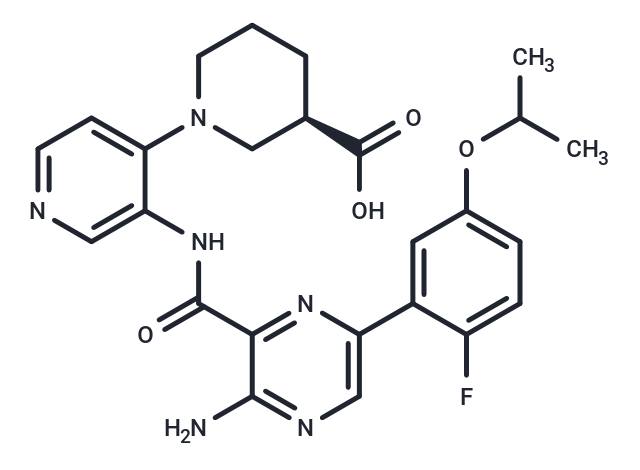
| Description | GNF4877 is a small molecule inhibitor, a potent dual-specificity kinase inhibitor targeting DYRK1A (IC50=6 nM) and GSK3β (IC50=16 nM). This compound promotes β-cell proliferation by blocking NFATc nuclear export (EC50=0.66 μM for mouse R7T1 cells) and is primarily used for research on β-cell regeneration related to diabetes. |
| Targets & IC50 | GSK-3β:16 nM, HT22 cells:16.3 μM, Pancreatic beta cell:0.54 μM (EC50), Pancreatic beta cell:0.19 mM (EC50), DYRK1 cellsA:6 nM |
| In vitro | Methods: Mouse β-cells (such as R7T1 cells) were treated with low concentrations of GNF4877 (0.1, 0.3 μM) in combination with high glucose, glucokinase activators (GKAs), glibenclamide, or Bay K8644 to detect cell proliferation, Ca²⁺ signaling, and NFATc nuclear translocation. Results: Low concentrations of GNF4877 promoted β-cell proliferation under high glucose or GKA stimulation; high glucose and GKAs enhanced Ca²⁺ signaling, activated calcineurin, and promoted NFATc nuclear translocation; glibenclamide or Bay K8644 increased intracellular Ca²⁺ and showed additive effects with GNF4877. [1] |
| In vivo | Methods: A mouse β-cell model was used, and low concentrations of GNF4877 (0.1, 0.3 μM) combined with high glucose or glucokinase activators (GKAs) were applied to detect cell proliferation; the effects of high glucose and GKAs on Ca²⁺ signaling, calcineurin activation, and NFATc nuclear translocation were also evaluated; additionally, glibenclamide or Bay K8644 combined with GNF4877 were used to detect synergistic effects. Results: Low concentrations of GNF4877 promoted β-cell proliferation under high glucose or GKA stimulation; high glucose and GKAs enhanced Ca²⁺ signaling, activated calcineurin, and promoted NFATc nuclear translocation; glibenclamide or Bay K8644 increased intracellular Ca²⁺ and showed additive effects with GNF4877. [1] |
| Molecular Weight | 494.52 |
| Formula | C25H27FN6O4 |
| Cas No. | 2041073-22-5 |
| Smiles | CC(C)Oc1ccc(F)c(c1)-c1cnc(N)c(n1)C(=O)Nc1cnccc1N1CCC[C@H](C1)C(O)=O |
| Relative Density. | 1.367 g/cm3 (Predicted) |
| Storage | Keep away from moisture Powder: -20°C for 3 years | In solvent: -80°C for 1 year Shipping with blue ice/Shipping at ambient temperature. | ||||||||||||||||||||
| Solubility Information | DMSO: 6.94 mg/mL (14.03 mM), Sonication is recommended.  | ||||||||||||||||||||
Solution Preparation Table | |||||||||||||||||||||
DMSO
Note : The dilution table applies only to solid products. For liquid products, please calculate the stock solution based on the stated concentration and/or density. | |||||||||||||||||||||
 For example, if the intended dosage is 10 mg/kg for animals weighing 20 g , with a dosing volume of 100 μL per animal, and a total of 10 animals are to be administered, using a formulation of
  10% DMSO+ 40% PEG300+ 5% Tween 80+ 45% Saline/PBS/ddH2O , the resulting working solution concentration would be 2 mg/mL.
Dissolve 2 mg of the compound in 100 μL DMSO to obtain a stock solution at a concentration of 20 mg/mL . If the required concentration exceeds the compound's known solubility, please contact us for technical support before proceeding.
1) Add 100 μL of the DMSO stock solution to 400 µL PEG300 and mix thoroughly until the solution becomes clear.
2) Add 50 µL Tween 80 and mix well until fully clarified.
3) Add 450 µL Saline,PBS or ddH2O and mix thoroughly until a homogeneous solution is obtained.
| Size | Quantity | Unit Price | Amount | Operation |
|---|
 Feedback
 Hello! How can I help you today?
Copyright © 2015-2026 TargetMol Chemicals Inc. All Rights Reserved.
