


Shopping Cart
Remove All Your shopping cart is currently empty

Synonyms:

| Pack Size | Price | USA Stock | Global Stock | Quantity |
|---|---|---|---|---|
| 1 mg | $163 | In Stock | In Stock | |
| 5 mg | $413 | In Stock | In Stock | |
| 10 mg | $589 | In Stock | In Stock | |
| 25 mg | $939 | In Stock | In Stock | |
| 50 mg | $1,260 | In Stock | In Stock | |
| 100 mg | $1,680 | - | In Stock | |
| 1 mL x 10 mM (in DMSO) | $419 | In Stock | In Stock |
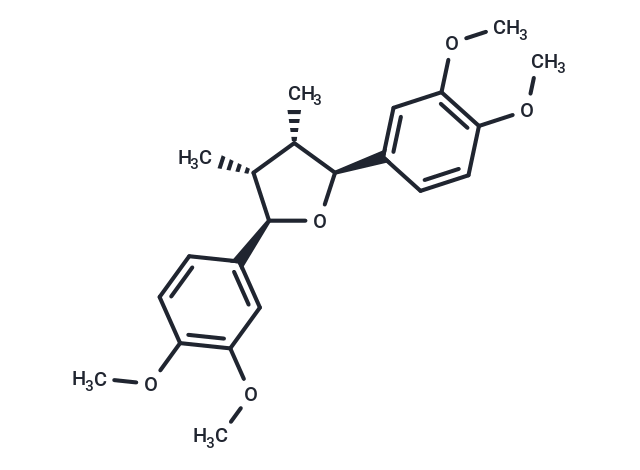
| Description | Galgravin has anti-inflammatory, and neuroprotective effects, it can promote neuronal survival and neurite outgrowth, protect hippocampal neurons against amyloid beta peptide (Abeta25-35)-induced cytotoxicity, and protect against neuronal death from 1-methyl-4-phenylpyridinium ion (MPP+)-induced toxicity in cultured rat hippocampal neurons. |
| In vitro | This approach resulted in the isolation and characterization of eight tetrahydrofuran neolignans: calopeptin (1), machilin-G (2), machilin-I (3), aristolignin (4), nectandrin A (5), veraguensin (6), ganschisandrin (7), and Galgravin (8). Different assays were conducted to evaluate their cytotoxic activities and to determine the possible mechanism(s) related to the activity displayed against human leukemia cells. The most active compounds 4, 5 and 8 gave IC50 values of 14.2 ± 0.7, 16.9 ± 0.8 and 16.5 ± 0.8 μg/mL, respectively, against human leukemia (HL-60) tumor cells. Moreover, these compounds induced specific apoptotic hallmarks, such as plasma membrane bleb formation, nuclear DNA condensation, specific chromatin fragmentation, phosphatidyl-serine exposure on the external leaflet of the plasma membrane, cleavage of PARP as well as mitochondrial damage, which as a whole could be related to the intrinsic apoptotic pathway. |
| Molecular Weight | 372.45 |
| Formula | C22H28O5 |
| Cas No. | 528-63-2 |
| Smiles | C[C@@H]1[C@H](O[C@H]([C@@H]1C)C2=CC(OC)=C(OC)C=C2)C3=CC(OC)=C(OC)C=C3 |
| Relative Density. | 1.082 g/cm3 (Predicted) |
| Storage | Store at low temperature Powder: -20°C for 3 years | In solvent: -80°C for 1 year Shipping with blue ice/Shipping at ambient temperature. | |||||||||||||||||||||||||
| Solubility Information | DMSO: 9 mg/mL (24.16 mM), Sonication is recommended.  | |||||||||||||||||||||||||
Solution Preparation Table | ||||||||||||||||||||||||||
DMSO
Note : The dilution table applies only to solid products. For liquid products, please calculate the stock solution based on the stated concentration and/or density. | ||||||||||||||||||||||||||
 For example, if the intended dosage is 10 mg/kg for animals weighing 20 g , with a dosing volume of 100 μL per animal, and a total of 10 animals are to be administered, using a formulation of
  10% DMSO+ 40% PEG300+ 5% Tween 80+ 45% Saline/PBS/ddH2O , the resulting working solution concentration would be 2 mg/mL.
Dissolve 2 mg of the compound in 100 μL DMSO to obtain a stock solution at a concentration of 20 mg/mL . If the required concentration exceeds the compound's known solubility, please contact us for technical support before proceeding.
1) Add 100 μL of the DMSO stock solution to 400 µL PEG300 and mix thoroughly until the solution becomes clear.
2) Add 50 µL Tween 80 and mix well until fully clarified.
3) Add 450 µL Saline,PBS or ddH2O and mix thoroughly until a homogeneous solution is obtained.
| Size | Quantity | Unit Price | Amount | Operation |
|---|
 Feedback
 Hello! How can I help you today?
Copyright © 2015-2026 TargetMol Chemicals Inc. All Rights Reserved.
