


Shopping Cart
Remove All
  • TargetMol
    Your shopping cart is currently empty

Ethambutol dihydrochloride (Synonyms: Ethambutol 2HCl, Emb dihydrochloride, CL40881)

Catalog No. T0810 Copy Product Info
Purity: 99.95%
🥰Excellent
Ethambutol dihydrochloride is an anti-mycobacterial compound that inhibits arabinosyl transferase activity to prevent cell wall formation and can be used to induce hyperuricemia models.

Ethambutol dihydrochloride

Copy Product Info
🥰Excellent
Catalog No. T0810
Synonyms Ethambutol 2HCl, Emb dihydrochloride, CL40881
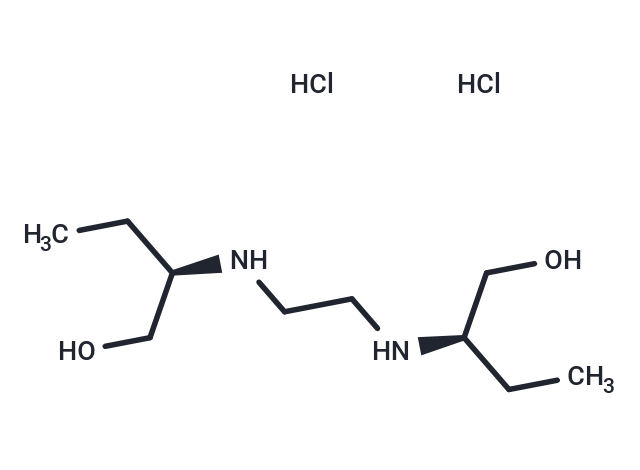
Ethambutol dihydrochloride is an anti-mycobacterial compound that inhibits arabinosyl transferase activity to prevent cell wall formation and can be used to induce hyperuricemia models.

Ethambutol dihydrochloride
Cas No. 1070-11-7
Pack SizePriceUSA StockGlobal StockQuantity
500 mg$29In StockIn Stock
1 g$42-In Stock
1 mL x 10 mM (in DMSO)$30In StockIn Stock
For In stock only · Estimated delivery: USA Stock (1-2 days) Global Stock (5-7 days)
Add to Cart
Add to Quotation
For research use only—not for human use. No sales to individuals. Use as intended only.
Questions
TargetMol
View More

Batch Information

Select Batch
Purity:99.95%
Appearance:Solid
Color:White
Contact us for more batch information

Resource Download

Product Introduction

Bioactivity
Description
Ethambutol dihydrochloride is an anti-mycobacterial compound that inhibits arabinosyl transferase activity to prevent cell wall formation and can be used to induce hyperuricemia models.
In vitro
Ethambutol primarily targets the product of the embB gene, inducing mutations within the emb gene in drug-resistant strains of tuberculosis. In Mycobacterium smegmatis, Ethambutol affects arabinogalactan and lipoarabinomannan biosynthesis.
In vivo
In animal models, Ethambutol is administered orally at a dosage of 100 mg/kg.
Disease Modeling Protocol
Hyperuricemic nephropathy model
  • Modeling Mechanism:

    Ethambutol dihydrochloride inhibits renal uric acid excretion, exacerbates uric acid accumulation in the body, and further aggravates kidney damage; ③ The two work together to activate inflammatory pathways, leading to upregulation of pro-inflammatory factors such as IL-6 and TNF, triggering renal tissue inflammation, glomerular sclerosis and interstitial fibrosis, mimicking the core pathological process of human hyperuricemic nephropathy.

  • Related Products:

    Ethambutol dihydrochloride (T0810)

  • Modeling Method:

    Experimental Subject:

    Rats, Wistar, Male, 7–8 weeks old, Body weight 200–220 g

    Dosage and Administration Route:

    ① Core modelling: Adenine (100 mg/kg)+Ethambutol hydrochloride (250 mg/kg), Dissolved in deionised water to prepare a 1% adenine+2.5% ethambutol hydrochloride suspension, Administered via gastric lavage;
    ② Control treatment: Equal volume of deionised water administered via gastric lavage using the same method;
    ③ Intervention Verification (Optional):
    - Allopurinol (50 mg/kg), 0.5% solution administered via gastric lavage, commencing from week 2 of modelling, for 2 consecutive weeks;
    - Chicory formula (CF): high dose 8.64 g/kg, low dose 2.16 g/kg; administered via gastric lavage as a decoction; commencing from week 2 of modelling, for 2 consecutive weeks.

    Dosing Frequency and Duration Model:

    Once daily, for 3 consecutive weeks

  • Validation:

    Key indicators (serum biochemistry): - Serum uric acid (UA): The model group reached 2.40 μMol/L, significantly higher than the control group (2.25 μMol/L). After intervention with allopurinol and high-dose CF, it decreased to 1.57 μMol/L (p<0.05); - Renal function indicators: Serum urea (UREA) increased from 6.75 mMol/L to 15.87 mMol/L, and serum creatinine (CREA) increased from 38.5 μmol/L to 64.83 μMol/L (p<0.001), both significantly decreasing after intervention; Pathological indicators: - HE staining showed disordered kidney structure in the model group, with glomerular sclerosis, renal tubular epithelial cell damage, renal interstitial inflammation, and uric acid crystal deposition. Pathological damage was significantly reduced in the intervention group; Molecular indicators: - Significantly upregulated expression of IL-6, TP53, and TNF mRNA in renal tissue (p<0.05), and VEGFA and CASP3 mRNA expression... The expression was downgraded, and the trend could be reversed after intervention.

*Precautions: To alleviate pain, rats were euthanized by intraperitoneal injection of sodium pentobarbital.

*References:Li N,et,al. Integration of network pharmacology and intestinal flora to investigate the mechanism of action of Chinese herbal Cichorium intybus formula in attenuating adenine and ethambutol hydrochloride-induced hyperuricemic nephropathy in rats. Pharm Biol. 2022 Dec;60(1):2338-2354.

SynonymsEthambutol 2HCl, Emb dihydrochloride, CL40881
Chemical Properties
Molecular Weight277.24
FormulaC10H26Cl2N2O2
Cas No.1070-11-7
SmilesCl.Cl.CC[C@H](CO)NCCN[C@H](CC)CO
Relative Density.no data available
Storage & Solubility Information
StoragePowder: -20°C for 3 years | In solvent: -80°C for 1 year | Shipping with blue ice/Shipping at ambient temperature.
Solubility Information
Ethanol: < 1 mg/mL (insoluble or slightly soluble)
DMSO: 60 mg/mL (216.42 mM), Sonication is recommended.
H2O: 51 mg/mL (183.96 mM), Sonication is recommended.
Solution Preparation Table
H2O/DMSO
1mg5mg10mg50mg
1 mM3.6070 mL18.0349 mL36.0698 mL180.3492 mL
5 mM0.7214 mL3.6070 mL7.2140 mL36.0698 mL
10 mM0.3607 mL1.8035 mL3.6070 mL18.0349 mL
20 mM0.1803 mL0.9017 mL1.8035 mL9.0175 mL
50 mM0.0721 mL0.3607 mL0.7214 mL3.6070 mL
100 mM0.0361 mL0.1803 mL0.3607 mL1.8035 mL
Note : The dilution table applies only to solid products. For liquid products, please calculate the stock solution based on the stated concentration and/or density.

Calculator

  • Molarity Calculator
  • Dilution Calculator
  • Reconstitution Calculator
  • Molecular Weight Calculator

In Vivo Formulation Calculator (Clear solution)

Please enter your animal experiment information in the following box and click Calculate to obtain the stock solution preparation method and in vivo formula preparation method:
TargetMol | Animal experiments For example, if the intended dosage is 10 mg/kg for animals weighing 20 g , with a dosing volume of 100 μL per animal, TargetMol | Animal experiments and a total of 10 animals are to be administered, using a formulation of TargetMol | reagent 10% DMSO+ 40% PEG300+ 5% Tween 80+ 45% Saline/PBS/ddH2O , the resulting working solution concentration would be 2 mg/mL.

Stock Solution Preparation:

Dissolve 2 mg of the compound in 100 μL DMSOTargetMol | reagent to obtain a stock solution at a concentration of 20 mg/mL . If the required concentration exceeds the compound's known solubility, please contact us for technical support before proceeding.

Preparation of the In Vivo Formulation:

1) Add 100 μL of the DMSOTargetMol | reagent stock solution to 400 μL PEG300TargetMol | reagent and mix thoroughly until the solution becomes clear.

2) Add 50 μL Tween 80 and mix well until fully clarified.

3) Add 450 μL Saline,PBS or ddH2OTargetMol | reagent and mix thoroughly until a homogeneous solution is obtained.

This example is provided solely to demonstrate the use of the In Vivo Formulation Calculator and does not constitute a recommended formulation for any specific compound. Please select an appropriate dissolution and formulation strategy based on your experimental model and route of administration.
All co-solvents required for this protocol, includingDMSO, PEG300/PEG400, Tween 80, SBE-β-CD, and Corn oil, are available for purchase on the TargetMol website.
1 Enter information below:
mg/kg
g
μL
2 Enter the in vivo formulation:
% DMSO
%
% Tween 80
% Saline/PBS/ddH2O

Dose Conversion

You can also refer to dose conversion for different animals. More Dose Conversion

Tech Support

Please see Inhibitor Handling Instructions for more frequently ask questions. Topics include: how to prepare stock solutions, how to store products, and cautions on cell-based assays & animal experiments, etc

Keywords

Related Tags: buy Ethambutol dihydrochloride | purchase Ethambutol dihydrochloride | Ethambutol dihydrochloride cost | order Ethambutol dihydrochloride | Ethambutol dihydrochloride chemical structure | Ethambutol dihydrochloride in vivo | Ethambutol dihydrochloride in vitro | Ethambutol dihydrochloride formula | Ethambutol dihydrochloride molecular weight





