


Shopping Cart
Remove All Your shopping cart is currently empty

Synonyms:

| Pack Size | Price | USA Stock | Global Stock | Quantity |
|---|---|---|---|---|
| 1 mg | $128 | - | In Stock | |
| 5 mg | $228 | In Stock | In Stock | |
| 10 mg | $378 | - | In Stock | |
| 25 mg | Preferential | - | In Stock | |
| 50 mg | Preferential | - | In Stock |
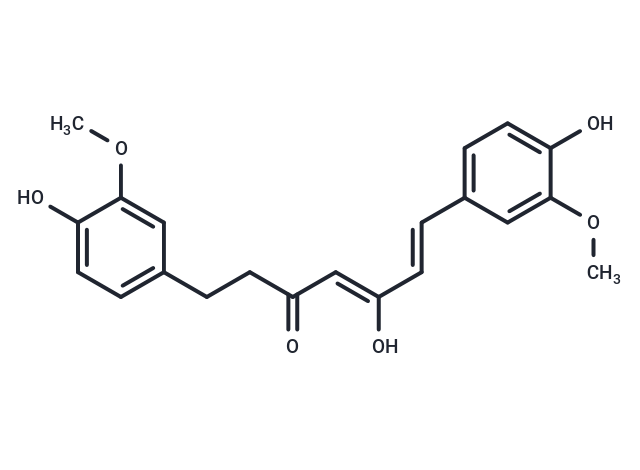
| Description | Dihydrocurcumin is the main metabolite of curcumin, which can reduce fat accumulation and oxidative stress response. Dihydrocurcumin can regulate the mRNA and protein expression levels of SREBP-1C, PNPLA3 and PPARα, increase the protein expression levels of pAKT and PI3K, and reduce the intracellular NO and ROS contents through Nrf2 signaling pathway. |
| In vitro | Colon bacteria may mediate the transformation of curcumin, but this metabolism has not been well studied. Methods AND RESULTS: The metabolism of curcumin to Escherichia Ferguson (ATCC 35469) and two strains of Escherichia coli (ATCC 8739 and DH10B) was studied in modified colonic bacteria (mMCB) medium of porcine cecal fluid with or without medication. LC-MS analysis showed that after fermentation for 36 h, the conversion rate of curcumin was 16-37%, the conversion rate of demethoxycurcumin (DMC) was 6-16%, the conversion rate of dimethoxycurcumin (bi-DMC) was 7-15%, and the conversion rate of dimethoxycurcumin (bi-DMC) was 7-15%. The amount of curcumin degradation varies with different strains and medium. Three metabolites (dihydrocurcumin (DHC), tetrahydrocurcumin (THC) and ferulic acid (FA)) were identified in the fermentation culture of all strains. In addition, a compound of m/z [M-H](-) 470 was found and identified as curcumin-adduct (curcumin-L-cysteine) by precise mass FT-ICR-MS. Conclusion: This study provides a new scheme for the bacterial metabolism of curcumin[1]. |
| Molecular Weight | 370.4 |
| Formula | C21H22O6 |
| Cas No. | 76474-56-1 |
| Smiles | COc1cc(CCC(=O)\C=C(/O)\C=C\c2ccc(O)c(OC)c2)ccc1O |
| Relative Density. | 1.277g/cm3 |
| Storage | Store at low temperature Powder: -20°C for 3 years | In solvent: -80°C for 1 year Shipping with blue ice/Shipping at ambient temperature. | ||||||||||||||||||||||||||||||
| Solubility Information | DMSO: 22.5 mg/mL (60.75 mM), Sonication and heating to 60℃ are recommended. | ||||||||||||||||||||||||||||||
Solution Preparation Table | |||||||||||||||||||||||||||||||
DMSO
Note : The dilution table applies only to solid products. For liquid products, please calculate the stock solution based on the stated concentration and/or density. | |||||||||||||||||||||||||||||||
 For example, if the intended dosage is 10 mg/kg for animals weighing 20 g , with a dosing volume of 100 μL per animal, and a total of 10 animals are to be administered, using a formulation of
  10% DMSO+ 40% PEG300+ 5% Tween 80+ 45% Saline/PBS/ddH2O , the resulting working solution concentration would be 2 mg/mL.
Dissolve 2 mg of the compound in 100 μL DMSO to obtain a stock solution at a concentration of 20 mg/mL . If the required concentration exceeds the compound's known solubility, please contact us for technical support before proceeding.
1) Add 100 μL of the DMSO stock solution to 400 µL PEG300 and mix thoroughly until the solution becomes clear.
2) Add 50 µL Tween 80 and mix well until fully clarified.
3) Add 450 µL Saline,PBS or ddH2O and mix thoroughly until a homogeneous solution is obtained.
| Size | Quantity | Unit Price | Amount | Operation |
|---|
 Feedback
 Hello! How can I help you today?
Copyright © 2015-2026 TargetMol Chemicals Inc. All Rights Reserved.
