


Shopping Cart
Remove All Your shopping cart is currently empty

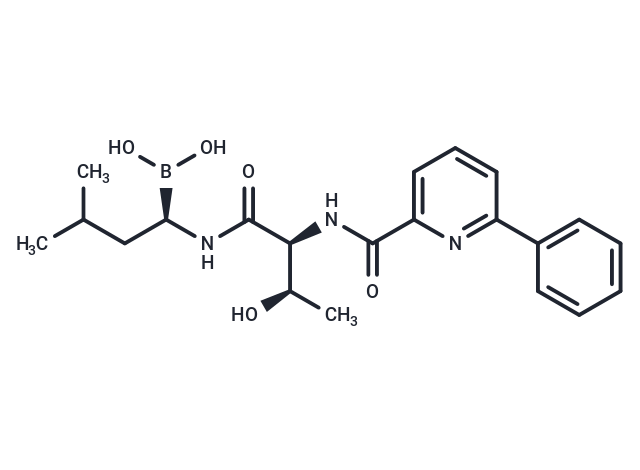
Synonyms: CEP-18770

| Pack Size | Price | USA Stock | Global Stock | Quantity |
|---|---|---|---|---|
| 1 mg | $38 | In Stock | In Stock | |
| 5 mg | $88 | In Stock | In Stock | |
| 10 mg | $143 | In Stock | In Stock | |
| 25 mg | $289 | In Stock | In Stock | |
| 50 mg | $463 | In Stock | In Stock | |
| 100 mg | $695 | - | In Stock | |
| 200 mg | $965 | - | In Stock | |
| 1 mL x 10 mM (in DMSO) | $96 | In Stock | In Stock |
| Description | Delanzomib (CEP-18770) is an orally active inhibitor of the chymotrypsin-like activity of proteasome (IC50: 3.8 nM). It only marginally inhibits the tryptic and peptidylglutamyl activities of the proteosome. |
| Targets & IC50 | Chymotrypsin-like proteasome:3.8 nM |
| In vitro | CEP-18770 demonstrates marginal prevention of the tryptic and peptidyl gultamyl activities of the protesome. The IC50 values of CEP-18770 are similar to those of bortezomib, with the chymotryptic and caspase-like activities being inhibited at low-nanomolar concentrations.[1] CEP-18770 inhibits A2780 ovarian cancer cells, PC3 prostate cancer, H460, LoVo colon cancer, RPMI8226 multiple myeloma cancer and HS-Sultan anaplastic non-Hodgkin lymphoma with IC50 values of 13.7, 22.2, 34.2 11.3, 5.6 and 8.2 nM, respectively.[1] CEP-18770 blocks the ubiquitin-proteasome pathway in several MM and in the chronic myelogenous leukemia cell line, K562. CEP-18770 causes an accumulation of ubiquitinated proteins over 4 to 8 hours with a profile similar to that observed after bortezomib treatment.[1] IκBα degradation is completely blocked by pretreatment with CEP-18770. CEP-18770 significantly inhibits high levels of NF-κB activity in both RPMI-8226 and U266 cells. The time- and concentration-dependent suppression of NF-kB DNA-binding activity in MM cell lines by CEP-18770 leads to a decrease of expression of several NF-κB-modulated genes mediating the growth and survival of tumor cells including IkBα itself, the X-chromosome-linked inhibitor-of-apoptosis protein (XIAP), the pro-inflammatory cytokines TNF-α and interleukin-1β (IL-1β), the intracellular adhesion molecule (ICAM1), and the pro-angiogeneic factor vascular endothelial growth factor. [1] The expression of these NF-κB–mediated genes and their modulation by bortezomib are associated with more favorable Clinicalal responsiveness to this agent, highlighting their potential prognostic value in response to CEP-18770 exposure. |
| In vivo | CEP-18770 reveals sustained dose-related relative tumor weight inhibition. CEP-18770 leads to dose-related complete tumor regressions, as compared to bortezomib treatment, which results in a 50% incidence of CR at its maximally tolerated dose (MTD) of 1.2 mg/kg intravenously. [1] In contrast to bortezomib, CEP-18770 reveals dose-related increase in the incidence of tumor-free mice by the completion of these studies (120 days after tumor transplantation). Oral administration of CEP-18770 produces a marked decrease in tumor weight and notable dose-related incidence of complete tumor regression with minimal changes in animal body weight over the course of the 120 day studies. [1]When compared to bortezomib, equiactive doses of CEP-18770 reveal a greater and more sustained dose-related inhibition of tumor proteasome activity, corresponding temporarily with maximum induction of caspase-3 and 7 activity.[1] The maximum apoptotic signal is 2.5 fold greater for CEP-18770 versus bortezomib. In contrast, proteasome inhibition profiles of CEP-18870 and bortezomib are comparable in the normal peripheral mouse tissues examined (liver, lungs, whole blood, and brain [no activity]) in both their magnitude and their duration.[1] No proteasome inhibition is detected in brain tissue at any time point for either CEP-18770 or bortezomib. In MM xenograft models, the addition of CEP-18770 to melphalan completely preventes the growth of both melphalan-sensitive or melphalan-resistant tumours. [1] The combination of CEP-18770 and bortezomib leads to complete regression of bortezomib-sensitive tumours and markedly delays progression of bortezomib-resistant tumours compared to treatment with either agent alone. Single agent CEP-18770 PO also shows marked anti-MM effects in these xenograft models[1] |
| Synonyms | CEP-18770 |
| Kinase Assay | Probing proteasome activity in cell extracts: Human multiple myeloma cells are washed twice with cold phosphate-buffered saline, pelleted and lysed with one volume of glass beads (<106 microns, acid-washed) and an equal volume of homogenization buffer (50 mM Tris (pH 7.4), 1 mM dithiothreitol, 5 mM MgCl2, 2 mM ATP and 250 mM sucrose) by vortexing at high speed for 15-30 min at 4 °C. Beads, membrane fractions, nuclei and cell debris are then removed from the supernatant by centrifugation at 16,000 g for 5 min. The protein content of extracts is quantitated using the Bradford assay. Proteasome activity is assayed as described below. Equal amounts (typically 60 g) of protein are denatured by boiling in reducing sample buffer, separated by 12.5% SDS-PAGE and electrotransferred onto polyvinylidene difluoride (PVDF) membranes. Immunoblotting is performed using a dansyl-sulfonamidohexanoyl polyclonal antibody (1:7,500, rabbit) and horseradish peroxidase–coupled goat or swine anti-rabbit secondary antibody followed by enhanced chemiluminescence. |
| Cell Research | HMEC and TEC cells are seeded into 24-well plates at a density of 104 cells/well in DMEM supplemented with 5% FCS. After incubation with proteasome inhibitors (48 hours), cells are washed, air dried, and stained with crystal violet as described. Cell number is determined, in duplicate samples, on the basis of a standard curve obtained with known cell numbers. All experiments are performed in triplicate. In vitro formation of capillary-like structures is studied on cells (4 × 10⁴ cells/well in DMEM supplemented with 5% FCS. After incubation with proteasome inhibitors (48 hours), cells are washed (cells/well in 24-well plates) and seeded onto Matrigel-coated wells in DMEM containing 0.25% BSA. HMEC and TEC cells (5 × 10³ per well), suspended in 200 μL DMEM with 5% FCS (positive control), serum-free medium (negative control), are layered onto the Matrigel surface in the presence or absence of proteasome inhibitor CEP-18770. Cells are observed with a inverted microscope and experimental results are then recorded after a 6-hour incubation at 37 °C. Data is analyzed, as the mean (× 1 SD) of total length of capillary-like structures, by the Micro-Image system and is expressed as mm/field by the computer analysis system in 5 different fields at 100 × magnification in duplicated wells for 4 different experiments. (Only for Reference) |
| Molecular Weight | 413.28 |
| Formula | C21H28BN3O5 |
| Cas No. | 847499-27-8 |
| Smiles | CC(C)C[C@H](NC(=O)[C@@H](NC(=O)c1cccc(n1)-c1ccccc1)[C@@H](C)O)B(O)O |
| Relative Density. | 1.207 g/cm3 |
| Storage | Powder: -20°C for 3 years | In solvent: -80°C for 1 year Shipping with blue ice/Shipping at ambient temperature. | |||||||||||||||||||||||||||||||||||
| Solubility Information | H2O: < 1 mg/mL (insoluble or slightly soluble) Ethanol: 77 mg/mL (186.31 mM), Sonication is recommended. DMSO: 150 mg/mL (362.95 mM), Sonication is recommended.  | |||||||||||||||||||||||||||||||||||
| In Vivo Formulation | 10% DMSO+40% PEG300+5% Tween 80+45% Saline: 10 mg/mL (24.2 mM), Solution. 10% DMSO+90% Saline: < 10 mg/mL (24.2 mM), Lower concentrations may be soluble, but exact solubility limit is unknown. Please add the solvents sequentially, clarifying the solution as much as possible before adding the next one. Dissolve by heating and/or sonication if necessary. Working solution is recommended to be prepared and used immediately. The formulation provided above is for reference purposes only. In vivo formulations may vary and should be modified based on specific experimental conditions. | |||||||||||||||||||||||||||||||||||
Solution Preparation Table | ||||||||||||||||||||||||||||||||||||
Ethanol/DMSO
Note : The dilution table applies only to solid products. For liquid products, please calculate the stock solution based on the stated concentration and/or density. | ||||||||||||||||||||||||||||||||||||
 For example, if the intended dosage is 10 mg/kg for animals weighing 20 g , with a dosing volume of 100 μL per animal, and a total of 10 animals are to be administered, using a formulation of
  10% DMSO+ 40% PEG300+ 5% Tween 80+ 45% Saline/PBS/ddH2O , the resulting working solution concentration would be 2 mg/mL.
Dissolve 2 mg of the compound in 100 μL DMSO to obtain a stock solution at a concentration of 20 mg/mL . If the required concentration exceeds the compound's known solubility, please contact us for technical support before proceeding.
1) Add 100 μL of the DMSO stock solution to 400 µL PEG300 and mix thoroughly until the solution becomes clear.
2) Add 50 µL Tween 80 and mix well until fully clarified.
3) Add 450 µL Saline,PBS or ddH2O and mix thoroughly until a homogeneous solution is obtained.
| Size | Quantity | Unit Price | Amount | Operation |
|---|
 Feedback
 Hello! How can I help you today?
Copyright © 2015-2026 TargetMol Chemicals Inc. All Rights Reserved.
