


Shopping Cart
Remove All Your shopping cart is currently empty

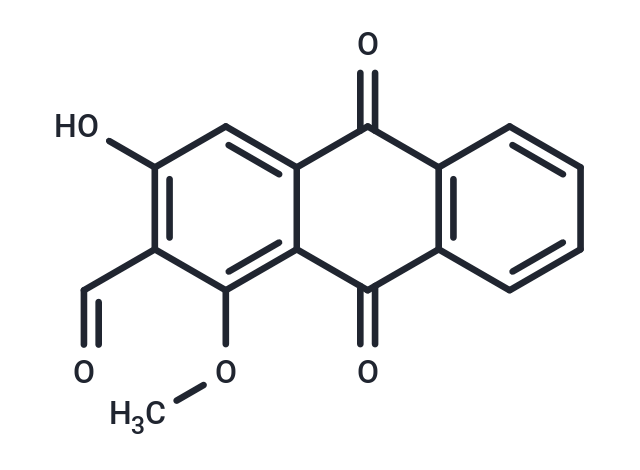
Synonyms: Damnacantal
| Pack Size | Price | USA Stock | Global Stock | Quantity |
|---|---|---|---|---|
| 1 mg | $800 | Inquiry | Inquiry |
| Description | Damnacanthal is a natural anthraquinone compound with potential anticancer, anti-inflammatory, antioxidant, anti-malarial, and antiviral effects.Damnacanthal inhibits a variety of protein kinases such as LIMK1 (IC50=0.8 μM), LIMK2 (IC50=1.5 μM), and Lck (IC50=17 nM), and inhibits the growth of human hepatocellular carcinoma (SKHep-1) and human breast cancer (MCF-7) cells. |
| Targets & IC50 | p56lck autophosphorylation:46 nM (IC50), Phosphorylation of exogenous substrates by p56lck:220 nM (IC50) |
| In vitro | Methods: Damnacanthal (100nM, 1, 10, 100μM, 1, 2, 4 days) was used to treat HCT-116 and SW480 cells to study its antiproliferative effects on human colorectal cancer cell types. Results: Treatment of HCT-116 cells with Damnacanthal resulted in a significant decrease in cell proliferation at 1 μM (P < 0.05), 10 μM (P < 0.01), and 100 μM (P < 0.01) after 4 days of treatment; SW480 cells also showed a significant decrease in cell proliferation at 10 μM (P < 0.05) and 100 μM (P < 0.001) after 4 days of treatment with Damnacanthal; Damnacanthal had a cytotoxic effect on colorectal cancer cells in both p53 wild-type (HCT-116) and p53 mutant (SW480) cells. Methods: HCT-116 cells were treated with Damnacanthal (1, 10, 50 μM) to determine its possible inhibitory effects on cell cycle progression and apoptosis, and caspase 3/7 activity was measured. Results: Treatment of HCT-116 cells with Damnacanthal (50 μM) resulted in a significant enrichment of cells in the S/G1 and G2/G1 phases. Treatment of HCT-116 cells with Damnacanthal (10 μM) significantly increased caspase 3/7 activity. [2] |
| In vivo | Damnacanthal (10-100 mg/kg, oral, 10-300 minutes) treatment of mice showed a dose-dependent and significant antinociceptive effect in the formalin test, and mice treated with Damnacanthal (100 mg/kg) significantly inhibited histamine-induced paw edema[3]. |
| Synonyms | Damnacantal |
| Molecular Weight | 282.25 |
| Formula | C16H10O5 |
| Cas No. | 477-84-9 |
| Smiles | O=CC1=C(O)C=C2C(=O)C=3C=CC=CC3C(=O)C2=C1OC |
| Relative Density. | 1.461g/cm3 |
| Storage | Store at low temperature,Keep away from direct sunlight,Keep away from moisture Powder: -20°C for 3 years | In solvent: -80°C for 1 year Shipping with blue ice/Shipping at ambient temperature. | |||||||||||||||
| Solubility Information | DMSO: 2 mg/mL (7.09 mM), Sonication is recommended. | |||||||||||||||
Solution Preparation Table | ||||||||||||||||
DMSO
Note : The dilution table applies only to solid products. For liquid products, please calculate the stock solution based on the stated concentration and/or density. | ||||||||||||||||
 For example, if the intended dosage is 10 mg/kg for animals weighing 20 g , with a dosing volume of 100 μL per animal, and a total of 10 animals are to be administered, using a formulation of
  10% DMSO+ 40% PEG300+ 5% Tween 80+ 45% Saline/PBS/ddH2O , the resulting working solution concentration would be 2 mg/mL.
Dissolve 2 mg of the compound in 100 μL DMSO to obtain a stock solution at a concentration of 20 mg/mL . If the required concentration exceeds the compound's known solubility, please contact us for technical support before proceeding.
1) Add 100 μL of the DMSO stock solution to 400 µL PEG300 and mix thoroughly until the solution becomes clear.
2) Add 50 µL Tween 80 and mix well until fully clarified.
3) Add 450 µL Saline,PBS or ddH2O and mix thoroughly until a homogeneous solution is obtained.
| Size | Quantity | Unit Price | Amount | Operation |
|---|
 Feedback
 Hello! How can I help you today?
Copyright © 2015-2026 TargetMol Chemicals Inc. All Rights Reserved.
