


Shopping Cart
Remove All Your shopping cart is currently empty

Synonyms: NVP-LAQ824, LAQ824
| Pack Size | Price | USA Stock | Global Stock | Quantity |
|---|---|---|---|---|
| 1 mg | $45 | In Stock | In Stock | |
| 2 mg | $62 | In Stock | In Stock | |
| 5 mg | $112 | In Stock | In Stock | |
| 10 mg | $189 | In Stock | In Stock | |
| 25 mg | $339 | In Stock | In Stock | |
| 50 mg | $513 | In Stock | In Stock | |
| 100 mg | $743 | In Stock | In Stock | |
| 500 mg | $1,520 | - | In Stock | |
| 1 mL x 10 mM (in DMSO) | $112 | In Stock | In Stock |
| Description | LAQ824 (Dacinostat (NVP-LAQ824)) is a novel HDAC inhibitor with IC50 of 32 nM and is an activator of the p21 promoter. |
| Targets & IC50 | HDAC:32 nM, HDAC1:9 nM |
| In vitro | A dose of 100 mg/kg LAQ824 effectively inhibits tumor growth in nude mice carrying HCT116 and human colorectal cancer xenografts in a dose-dependent manner, without cytotoxic effects. |
| In vivo | LAQ824 induces a dose-dependent increase in the expression of p21 protein and an increase in the hypo-phosphorylated state of the Rb tumor suppressor in A549 cells. It also induces chromatin modifications at the IL-10 gene promoter level, leading to enhanced recruitment of the transcription repressors HDAC11 and PU.1, thereby inhibiting the production of IL-10 in BALB/c mouse macrophages. Additionally, LAQ824 activates the expression of the gene encoding the p21 cell cycle inhibitor by activating the p21 promoter, with the maximum promoter activity (AC50) seen at a concentration of 0.30 μM. LAQ824 inhibits cell growth in H1299 (a non-small cell lung cancer cell line) and HCT116 (a colon cancer cell line) with IC50 values of 0.15 μM and 0.01 μM, respectively, demonstrating selective antiproliferative effects on tumor cell lines while inducing growth arrest only in normal fibroblasts. |
| Synonyms | NVP-LAQ824, LAQ824 |
| Kinase Assay | In Vitro Histone Deacetylase Assay: HDAC enzymes are partially purified from H1299 cell lysate by ion exchange chromatography using the Q Sepharose Fast Flow column. Enzyme complexes are collected from 500 mg of total cell lysate by immunoprecipitation with cdk2 polyclonal antibody or cdk1/cdc2 monoclonal antibody. Immunoprecipitates are resuspended in kinase buffer (50 mM Hepes, pH 8, 10 mM MgCl2, 2.5 mM EDTA, 1 mM dithiothreitol, 20 mM ATP, 10 mM β-glycerophosphate, 0.1 mM NaVO4, 1 mM sodium fluoride, 50 mM ATP, 10 μCi of [γ-32P]ATP) along with 1 μg of pRb recombinant protein substrate (cdk2) or 10 mL of H1 histone mixture containing 20 μg of substrate (cdc2). Phosphorylated Rb and H1 histone are resolved by electrophoresis and quantitated using a PhosphorImager. |
| Cell Research | Cell proliferation is measured using an adaptation of published procedures (3-(4,5-dimethylthiazol-2-yl)-5-(3-carboxymethoxy-phenyl)-2-(4-sulfonyl)-2H-tetrazolium assay). The cells are seeded in 12-well dishes and cultured in RPMI 1640 containing 10% FBS. The cells are cultured in the presence of various concentrations of TSA (up to 1,000 ng/mL). To examine the growth inhibition by TSA, viable cell numbers are determined by trypan blue dye exclusion, counted in a Nesbauer-type hemocytometer for 0 hour, 24 hours, and 48 hours. The same amount of ethanol is added to the RPMI 1640 medium as the control experiment. All experiments are performed in duplicate and repeated 3 times The average background value (treatment with medium alone) is subtracted from each experimental well; triplicate values are averaged for each compound dilution. The following formulas are used to calculate the percentage of growth: If X |
| Molecular Weight | 379.45 |
| Formula | C22H25N3O3 |
| Cas No. | 404951-53-7 |
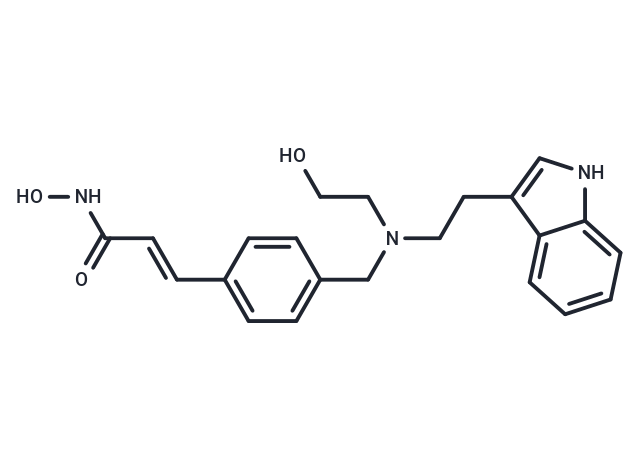
| Smiles | OCCN(CCc1c[nH]c2ccccc12)Cc1ccc(\C=C\C(=O)NO)cc1 |
| Relative Density. | 1.29g/cm3 |
| Storage | Powder: -20°C for 3 years | In solvent: -80°C for 1 year Shipping with blue ice/Shipping at ambient temperature. | |||||||||||||||||||||||||||||||||||
| Solubility Information | Ethanol: < 1 mg/mL (insoluble or slightly soluble) H2O: < 1 mg/mL (insoluble or slightly soluble) DMSO: 245 mg/mL (645.67 mM), Sonication is recommended.  | |||||||||||||||||||||||||||||||||||
| In Vivo Formulation | 10% DMSO+40% PEG300+5% Tween 80+45% Saline: 10 mg/mL (26.35 mM), Solution. 10% DMSO+90% Saline: < 10 mg/mL (26.35 mM), Lower concentrations may be soluble, but exact solubility limit is unknown. Please add the solvents sequentially, clarifying the solution as much as possible before adding the next one. Dissolve by heating and/or sonication if necessary. Working solution is recommended to be prepared and used immediately. The formulation provided above is for reference purposes only. In vivo formulations may vary and should be modified based on specific experimental conditions. | |||||||||||||||||||||||||||||||||||
Solution Preparation Table | ||||||||||||||||||||||||||||||||||||
DMSO
Note : The dilution table applies only to solid products. For liquid products, please calculate the stock solution based on the stated concentration and/or density. | ||||||||||||||||||||||||||||||||||||
 For example, if the intended dosage is 10 mg/kg for animals weighing 20 g , with a dosing volume of 100 μL per animal, and a total of 10 animals are to be administered, using a formulation of
  10% DMSO+ 40% PEG300+ 5% Tween 80+ 45% Saline/PBS/ddH2O , the resulting working solution concentration would be 2 mg/mL.
Dissolve 2 mg of the compound in 100 μL DMSO to obtain a stock solution at a concentration of 20 mg/mL . If the required concentration exceeds the compound's known solubility, please contact us for technical support before proceeding.
1) Add 100 μL of the DMSO stock solution to 400 µL PEG300 and mix thoroughly until the solution becomes clear.
2) Add 50 µL Tween 80 and mix well until fully clarified.
3) Add 450 µL Saline,PBS or ddH2O and mix thoroughly until a homogeneous solution is obtained.
| Size | Quantity | Unit Price | Amount | Operation |
|---|
 Feedback
 Hello! How can I help you today?
Copyright © 2015-2026 TargetMol Chemicals Inc. All Rights Reserved.
