Shopping Cart
Remove All
  • TargetMol
    Your shopping cart is currently empty

Cinoxacin

Copy Product Info
🥰Excellent
Catalog No. T0274Cas No. 28657-80-9
Alias Compound 64716

Cinoxacin (Compound 64716), an older synthetic antimicrobial, was related to the quinolone class of antibiotics. Its activity was similar to oxolinic acid and nalidixic acid.

Cinoxacin

Cinoxacin

Copy Product Info
🥰Excellent
Purity: 99.98%
Catalog No. T0274Alias Compound 64716Cas No. 28657-80-9
Cinoxacin (Compound 64716), an older synthetic antimicrobial, was related to the quinolone class of antibiotics. Its activity was similar to oxolinic acid and nalidixic acid.
Pack SizePriceUSA WarehouseGlobal WarehouseQuantity
50 mg$40In StockIn Stock
100 mg$64In StockIn Stock
1 mL x 10 mM (in DMSO)$29In StockIn Stock
Add to Cart
Add to Quotation
In Stock Estimated shipping dateUSA Warehouse[1-2 days] Global Warehouse[5-7 days]
All TargetMol products are for research purposes only and cannot be used for human consumption. We do not provide products or services to individuals. Please comply with the intended use and do not use TargetMol products for any other purpose.
Questions
TargetMol
View More

Batch Information

Select Batch
Purity:99.98%
Color:White
Contact us for more batch information

Resource Download

Product Introduction

Cinoxacin AI Summary
Cinoxacin exhibits multifaceted bioactivities across various biological targets and organism models. It demonstrates inhibitory activity at low concentrations against enzymes such as beta-lactamase, chymotrypsin, and malate dehydrogenase (MDH), with all inhibition levels below 5.0%. The compound also inhibits DNA gyrase-induced DNA cleavage with a MIC of 43.0 µg/mL and shows antibacterial activities against several strains of Escherichia coli, Klebsiella pneumonia, and Pseudomonas aeruginosa with MIC values ranging from 1.6 µg/mL to >100.0 µg/mL. Additionally, it inhibits human FAAH at 1 µM with an inhibition rate of 3.36%. In antiplasmodial assays, Cinoxacin shows moderate potency against Plasmodium falciparum strains 3D7, HB3, and W2. It also exhibits inhibition of Plasmodium falciparum lines Dd2, GB4, 7G8, showing IC50 values ranging from 5633.4 nM to 10000.0 nM. Other notable activities include modulation of Lamin A splicing (5.0 nM), inhibition of Human Jumonji Domain Containing 2E (JMJD2E), and action against malaria parasite plastids and several enzymes such as Bloom's syndrome helicase (BLM) and ALDH1A1. Cinoxacin affects liver enzyme functions, increasing levels of alkaline phosphatase, SGOT, SGPT, LDH, and GGT, indicating potential impacts on liver function. However, it shows no significant bioactivity associated with drug-induced liver injury (DILI), receiving a score of 0.0 in related assays. The compound's pKa of 4.7 suggests significant ionization under physiological pH conditions, affecting its bioavailability and interactions. In transporter assays, Cinoxacin strongly inhibits the uptake of sodium fluorescein in OATP1B1- and OATP1B3-transfected CHO cells. While it has shown moderate liver toxicity in clinical trials, it exhibits high intrinsic clearance in human liver microsomes, with a clearance rate of less than 3.0 mL/min/g. Against SARS-CoV-2, Cinoxacin demonstrated inhibition of viral-induced cytotoxicity in VERO-6 cells and moderate inhibition of the viral 3CL-Pro protease. However, its overall antiviral potency against SARS-CoV-2 was relatively weak with an IC50 value exceeding 20000.0 nM in specific assays. Lastly, the compound shows varied bioactivities against human HDAC6 and exhibits potential as an antimalarial agent, inhibiting both hepatic and blood stages of malaria parasites, including Plasmodium yoelii yoelii 265 BY and chloroquine-sensitive P. falciparum, with IC50 values ranging from 28.5 µg/mL to 118.2 µg/mL. In summary, Cinoxacin displays a diverse array of biochemical activities, potential therapeutic implications, and moderate levels of toxicity in various biological contexts..
Note: Summary generated by AI. Data source: ChEMBL
Bioactivity
Description
Cinoxacin (Compound 64716), an older synthetic antimicrobial, was related to the quinolone class of antibiotics. Its activity was similar to oxolinic acid and nalidixic acid.
SynonymsCompound 64716
Chemical Properties
Molecular Weight262.22
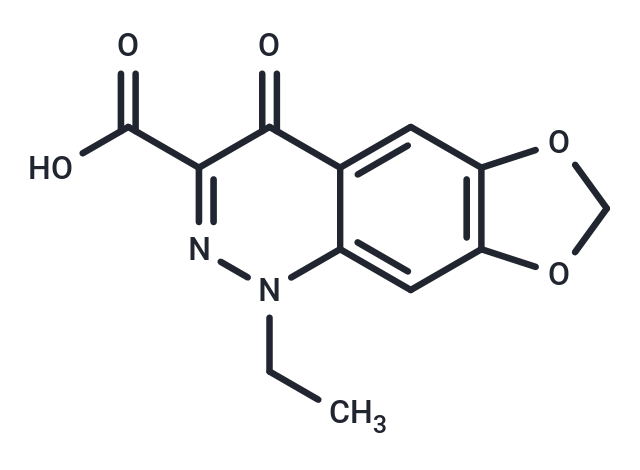
FormulaC12H10N2O5
Cas No.28657-80-9
SmilesCCn1nc(C(O)=O)c(=O)c2cc3OCOc3cc12
Relative Density.1.64g/cm3
Storage & Solubility Information
StoragePowder: -20°C for 3 years | In solvent: -80°C for 1 year | Shipping with blue ice/Shipping at ambient temperature.
Solubility Information
DMSO: 4.55 mg/mL (17.35 mM), Sonication is recommended.

Solution Preparation Table
DMSO
1mg5mg10mg50mg
1 mM3.8136 mL19.0680 mL38.1359 mL190.6796 mL
5 mM0.7627 mL3.8136 mL7.6272 mL38.1359 mL
10 mM0.3814 mL1.9068 mL3.8136 mL19.0680 mL

Calculator

  • Molarity Calculator
  • Dilution Calculator
  • Reconstitution Calculator
  • Molecular Weight Calculator

In Vivo Formulation Calculator (Clear solution)

Please enter your animal experiment information in the following box and click Calculate to obtain the stock solution preparation method and in vivo formula preparation method:
TargetMol | Animal experiments For example, if the intended dosage is 10 mg/kg for animals weighing 20 g , with a dosing volume of 100 μL per animal, TargetMol | Animal experiments and a total of 10 animals are to be administered, using a formulation of TargetMol | reagent 10% DMSO+ 40% PEG300+ 5% Tween 80+ 45% Saline/PBS/ddH2O , the resulting working solution concentration would be 2 mg/mL.

Stock Solution Preparation:

Dissolve 2 mg of the compound in 100 μL DMSOTargetMol | reagent to obtain a stock solution at a concentration of 20 mg/mL . If the required concentration exceeds the compound's known solubility, please contact us for technical support before proceeding.

Preparation of the In Vivo Formulation:

1) Add 100 μL of the DMSOTargetMol | reagent stock solution to 400 μL PEG300TargetMol | reagent and mix thoroughly until the solution becomes clear.

2) Add 50 μL Tween 80 and mix well until fully clarified.

3) Add 450 μL Saline,PBS or ddH2OTargetMol | reagent and mix thoroughly until a homogeneous solution is obtained.

This example is provided solely to demonstrate the use of the In Vivo Formulation Calculator and does not constitute a recommended formulation for any specific compound. Please select an appropriate dissolution and formulation strategy based on your experimental model and route of administration.
All co-solvents required for this protocol, includingDMSO, PEG300/PEG400, Tween 80, SBE-β-CD, and Corn oil, are available for purchase on the TargetMol website.
1 Enter information below:
mg/kg
g
μL
2 Enter the in vivo formulation:
% DMSO
%
% Tween 80
% Saline/PBS/ddH2O

Dose Conversion

You can also refer to dose conversion for different animals. More Dose Conversion

Tech Support

Please see Inhibitor Handling Instructions for more frequently ask questions. Topics include: how to prepare stock solutions, how to store products, and cautions on cell-based assays & animal experiments, etc

Keywords

Related Tags: buy Cinoxacin | purchase Cinoxacin | Cinoxacin cost | order Cinoxacin | Cinoxacin chemical structure | Cinoxacin formula | Cinoxacin molecular weight