


Shopping Cart
Remove All Your shopping cart is currently empty

Synonyms: TCV-116
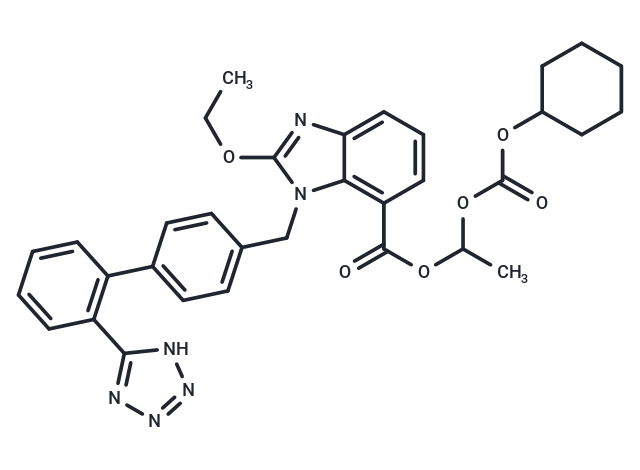
| Pack Size | Price | USA Stock | Global Stock | Quantity |
|---|---|---|---|---|
| 500 mg | $54 | - | In Stock | |
| 1 g | $72 | - | In Stock | |
| 1 mL x 10 mM (in DMSO) | $66 | In Stock | In Stock |
| Description | Candesartan Cilexetil (TCV-116) is an angiotensin II receptor antagonist (IC50: 0.26 nM). Upon hydrolysis to candesartan during gastrointestinal absorption, it selectively competes with angiotensin II for binding to the angiotensin II receptor subtype 1 (AT1) in vascular smooth muscle, blocking angiotensin II-mediated vasoconstriction and inducing vasodilatation. |
| Targets & IC50 | Ang II receptor:0.26 nM |
| In vitro | Five hours post-administration, Candesartan (1 mg/kg, orally) reduced blood pressure to a similar extent as Enalapril (10 mg/kg, orally) on both the 1st and 7th days. Candesartan significantly increased renal blood flow without altering the cardiac index. In rat myocardium with dilated cardiomyopathy (DCM), Candesartan dose-dependently improved functional markers and upregulated angiotensin (1-7), ACE2, and MAS1. Treatment with Candesartan in rats led to a reduction in various endoplasmic reticulum (ER) stress markers, apoptotic markers, and the number of apoptotic cells. Furthermore, Candesartan demonstrated a dose-dependent blockade of angiotensin-II in rats with dilated cardiomyopathy. |
| In vivo | The prodrug of Candesartan is absorbed through the gastrointestinal tract and activated by ester hydrolysis into Candesartan. Candesartan then blocks the effects of angiotensin II on the angiotensin II type 1 receptors. |
| Synonyms | TCV-116 |
| Kinase Assay | Kinetic Methods: In a typical kinetic run, 2.00 mL of assay buffer (20 mM HEPES, 0.5 mM EDTA, 0.035% SDS, pH 7.8) and Suc-Leu-Leu-Val-Tyr-AMC in DMSO are added to a 3 mL fluorescence cuvette, and the cuvette is placed in the jacketed cell holder of a fluorescence spectrophotometer. Reaction temperature is maintained at 37℃ by a circulating water bath. After the reaction solution has reached thermal equilibrium (5 minutes), 1 μL?10 μL of the stock enzyme solution is added to the cuvette. Reaction progress is monitored by the increase in fluorescence emission at 440 nm (λex= 380 nm) that accompanies cleavage of AMC from peptide-AMC substrates. |
| Molecular Weight | 610.66 |
| Formula | C33H34N6O6 |
| Cas No. | 145040-37-5 |
| Smiles | C(N1C=2C(N=C1OCC)=CC=CC2C(OC(OC(OC3CCCCC3)=O)C)=O)C4=CC=C(C=C4)C5=C(C=CC=C5)C=6NN=NN6 |
| Relative Density. | 1.37 g/cm3 |
| Storage | Powder: -20°C for 3 years | In solvent: -80°C for 1 year Shipping with blue ice/Shipping at ambient temperature. | |||||||||||||||||||||||||||||||||||
| Solubility Information | DMSO: 250 mg/mL (409.39 mM), Sonication is recommended.  | |||||||||||||||||||||||||||||||||||
| In Vivo Formulation | 10% DMSO+90% Saline: < 10 mg/mL (16.38 mM), Lower concentrations may be soluble, but exact solubility limit is unknown. 10% DMSO+40% PEG300+5% Tween 80+45% Saline: 10 mg/mL (16.38 mM), Suspension. 10% DMSO+90% (20% SBE-β-CD in Saline): < 10 mg/mL (16.38 mM), Lower concentrations may be soluble, but exact solubility limit is unknown. 10% DMSO+90% Corn oil: 10 mg/mL (16.38 mM), Solution. Please add the solvents sequentially, clarifying the solution as much as possible before adding the next one. Dissolve by heating and/or sonication if necessary. Working solution is recommended to be prepared and used immediately. The formulation provided above is for reference purposes only. In vivo formulations may vary and should be modified based on specific experimental conditions. | |||||||||||||||||||||||||||||||||||
Solution Preparation Table | ||||||||||||||||||||||||||||||||||||
DMSO
Note : The dilution table applies only to solid products. For liquid products, please calculate the stock solution based on the stated concentration and/or density. | ||||||||||||||||||||||||||||||||||||
 For example, if the intended dosage is 10 mg/kg for animals weighing 20 g , with a dosing volume of 100 μL per animal, and a total of 10 animals are to be administered, using a formulation of
  10% DMSO+ 40% PEG300+ 5% Tween 80+ 45% Saline/PBS/ddH2O , the resulting working solution concentration would be 2 mg/mL.
Dissolve 2 mg of the compound in 100 μL DMSO to obtain a stock solution at a concentration of 20 mg/mL . If the required concentration exceeds the compound's known solubility, please contact us for technical support before proceeding.
1) Add 100 μL of the DMSO stock solution to 400 µL PEG300 and mix thoroughly until the solution becomes clear.
2) Add 50 µL Tween 80 and mix well until fully clarified.
3) Add 450 µL Saline,PBS or ddH2O and mix thoroughly until a homogeneous solution is obtained.
| Size | Quantity | Unit Price | Amount | Operation |
|---|
 Feedback
 Hello! How can I help you today?
Copyright © 2015-2026 TargetMol Chemicals Inc. All Rights Reserved.
