


Shopping Cart
Remove All Your shopping cart is currently empty


Synonyms: BRL 15573 dihydrochloride
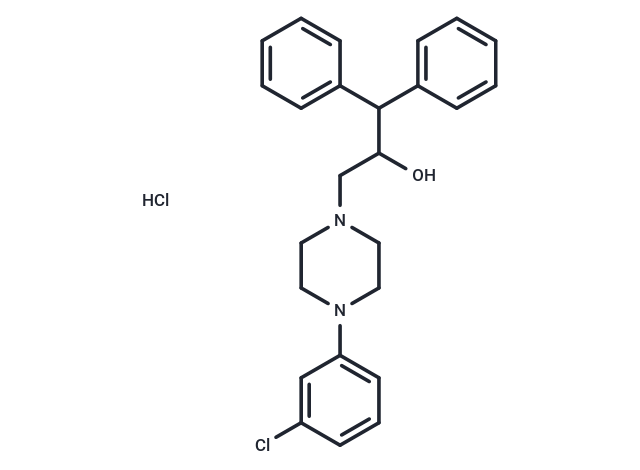
| Pack Size | Price | USA Stock | Global Stock | Quantity |
|---|---|---|---|---|
| 10 mg | $40 | In Stock | In Stock | |
| 25 mg | $65 | In Stock | In Stock | |
| 50 mg | $100 | In Stock | In Stock | |
| 100 mg | $148 | In Stock | In Stock | |
| 1 mL x 10 mM (in DMSO) | $30 | In Stock | In Stock |
| Description | BRL-15572 dihydrochloride (BRL 15573 dihydrochloride) is a 5-HT1D receptor antagonist with pKi of 7.9, also shows a considerable affinity at 5-HT1A and 5-HT2B receptors, exhibiting 60-fold selectivity over 5-HT1B receptor. |
| Targets & IC50 | 5-HT7:6.3(pKi), 5-HT1A:7.7(pKi), 5-HT2B:7.4(pKi), 5-HT2A:6.6(pKi), 5-HT1D:7.9(pKi) |
| In vitro | BRL-15572 displays high affinity and selectivity for h5-HT1D receptors. BRL-15572 has 60-fold higher affinity for h5-HT1D than 5-HT1B receptors. BRL-15572 binds to h5-HT1B and h5-HT1D receptors with pKB of less than 6 and 7.1, respectively. BRL-15572 stimulates [35S]GTP γ S binding in both cell lines, with potencies that correlated with their receptor binding affinities in both h5-HT1B and h5-HT1D receptor expressing cell lines. BRL-15572 reveals receptor binding affinities for 5-HT1A, 5-HT1B, 5-HT1E, 5-HT1F, 5-HT2A, 5-HT2B, 5-HT2C, 5-HT6 and 5-HT7 with pKi of 7.7, 6.1, 5.2, 6.0, 6.6, 7.4, 6.2, 5.9 and 6.3, respectively. In the h5-HT1D cell line, both BRL-15572 (1 μM) shifts the 5-HT concentration response curve with pKB of 7.1, respectively. BRL-15572 does have moderately high affinity at human 5-HT1A and 5-HT2B receptors. [1] In human atrial appendages, the electrically evoked tritium overflow is inhibited by 5-HT in a manner susceptible to antagonism by BRL-15572 (300 nM; 23 times Ki at h5-HT1D receptors). [2] The inhibitory effect of 5-HT on the K+-evoked overflow of glutamate is antagonized by the h5-HT1D receptor ligand BRL-15572. BRL-15572 (1 μM) is unable to modify the effect of 5-HT at the autoreceptor regulating [3H]5-HT release. [3] The selective 5-HT1D/1B receptor antagonist BRL 15572 inhibits the effect of the agonist L-694 247. [4] |
| In vivo | In diabetic pithed rats, administration of the selective 5-HT1D receptor antagonist BRL-15572 (2 mg/kg) does not modify the decreased HR induced by vagal electrical stimulation. The effects of L-694,247 (50 μg/kg), a selective agonist for non-rodent 5-HT1B and 5-HT1D receptors, on the vagally induced bradycardia are not apparent after pretreatment with BRL-15572. [5] |
| Synonyms | BRL 15573 dihydrochloride |
| Cell Research | [35S]GTPγS binding studies. [35S]GTPγS binding studies in CHO cells expressing the h5-HT1B or h5-HT1D receptors are performed. In brief, membranes from 1 × 10⁶ cells are preincubated at 30°C for 30 minutes, in HEPES buffer (HEPES [20 mM], MgCl2 [3 mM], NaCl [100 mM], ascorbate [0.2 mM]), containing GDP (10 μ M), with or without BRL-15572. The reaction is started by the addition of 10 μL of [35S]GTPγS (100 pM, assay concentration) followed by a further 30 minutes incubation at 30°C. Non-specific binding is determined by addition of unlabelled GTPγS (10 μM), prior to the addition of cells. The reaction is stopped by rapid filtration using Whatman GF/B grade filters followed by five washes with ice-cold HEPES buffer. Radioactivity is determined by liquid scintillation spectrometry.(Only for Reference) |
| Molecular Weight | 479.87 |
| Formula | C25H27ClN2O·2HCl |
| Cas No. | 193611-72-2 |
| Smiles | Cl.OC(CN1CCN(CC1)c1cccc(Cl)c1)C(c1ccccc1)c1ccccc1 |
| Relative Density. | no data available |
| Storage | Powder: -20°C for 3 years | In solvent: -80°C for 1 year Shipping with blue ice/Shipping at ambient temperature. | ||||||||||||||||||||||||||||||||||||||||
| Solubility Information | DMSO: 89 mg/mL (185.47 mM), Sonication is recommended. H2O: < 1 mg/mL (insoluble or slightly soluble) Ethanol: 38 mg/mL (79.19 mM), Sonication is recommended. | ||||||||||||||||||||||||||||||||||||||||
| In Vivo Formulation | 10% DMSO+40% PEG300+5% Tween 80+45% Saline: 3.3 mg/mL (6.88 mM), Sonication is recommended. Please add the solvents sequentially, clarifying the solution as much as possible before adding the next one. Dissolve by heating and/or sonication if necessary. Working solution is recommended to be prepared and used immediately. The formulation provided above is for reference purposes only. In vivo formulations may vary and should be modified based on specific experimental conditions. | ||||||||||||||||||||||||||||||||||||||||
Solution Preparation Table | |||||||||||||||||||||||||||||||||||||||||
Ethanol/DMSO
DMSO
Note : The dilution table applies only to solid products. For liquid products, please calculate the stock solution based on the stated concentration and/or density. | |||||||||||||||||||||||||||||||||||||||||
 For example, if the intended dosage is 10 mg/kg for animals weighing 20 g , with a dosing volume of 100 μL per animal, and a total of 10 animals are to be administered, using a formulation of
  10% DMSO+ 40% PEG300+ 5% Tween 80+ 45% Saline/PBS/ddH2O , the resulting working solution concentration would be 2 mg/mL.
Dissolve 2 mg of the compound in 100 μL DMSO to obtain a stock solution at a concentration of 20 mg/mL . If the required concentration exceeds the compound's known solubility, please contact us for technical support before proceeding.
1) Add 100 μL of the DMSO stock solution to 400 µL PEG300 and mix thoroughly until the solution becomes clear.
2) Add 50 µL Tween 80 and mix well until fully clarified.
3) Add 450 µL Saline,PBS or ddH2O and mix thoroughly until a homogeneous solution is obtained.
| Size | Quantity | Unit Price | Amount | Operation |
|---|
 Feedback
 Hello! How can I help you today?
Copyright © 2015-2026 TargetMol Chemicals Inc. All Rights Reserved.
